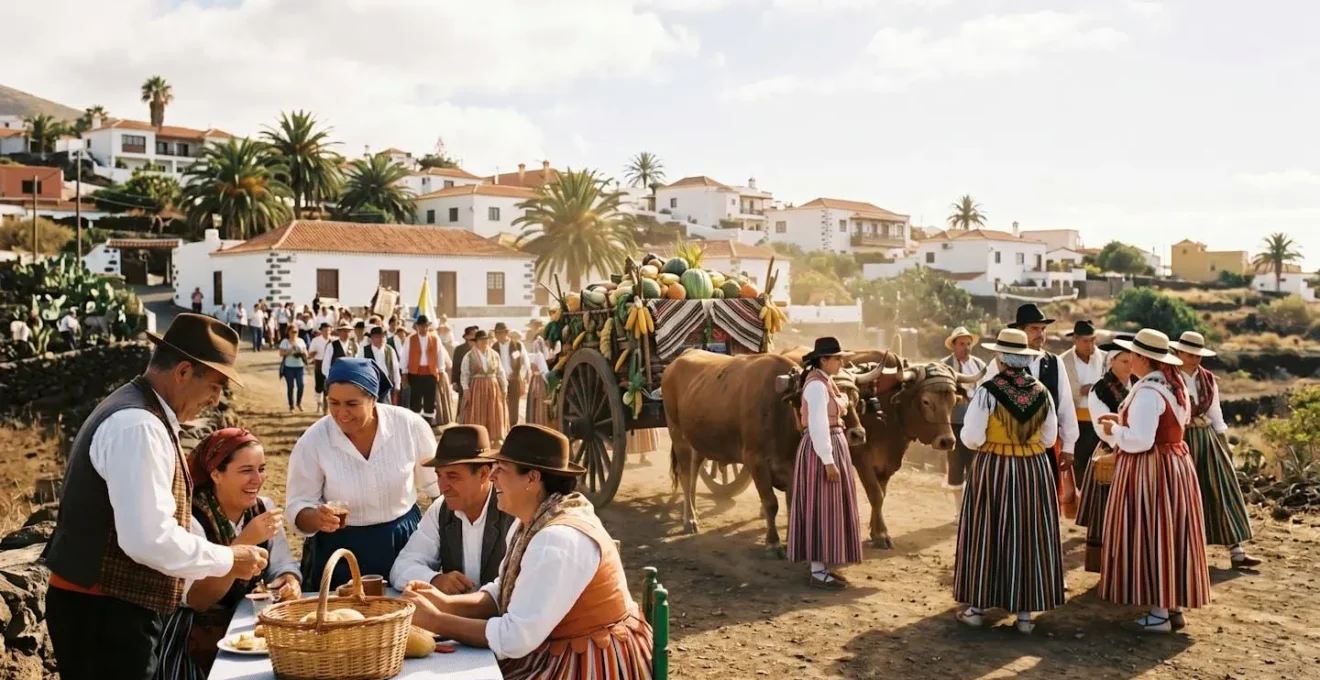
Thinking a Canarian Romería is just another street party is the first mistake. The key to truly experiencing it isn’t just about surviving the sun and wine; it’s about understanding its unique cultural rhythm. This guide reveals the unwritten rules of participation—from respectful dress to the art of catching flying food—transforming you from a passive observer into a welcome guest in one of the world’s most vibrant celebrations.
The first thing that hits you is the sound. It’s a wave of traditional folk music, joyful chatter, and the lowing of oxen. Then comes the smell of grilled meat, sweet wine, and the hot, dusty air of a Canarian village. You’re swept into a moving river of people, a riot of colour and energy. This is a Romería, a festive pilgrimage that is the heart and soul of the Canary Islands. You’ve probably heard the basic advice: wear comfortable shoes, stay hydrated. But that’s like saying the key to swimming is “don’t drown.” It misses the entire point.
The real secret to not just surviving, but truly thriving at a Romería, lies beyond a simple checklist. It’s about participating with respect and understanding the unwritten rules that govern the day. This isn’t a spectacle put on for tourists; it’s a living, breathing community event. But if the real key wasn’t just observing the party, but knowing how to become part of it? This guide is your local friend, the festival organizer who loves the chaos but knows the pitfalls, here to give you the insider scoop.
We’ll dive into the nuances of the traditional ‘Mago’ costume and why wearing it wrong is worse than not wearing it at all. We’ll cover the essential tactics for catching food thrown from ornate ox carts, navigating the midday ‘siesta’ that isn’t for sleeping, and understanding the delicate balance between sacred procession and wild party. By the end, you’ll be ready to join the celebration with the confidence and respect of a local.
Summary: A Guide to Partying Like a Canario at a Romería
- Mago Costume: Why You Should (or Shouldn’t) Wear Traditional Dress?
- The Tradition of Throwing Food from Ox Carts: How to Catch It safely?
- Road Closures: Why You Cannot Drive Near the Town Centre on Romería Day?
- Wine and Sun: The Risk of Dehydration During the Day-Long Procession
- Saint Worship vs Party: Understanding the Core of the Celebration
- The Risk of Disrespecting Religious Processions by Taking Selfies
- Siesta Hours: Why Shops Close at 2 PM and When They Reopen?
- Breaking the Tourist Bubble: How to Make Genuine Connections with Canarios?
Mago Costume: Why You Should (or Shouldn’t) Wear Traditional Dress?
One of the first things you’ll notice is that nearly everyone is dressed in stunning traditional attire, known as the ‘traje de mago’ or ‘traje de campesino’ (peasant dress). Your first instinct might be to join in, and showing that effort is hugely appreciated by locals. However, this is where many visitors make their first mistake. A cheap, mass-produced “costume” or, even worse, pairing traditional elements with modern sneakers, can be seen as disrespectful. It signals you see their culture as a mere novelty. As one cultural guide notes, for Canarians, “it’s very important for the local people to wear the right clothes and put them on in the right way”.
So, you face a dilemma: wear the costume and risk getting it wrong, or don’t wear it and feel like an outsider? The best approach is respectful participation. If you’re not going to rent an authentic outfit from a local shop, it’s better to wear simple, smart clothes (think linen shirts, trousers or skirts) than a bad imitation. But if you want to create your own respectful ensemble, focus on getting the key details right. It shows you’ve done your homework and value the tradition you’re taking part in.
Your Action Plan: Assembling a Respectful DIY Mago Look
- Choose natural fiber fabrics: Traditional attire was made from 19th-century peasant wear materials like wool, linen, or cotton. Avoid shiny, synthetic fabrics.
- Focus on key accessories: A proper hat (a wide-brimmed ‘sombrero’ for men, a headscarf for women), a vest or bodice, and a shoulder scarf are the minimum elements for a respectful nod to the tradition.
- Avoid modern footwear: This is a non-negotiable rule. Never pair the costume with sneakers. Opt for traditional leather shoes or simple, plain leather sandals.
- Understand regional variations: Each island and even town has its own distinct style. A quick search for the specific Romería you’re attending will show you the local colours and patterns.
- Consider renting locally: The easiest and most authentic option is to rent an outfit. Most towns have pop-up rental shops during the festival season, ensuring you look the part while supporting local artisans.
The Tradition of Throwing Food from Ox Carts: How to Catch It safely?
As the procession of decorated ox carts (‘carretas’) trundles by, you’ll suddenly find the air filled with more than just music. Hard-boiled eggs, small sandwiches (‘bocadillos’), and even ‘papas arrugadas’ (wrinkled potatoes) will start flying towards the crowd. This isn’t a food fight; it’s a fundamental part of the Romería experience—a powerful gesture of sharing and community that harks back to the festival’s harvest celebration roots. The goal isn’t to hoard as much as you can, but to participate in this act of collective generosity.
To the uninitiated, it can be chaotic. But for locals, there’s an art to it. The key is to be alert, make eye contact with the people on the cart, and have your hands ready. Don’t be shy! A ready smile and an open posture signal you’re ready to receive. Catching a flying egg is a badge of honour and an instant icebreaker. It’s a moment of connection, a shared laugh with a stranger. Remember, accepting the food is accepting the welcome of the community.
Case Study: The Food-Throwing Ritual at Gran Canaria Romerías
During Canarian romerías, large wooden carts (‘carretas’) pulled by oxen carry people who actively share food and drink. The most typical items thrown include ‘papas arrugadas’, hard-boiled eggs, small sandwiches, ‘carne de fiesta’ (festival meat), and cakes. This tradition transforms the religious procession into a communal feast where catching food is not competitive but a gesture of shared celebration. Locals advise that you’ll need good reflexes to catch what comes flying, and the experience is considered an authentic way to participate in the festival’s agricultural harvest celebration roots.
This image perfectly captures the energy and focus required in this unique tradition. It’s about being in the moment, ready to engage.
Your technique should be relaxed but focused. Position yourself with a clear view of the carts, but don’t push to the front. The people on the carts are skilled at spotting open hands and friendly faces in the crowd. And if you drop one? Laugh it off and get ready for the next one. It’s all part of the fun.
Road Closures: Why You Cannot Drive Near the Town Centre on Romería Day?
On the day of a Romería, any plan involving a car and the town centre is doomed to fail. From the early morning, police will have cordoned off a wide perimeter around the procession route. This isn’t just to manage traffic; it’s a matter of public safety. The streets become a pedestrian-only zone, filled with thousands of people, parade floats, live bands, and, of course, massive ox-drawn carts. Trying to drive anywhere near this would be impossible and incredibly dangerous. The procession itself can last for 2 to 3 hours, and the crowds remain long after.
Locals know this and have a clear strategy: leave the car behind. The ‘guagua’ (the local word for bus) is the transportation of choice. Public transport services are massively increased on Romería days, with special routes designed to get thousands of people to and from the event safely. It’s stress-free and allows everyone to partake in the free-flowing wine without worrying about driving home. If you absolutely must drive, your only option is to arrive extremely early and park on the far outskirts of town, likely in an industrial park or distant residential area, and be prepared for a long walk. The walk itself, however, is part of the cultural rhythm, a time to socialize and build anticipation with fellow party-goers.
Your transport plan should be decided the day before. Check the local bus company’s website for the special Romería schedule. Planning your exit is just as important. You either leave early before the main event ends, or you embrace the full experience and stay for the ‘verbena’ (the evening party) and catch a late bus home. Trying to get a taxi right after the procession ends is a recipe for a long, frustrating wait.
Wine and Sun: The Risk of Dehydration During the Day-Long Procession
Here’s the deal: a Romería is a day-long party under the powerful Canarian sun, and local wine (‘vino del país’) is shared generously and often for free. For a visitor, this combination is a potent cocktail for dehydration and heatstroke, the fastest way to end your day in a medical tent instead of on the dance floor. It’s the number one rookie mistake. The festive atmosphere makes it easy to forget that you’re losing fluids rapidly. As the US National Institute on Alcohol Abuse and Alcoholism points out, it’s a double-whammy: hot days cause fluid loss through perspiration, while alcohol causes fluid loss through increased urination.
Being a responsible party-goer means having a hydration strategy. This isn’t about avoiding alcohol altogether; it’s about managing it smartly. The local approach is one of pace and balance. The goal is to last until the ‘verbena’ kicks off in the evening, not to pass out by 3 PM. The most effective strategy is the 1-to-1 ratio: for every glass of wine or beer you accept, you must drink a full glass or bottle of water. This not only keeps you hydrated but also slows down your alcohol consumption naturally. Carry a large reusable water bottle with you and refill it at every opportunity.
Another pro tip is to pre-hydrate. Start drinking extra water the night before and the morning of the event. Don’t wait until you’re already in the sun to think about it. Also, take advantage of the food being shared. Salty snacks like the ‘papas arrugadas’ or ‘carne fiesta’ will help your body retain the water you’re drinking. And crucially, don’t be afraid to take a break from alcohol during the peak heat of the day, typically from 1 PM to 4 PM. Switch to water or a soft drink during these hours. Your body will thank you when you still have the energy to dance as the sun sets.
Saint Worship vs Party: Understanding the Core of the Celebration
Is a Romería a solemn religious pilgrimage or a wild, chaotic street party? The answer is yes. It is both, intertwined in a way that is fundamental to Canarian culture. For an outsider, this duality can be confusing, but understanding it is the key to truly grasping the event’s soul. Everything begins with the sacred. The day starts with a formal mass in the town church, paying tribute to the patron saint. Afterward, the statue of the saint is carefully carried out and paraded through the streets. This is the heart of the procession, the ‘romería’ itself.
The party—the ox carts, the music, the food and wine—follows the saint. It does not lead. This structure is crucial. The joyous celebration is seen as an expression of gratitude and devotion, not a contradiction of it. It’s a unique fusion of Catholic faith and older, pagan harvest festival traditions. As one local expert beautifully puts it, the pilgrimage is a form of expression of faith and devotion of the Canarians, but it is also a celebration of their culture and traditions. The ‘fiesta’ exists *because* of the faith.
Case Study: The Dual Nature of Canarian Romerías
Canarian romerías represent a unique blend of Christian and pagan traditions dating back centuries. Everything starts with a mass in tribute to the saint, followed by the saint being paraded around the village. The carts then follow, pulled by oxen and carrying food, processing until they reach the central square where the party continues. Locals wear brightly colored traditional dress, and ‘parranda’ groups play music while people dance. The abundant local wine and food—’papas arrugadas’, ‘carne fiesta’, ‘gofio’—are shared freely. This structure demonstrates that for many Canarians, the joyous celebration, sharing, and community spirit is itself a form of worship and gratitude.
This understanding of the sacred and profane should guide your behaviour throughout the day. When the saint’s float passes, the music might quiet down, and people will show a more visible form of respect. This is a moment for quiet observation, not loud cheering. Once it has passed, the party atmosphere resumes. By recognizing and respecting this shift, you show you’re not just there for the free wine; you’re there for the whole experience.
The Risk of Disrespecting Religious Processions by Taking Selfies
In an age of social media, the temptation to capture every moment is strong. A Romería, with its vibrant colours and lively atmosphere, is incredibly photogenic. However, this is where a tourist’s mindset can clash dramatically with the event’s spirit. Wading into the procession, selfie stick held high, or taking close-up shots of people praying are major acts of disrespect. It breaks the magic and transforms a sacred moment into a background for your profile picture. This is especially true when the statue of the saint is passing by. This is a moment of devotion for the participants, and an intrusive camera is an unwelcome guest.
The goal should be to capture the atmosphere, not to become the main attraction. Think like a photojournalist, not an influencer. Stay on the sidelines, use a zoom lens if you have one, and be discreet. An essential rule is to never use flash. It’s incredibly distracting and disrespectful during the solemn parts of the procession. Also, be mindful of personal space. Taking photos of people in costume is generally fine, especially if you ask politely (‘¿Puedo sacar una foto?’), but avoid taking intrusive photos of people in moments of private prayer or reflection. They are not part of the scenery.
This image shows the ideal approach: observing from a respectful distance, capturing the overall scene rather than intruding upon it.
Ultimately, some of the best moments are the ones you don’t photograph. Sometimes, the right thing to do is to put the phone away and simply be present. Absorb the sounds, the energy, and the collective emotion of the crowd. This is respectful participation in its purest form, and it will leave you with memories far more vivid than any photo could provide.
Siesta Hours: Why Shops Close at 2 PM and When They Reopen?
Around 2 PM, you might notice a shift in the Romería’s energy. The main procession may be winding down, and many shops will close their doors. A first-time visitor might assume this is the traditional Spanish ‘siesta’ and that the party is over until 5 PM. This is a misunderstanding of the day’s cultural rhythm. The party doesn’t stop; it merely changes location and tempo. This midday lull is not for sleeping—it’s for strategic refueling.
For local families and groups of friends, this period is for a proper, sit-down meal. They might retreat to a pre-booked restaurant on a side street, head to a family member’s home nearby, or gather at designated food stalls (‘ventorrillos’) set up in squares. They are stocking up on energy for the second half of the event: the ‘verbena’, an open-air party with live bands and dancing that often goes late into the night. The Romería transitions from a family-oriented daytime parade to a more youth-focused concert atmosphere as evening approaches.
Case Study: The Romería Siesta – Strategic Refueling, Not Sleeping
During romerías, the traditional siesta hours (roughly 2-4 PM) serve a unique purpose. This midday lull is not about napping but about locals having a proper meal with their group before the evening ‘verbena’ kicks off around 5 PM. While main streets may quiet down, the party continues at ‘ventorrillos’ (food and drink stalls) and in public squares. The vibe shifts dramatically after 5 PM, moving from a family event with a religious procession to a high-energy party. Strategic visitors use these hours to rehydrate, apply more sunscreen, and position themselves for the evening festivities before they become crowded.
As a visitor, you should use this time just as strategically. It’s the perfect moment to find a less crowded spot to eat, drink a lot of water, reapply sunscreen, and rest your feet. It’s a marathon, not a sprint. By understanding this rhythm, you can use the ‘siesta’ to recharge, ensuring you have the stamina to enjoy the ‘verbena’ along with everyone else, instead of heading home exhausted before the real evening party even begins.
Key Takeaways
- Participation is a balancing act: It’s better to wear simple, smart clothes than a disrespectful costume. Your effort to respect the culture will be more appreciated than a cheap imitation.
- It’s a party with a purpose: The wild celebration exists because of the solemn religious procession that precedes it. Respect the sacred moments, and you’ll be welcomed into the party.
- Reciprocity is the secret code: A Romería is about sharing. By accepting food and drink with a smile, and perhaps even offering something small in return, you move from tourist to participant.
Breaking the Tourist Bubble: How to Make Genuine Connections with Canarios?
You’ve got the right clothes (or lack thereof), you’ve caught a hard-boiled egg, and you’re properly hydrated. You’ve mastered the logistics. Now for the final, most rewarding step: breaking the tourist bubble and making genuine connections. Canarians are famously warm and welcoming, especially in a festival setting. As one local guide proudly states, “Canarians love to party, and they will ensure that everyone is having fun”. The entire event is an open invitation to connect, but it requires you to make the first small move.
The secret lies in small reciprocity gestures. When someone on a cart offers you a glass of wine, accept it with a smile and a ‘gracias’. This simple act says, “I accept your welcome.” The ultimate integration move is to come prepared to give back. Bringing a small bottle of your own wine or some snacks to share is a powerful signal that you understand the spirit of the event. It’s not about the value of what you bring; it’s about the gesture of reciprocity.
Don’t be afraid to use a few words of Spanish, even if they’re clumsy. A simple compliment about someone’s traditional dress (‘¡Qué bonito el traje!’) or a curious question about their cart (‘¿De qué pueblo es la carreta?’) can open up a conversation. Using a bit of local slang like ‘guagua’ for bus will definitely earn you a smile. These small efforts show you’re not just a passive consumer of their culture; you’re an active and interested guest. This is how you collect stories, not just souvenirs, and experience the true, unforgettable magic of a Romería.
So when you find yourself in the middle of that joyful chaos, remember these unwritten rules. Go forth with an open heart, a respectful attitude, and a ready smile. By doing so, you’re not just surviving a Romería; you’re being welcomed into it. Get ready to create memories that go far beyond a simple holiday photo and truly party like a local.