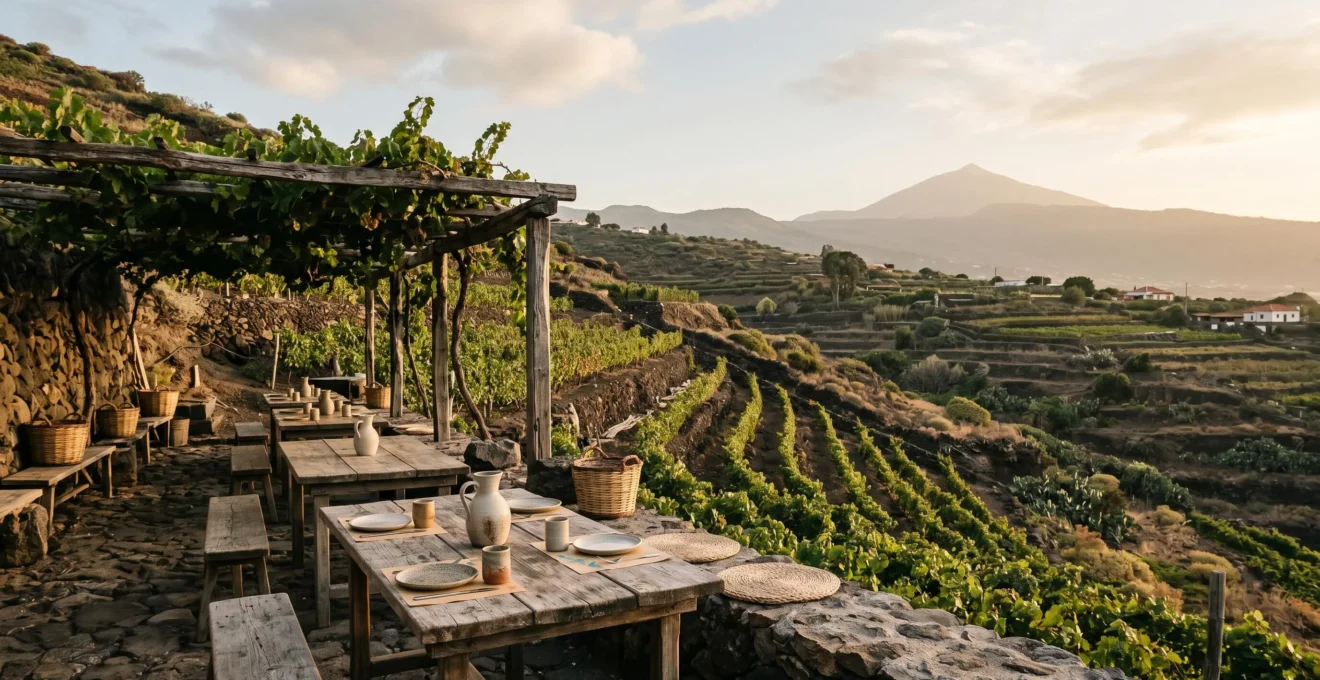
The secret to an authentic Guachinche experience isn’t finding a restaurant; it’s understanding you’re a guest in a winemaker’s home, where the food is legally just an ‘accompaniment’ to their homemade wine.
- A true Guachinche is identified by a “V” sign, has a menu of only 3-4 dishes by law, and operates for just a few months a year.
- Forget your credit card and glossy menus; expect to pay cash and trust the verbal, handwritten daily offerings.
Recommendation: Embrace the simplicity. Go for the wine, enjoy whatever food is on offer, and bring cash. This is the only way to experience this unique piece of Canarian culture.
So, you’ve heard the whispers. Tales of rustic, garage-like eateries tucked away in the hills of Tenerife, serving hearty food and cheap wine to tables of laughing locals. You want in. You want to find a real Guachinche. But here’s the first secret you need to know: a Guachinche isn’t really a restaurant. Thinking of it that way is the fastest path to disappointment, or worse, a tourist trap.
Most guides will tell you they are “cheap, family-run places.” That’s true, but it misses the entire point. The real magic, the very reason for their existence, is the wine. A Guachinche is a legal, temporary extension of a winemaker’s bodega, a way for them to sell their surplus harvest directly to the public. The food? It’s just a delicious, legally mandated afterthought. This isn’t a business model; it’s a cultural tradition wrapped in a government decree.
Understanding this distinction is the key that unlocks everything. It explains the comically short menus, the erratic opening hours, and the unapologetic, cash-only simplicity. This guide is your initiation. We’re going to bypass the tourist-friendly imitations and dive deep into the rules—not to restrict you, but to give you the confidence to walk into a bustling garage, grab a carafe of vino del país, and eat like a true Canarian.
To navigate this unique culinary world, we’ve broken down the essential codes you need to crack. This summary will guide you through spotting a real Guachinche, understanding its quirks, and enjoying the experience to its fullest.
Summary: A Deep Dive into Guachinche Culture
- The ‘V’ Sign: How to Spot a Legal Guachinche from the Road?
- Why Do Real Guachinches Only Serve 3 or 4 Dishes?
- Listán Negro: What to Expect from the House Wine Served in Carafes?
- Why Are Guachinches Only Open Certain Months of the Year?
- Cash Only: The Mistake of Trying to Pay with Apple Pay in a Garage
- The Risk of Eating at Restaurants with Pictures on the Menu
- Supermarket vs Market Stall: Where to Buy the Best Jarred Mojo?
- Canarian Food for Divers: Best Meals to Refuel After Nitrogen Loading
The ‘V’ Sign: How to Spot a Legal Guachinche from the Road?
Forget polished signs and professional branding. The first clue to an authentic Guachinche is often a hand-painted sign, sometimes on a simple board or even an old bedsheet, nailed to a post on a winding rural road. But the most important symbol to look for is a small, official plaque near the entrance displaying a “V” inside a cluster of grapes. This isn’t just decoration; it’s the legal footprint. According to official Canary Islands regulations, this “V” designates the establishment as ‘Vino de cosecha propia’ (selling homegrown wine), distinguishing it from a standard Restaurant (R) or Bar-Cafeteria (BC).
If you see a fancy, professionally printed banner with food pictures, be skeptical. The real deal advertises its presence with a charming, almost accidental, simplicity. Keep an eye out for these other tell-tale visual clues that you’re on the right track:
- Rural Location: True Guachinches are almost always far from tourist centers, nestled in the wine-growing municipalities of the north like Tacoronte, La Orotava, or El Sauzal.
- Haphazard Parking: A collection of cars parked precariously on the shoulder of a country lane is a fantastic sign. It means locals are inside.
- Rustic Vibes: Peek inside if you can. If you see plastic garden chairs, simple wooden tables, and a distinct lack of “décor,” you’re likely in the right place. It should feel more like someone’s garage or covered patio than a commercial enterprise.
Finding a place with the ‘V’ sign and these rustic characteristics is your guarantee that you’re about to experience the genuine article, not a place masquerading as one.
Why Do Real Guachinches Only Serve 3 or 4 Dishes?
Walking into a Guachinche and seeing a menu with only three items is not a sign of a lazy chef; it’s a sign of authenticity and, more importantly, legality. This is the core principle that separates them from restaurants. The food is legally considered an “accompaniment” to the wine, which is the primary product they are licensed to sell. To protect traditional restaurants from unfair competition, the government stepped in with strict regulations.
The definitive rule comes from a government decree that is the DNA of every true Guachinche. As stipulated by the 2013 Canary Islands government decree, a Guachinche can offer a maximum of three different main dishes. This usually consists of some grilled meat (carne a la brasa), a classic stew like ‘ropa vieja’ (shredded meat and chickpeas), and perhaps some fried fish, always served with the obligatory ‘papas arrugadas’ (wrinkly potatoes) and ‘mojo’ sauces. Anything beyond that, like starters (excluding simple nuts or pickles from the farm), desserts, or coffee, is technically breaking the rules.
Food is officially an ‘accompaniment’ to the wine they are licensed to sell. The menu is limited by law to ensure the primary business remains selling their own wine, not running a restaurant.
– Decree 83/2013 regulatory framework, Canary Islands Official Bulletin – Guachinche Regulation
So when you see that short menu, don’t feel limited. Celebrate it. It means the family is following the tradition, focusing on their wine, and offering you a simple, honest meal straight from their kitchen, just as it was always meant to be.
Listán Negro: What to Expect from the House Wine Served in Carafes?
Let’s be clear: you go to a Guachinche for the wine. It’s the star of the show, the reason the place exists. And more often than not, the red wine pouring generously from unlabelled glass carafes will be made from the island’s signature grape: Listán Negro. Don’t expect a fancy wine list or a sommelier; you’ll usually get a choice of ‘tinto’ (red), ‘blanco’ (white), or ‘rosado’ (rosé). Just say “un cuarto” (a quarter litre), “medio” (half a litre), or “un litro” (a full litre) of red, and get ready for a true taste of the volcanic terroir.
With more than 5,000 hectares planted across the Canary Islands, Listán Negro is the backbone of the region’s red wine production. The wines it produces are unique, often with a distinctive mineral or volcanic ash character from the soil. The house wine in a Guachinche is young, meant for easy drinking, and rarely sees the inside of an oak barrel. Expect a vibrant, ruby-red colour and a lively personality.
This isn’t a complex, contemplative wine, but it’s honest and delicious. As the experts at the Wine & Spirit Education Trust note, it typically shows a profile of fresh red fruits like cherry and raspberry, often with a characteristic peppery or spicy note. It’s light to medium-bodied with gentle tannins, making it the perfect, thirst-quenching partner for the hearty, often rich food like grilled pork or chickpea stew. It’s a wine that’s all about pure, unpretentious enjoyment.
So, when that carafe lands on your table, don’t overthink it. Just pour it, taste the island’s volcanic soul, and enjoy the simple pleasure of drinking a wine in the very place it was born.
Why Are Guachinches Only Open Certain Months of the Year?
You’ve found the perfect Guachinche, raved about it to your friends, and returned a few months later only to find it shuttered, with no sign of life. This isn’t a business failure; it’s the system working exactly as designed. A real Guachinche operates on the “Harvest Clock,” a rhythm dictated by its wine supply and strict legal time limits. This seasonality is one of the most charming and frustrating—and authentic—aspects of the experience.
Legally, the rules are clear. A Guachinche is permitted to be open for a maximum of four consecutive months per year, and their license also expires the moment they sell the last drop of their own wine. This creates a finite season that usually starts in late autumn and runs through winter or early spring. They open to sell the wine from the recent harvest and close when the tanks are empty or their time is up, whichever comes first.
The St. Andrew’s Day Tradition
The traditional opening day for many Guachinches is November 30th, the festival of San Andrés (St. Andrew). This day marks the “fiesta del vino nuevo” (new wine festival) across the wine-growing regions. The doors are thrown open, and the very first of the young wine from the autumn harvest is served, often alongside roasted chestnuts and grilled sardines. From this day forward, the clock is ticking. They will stay open, serving their wine and simple food, until the supply is exhausted or the four-month legal window slams shut, usually around March or April.
This ephemeral nature is part of the magic. It ensures the wine is always fresh and the experience remains a special, seasonal treat rather than a year-round commercial operation. It forces you to live in the moment, because you never know if that incredible ‘carne fiesta’ you’re eating will be available next week, let alone next year.
So, if you find a good one, cherish it. And if you go back and it’s closed, don’t be sad. Just smile, knowing that the family has successfully shared their harvest and is already tending the vines for next year’s vintage.
Cash Only: The Mistake of Trying to Pay with Apple Pay in a Garage
Imagine the scene: you’ve had a fantastic, hearty meal. The wine was flowing, the atmosphere was electric, and you’re feeling content. You confidently walk up to the counter, iPhone in hand, ready to tap and pay. The owner, a friendly but weathered man in his 60s, just stares at your phone with a look of complete bewilderment. This is the moment you realise your final, crucial mistake: you didn’t bring cash.
In the world of Guachinches, cash is king, queen, and the entire royal court. Attempting to pay with a card—let alone a digital wallet—is a rookie error. This isn’t a technological statement; it’s a matter of pure economics. Remember, these are not professional restaurants. They are low-margin, seasonal, family-run operations. For a business that’s only open for a few months a year and operates with minimal infrastructure, the costs, fees, and technical complexities of setting up a card payment terminal are simply not viable. The entire business model is built on an honest simplicity that electronic payments would complicate and erode.
With meal prices often hovering between €12 and €20 for a very generous amount of food, the profit margins are razor-thin. The cash-only policy keeps their costs down and the prices low for you. It’s a fundamental part of the ecosystem. Before you even think about heading up into the hills in search of a Guachinche, your first stop should always be an ATM.
Your Guachinche Action Plan: The Pre-emptive Cash Run
- Visit an ATM in a major town before you start your ascent. Don’t assume you’ll find one in a tiny hillside village.
- Plan for major towns on the north coast like La Orotava, Tacoronte, El Sauzal, or Icod de los Vinos as your last chance for cash.
- Estimate your bill: A good rule of thumb is to bring at least €25-€30 per person. You’ll likely spend less, but it’s better to be safe.
- Bring small notes and coins. Don’t be the person trying to pay for a €15 meal with a €100 note.
- Check your wallet before ordering that last litre of wine. It’s the responsible, and necessary, thing to do!
Treating the cash-only rule as part of the authentic charm, rather than an inconvenience, is the mindset of a seasoned visitor. It’s a small price to pay for such a genuine experience.
The Risk of Eating at Restaurants with Pictures on the Menu
You’re walking down a street and a place has a sign that says “Authentic Guachinche.” But something feels off. There’s a glossy, laminated menu by the door, complete with pictures of every dish, translated into five languages. Your tourist-trap alarm bells should be screaming. This is the single biggest red flag in the Guachinche world. A real one would never, ever have a picture menu.
The menu in a true Guachinche is a verbal contract based on trust. The owner or a family member will come to your table and simply tell you what they have today: “Hoy tenemos carne a la brasa, costillas con papas, y garbanzas.” (Today we have grilled meat, ribs with potatoes, and a chickpea stew). There might be a simple chalkboard or a handwritten piece of paper, but that’s as fancy as it gets. This lack of a formal menu isn’t a flaw; it’s a feature. It signifies that the food is fresh, made in small batches, and subject to change based on what’s good that day.
A glossy menu with pictures is designed for tourists who need to see what they’re ordering. It’s a sign of a professional restaurant that has a large, static inventory of ingredients and is trying to appeal to a broad, international clientele. A Guachinche is the opposite: it’s for locals (and savvy visitors) who trust the kitchen and are there for the simple, honest fare of the day.
If an establishment claiming to be a guachinche has a glossy, multi-language menu with photos, it’s the single biggest red flag that it’s a tourist-focused restaurant, not an authentic guachinche.
– Traditional guachinche authentication guide, What is a Guachinche – Messy Feast travel guide
So, take a deep breath, trust the owner’s recommendation, and order what’s fresh. The surprise is part of the adventure, and it’s a far more rewarding experience than choosing from a predictable, laminated page.
Supermarket vs Market Stall: Where to Buy the Best Jarred Mojo?
After a few meals in the Canaries, you will become addicted to Mojo, the ubiquitous garlic-and-pepper sauce served with everything, especially the famous ‘papas arrugadas’. You’ll see jars of it in every supermarket, a tempting and easy souvenir. But if you want to take home the real taste of the island, you need to be more discerning. The mass-produced supermarket versions are often pale imitations, filled with preservatives and lacking the fiery soul of the real thing.
The best Mojo is found closer to the source. Your top choice should be the local ‘agromercados’ or farmer’s markets. Here, you’ll find small, artisanal producers, often the same families who run fincas (farms) and Guachinches, selling their own homemade sauces. These versions are vibrant, fresh, and made with love. But how do you spot the good stuff among the stalls?
Look for the signs of a truly artisanal product. A high-quality, homemade Mojo will often have a visible layer of oil on top that needs to be stirred back in. This is a good thing! It means it hasn’t been homogenized with industrial emulsifiers. Check the ingredient list; it should be short and simple: garlic, local peppers (pimiento), cumin, olive oil, vinegar, and salt. Anything with a long list of chemical-sounding names is a no-go. The very best mojo often comes from vendors who also sell their own wine or produce, showing a deeper connection to the land.
Here are the key indicators of quality to look for at a farmer’s market:
- Natural Oil Separation: A clear sign that no industrial emulsifiers have been used.
- Simple Ingredient List: Avoid anything with a long list of chemicals. Authenticity lies in simplicity.
- The Vendor’s Story: Ask the person selling it who made it. A good vendor at a farmer’s market will have a story connecting the product to a specific person or family.
- The Ultimate Secret Move: After a great meal at a Guachinche, politely ask if they sell their homemade Mojo to take away. It’s not always possible, but when it is, you’ve hit the jackpot. This is the most authentic bottle you can possibly buy.
Taking the time to hunt down a jar of real, artisanal Mojo is a delicious final chapter to your culinary adventure. It’s a souvenir that will bring the vibrant taste of the islands back to your own kitchen.
Key takeaways
- A true Guachinche is defined by law: it primarily sells its own wine, with food as a secondary accompaniment.
- Authenticity has clear markers: a ‘V’ sign, a menu of 3-4 dishes, seasonal opening hours, and a cash-only policy.
- The experience is about trust and simplicity; embrace the unwritten menu and the rustic, “winemaker’s living room” atmosphere.
Canarian Food for Divers: Best Meals to Refuel After Nitrogen Loading
Now for a tip for a very specific tribe of ‘bon vivants’: my fellow scuba divers. After a morning spent exploring the incredible volcanic underwater landscapes of Tenerife, your body is in a specific state of recovery. You’re happy, you’re a bit tired, and you’ve been “loading nitrogen.” Your post-dive meal isn’t just about satisfying hunger; it’s about refueling and rehydrating properly. And a Guachinche, if chosen wisely, can be the perfect place for it.
The key is to make smart choices from the typically limited menu. While the temptation is to order everything, a diver’s priority should be high-quality protein for muscle recovery and smart carbs for energy, without feeling overly full or bloated. While the house wine is a core part of the experience, remember that rehydration is paramount after a dive. Make sure to order a large bottle of ‘agua sin gas’ (still water) and make it your priority before indulging in the vino.
Focus on the protein-rich dishes. A ‘potaje de berros’ (watercress stew) or a hearty ‘garbanzas’ (chickpea stew) are fantastic choices, providing slow-release energy and nutrients. If ‘carne a la brasa’ (grilled meat) is on offer, it’s an excellent source of lean protein. A classic ‘ropa vieja’, with its shredded meat, is also easily digestible. The one thing to be mindful of is going too heavy on the ‘papas arrugadas’. They are delicious but can be incredibly filling. Eat a few, but save most of your stomach space for the protein that will help your body recover best.
By choosing your dishes thoughtfully, you can turn a trip to a Guachinche into the perfect, restorative end to a day of diving—a truly Canarian “surf and turf” experience, island style.