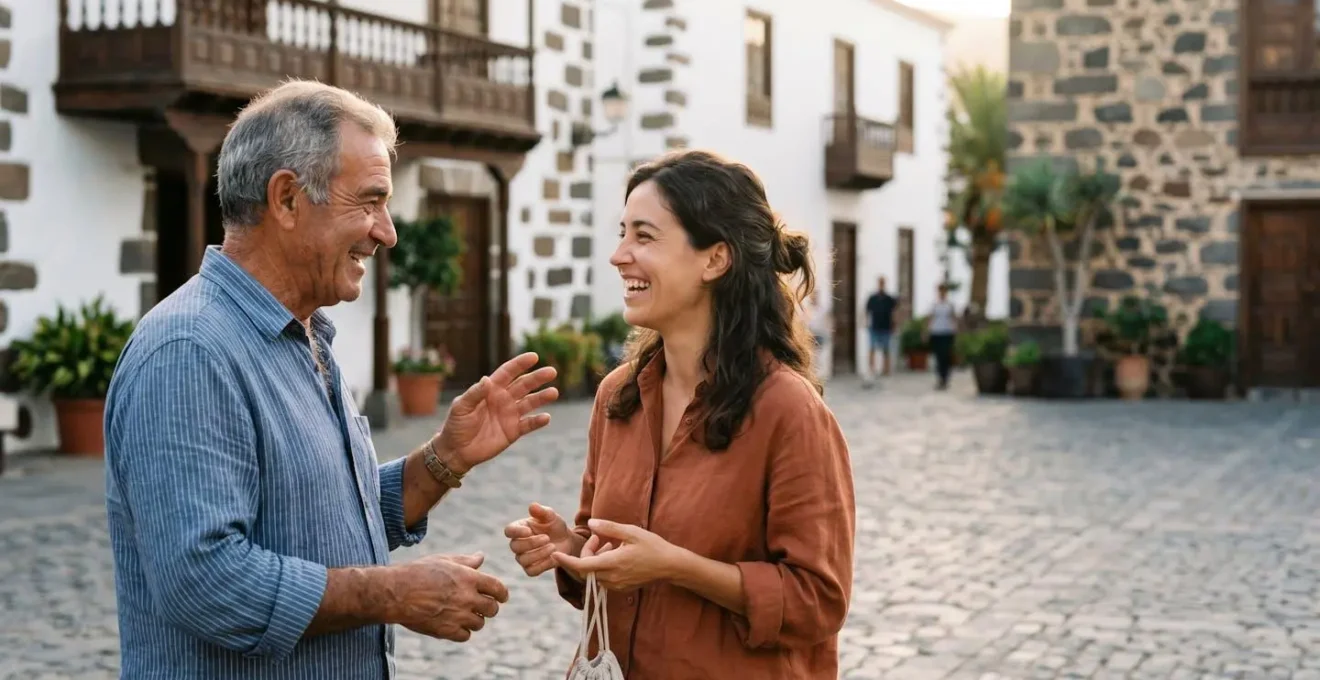
Contrary to popular travel advice, making a genuine connection with Canarios isn’t about memorizing a checklist of Spanish phrases or « going local. » It’s about a fundamental mindset shift from being a consumer of experiences to becoming a respectful observer of a living culture. This guide unpacks the unspoken social rhythms and cultural codes that allow you to move beyond transactional tourism and foster authentic, human interactions.
There’s a feeling familiar to many thoughtful travelers: you’re standing in a place of stunning beauty, surrounded by people, yet separated by an invisible wall. You’ve followed the advice. You say ‘hola’ and ‘gracias’, you eat at restaurants away from the main strip, but the interactions remain polite, brief, and transactional. You are a client, a tourist. The genuine human connection you hoped for remains just out of reach, leaving a sense of being an outsider looking in.
The common wisdom for breaking this barrier—learn the language, be respectful—is not wrong, but it is profoundly incomplete. These actions are the entry ticket, not the main event. They are often presented without the cultural context that gives them meaning. The Canary Islands, a crossroads of continents and cultures, operate on a complex system of social codes and rhythms that are not written in any guidebook.
But what if the key wasn’t in doing more, but in seeing differently? What if the path to connection wasn’t about asserting your presence, but about quieting it? This is where we must adopt the mindset of a cultural sociologist: observing, listening, and understanding the ‘why’ behind the ‘what’. This guide is built on this principle. It moves beyond the platitudes to explore the nuanced social landscape of the islands, showing you how to read the cultural map and navigate your way to more meaningful encounters.
This article will guide you through the subtle art of cultural integration, from the conversations you have in a local bar to the way you experience a public procession. By understanding the underlying social dynamics, you can begin to dissolve the tourist bubble and participate in the life of the islands in a more authentic and rewarding way.
Summary: A Guide to Authentic Interaction in the Canary Islands
- Why Saying ‘Hola’ and ‘Gracias’ Is Not Enough for Meaningful Interaction?
- Football vs Politics: Safe Topics to Discuss at the Local Bar
- Plaza vs Pub: Where Do Locals Actually Socialize in the Evening?
- The Risk of Disrespecting Religious Processions by Taking Selfies
- How to Behave If You Are Invited to a Canarian Family Lunch?
- How Learning Basic Spanish Changes Your Treatment in Local Bars?
- The ‘V’ Sign: How to Spot a Legal Guachinche from the Road?
- Finding Authenticity: Where to Stay to Avoid the Neon Lights of Playa de las Américas?
Why Saying ‘Hola’ and ‘Gracias’ Is Not Enough for Meaningful Interaction?
Learning basic pleasantries in the local language is a fundamental sign of respect, and it is always appreciated. It signals that you see your hosts as more than just service providers. However, these words are merely the key to the door; they do not, by themselves, grant you entry into the house. The leap from a polite nod to a genuine conversation requires moving from transactional to relational interaction. Your ‘gracias’ to a shopkeeper is transactional. A shared laugh over a misunderstood word is relational.
The goal is not simply to be understood, but to connect. As research on cultural travel points out, « meaningful experiences arise from the interaction between travelers and their destinations, where both the individual and the cultural context contribute to and benefit from the encounter. » This reciprocity is the heart of genuine connection. It’s an exchange, not just a purchase of goods or services. It acknowledges a shared humanity that exists beyond the tourist-host dynamic.
The insufficiency of language skills alone is a well-documented phenomenon. A long-term study of students abroad found that linguistic ability was not the primary predictor of social integration. Many participants, despite becoming proficient in Spanish, struggled to form close friendships with locals. The research concluded that building authentic relationships required moving beyond the safety of transactional exchanges. It’s the difference between asking for the bill and asking the waiter for their favorite dish on the menu and why they love it. The first is a transaction; the second is an invitation to share a piece of themselves.
Therefore, while ‘hola’ is a beautiful start, the real work begins afterwards. It lies in showing curiosity, vulnerability, and a willingness to engage on a human level, transforming a simple greeting into a potential bridge for connection.
Football vs Politics: Safe Topics to Discuss at the Local Bar
The local bar, or *tasca*, is a cornerstone of Canarian social life. It is not just a place to drink, but a semi-public living room where news is exchanged, friendships are maintained, and community is reaffirmed. For a visitor, stepping into one can feel intimidating, and the pressure to start a conversation can be high. The key, however, is to first adopt an observer’s mindset. Listen more than you speak. Notice the rhythm of conversations around you.
When the moment for conversation arises, your choice of topic is a powerful signal of your cultural awareness. The safest and most effective topics are those that build a sense of shared, positive experience. These include:
- Football: An almost universally safe and passionate topic. Showing knowledge of the local teams (CD Tenerife or UD Las Palmas) can be an immediate icebreaker. Asking « Who played well last weekend? » is far better than stating your own opinion.
- Local Pride: Asking about the island itself is always a winner. Questions like « What is your favorite beach on the island? » or « I heard the food in this village is the best, what should I try? » show appreciation for their home.
- The Weather: A classic for a reason. Discussing the heat, the *calima* (dust from the Sahara), or the « panza de burro » (the cloud bank common in the north of Tenerife) is a neutral and relatable topic.
Conversely, certain topics are best avoided, not because Canarios are not open to discussion, but because a bar with a stranger is not the appropriate forum. Steer clear of Spanish national politics, discussions about Canarian independence, or making comparisons between the islands and mainland Spain. Above all, avoid complaining about local « inefficiencies » or ways of doing things. You are a guest in their space; the goal is connection, not critique.
Ultimately, the best topic is a question, not a statement. By asking for an opinion or a recommendation, you cede the floor, demonstrate humility, and position the local as the expert—a dynamic that is far more likely to lead to a warm and open exchange.
Plaza vs Pub: Where Do Locals Actually Socialize in the Evening?
For many visitors from northern cultures, socializing in the evening is synonymous with the pub or an indoor bar. While the Canary Islands have plenty of these, many of which cater specifically to tourists, the true heart of local evening life beats outdoors in the public square, or plaza. Understanding this distinction is key to understanding the local social rhythms. The plaza is the community’s stage, where life is performed in public and everyone, from toddlers to grandparents, has a role.
The most important ritual associated with the plaza is the evening *paseo*. As the sun begins to set and the heat of the day subsides, the community spills out into the streets and squares. It is a slow, unhurried stroll with no fixed destination, a time for seeing and being seen, for casual chats with neighbors, and for children to play under the watchful eyes of the entire community.
This image captures the essence of the *paseo*, a far cry from the noisy, enclosed atmosphere of a tourist pub. For the traveler seeking connection, the plaza offers a perfect opportunity to practice the observer’s mindset. Find a bench, order a coffee or a small beer (*caña*) from a bordering café, and simply watch. You will learn more about the social fabric of the town in one hour on a plaza bench than in a week of guided tours.
It is in these moments of quiet observation that the invisible wall between tourist and local begins to feel permeable. You are not the center of attention; you are simply part of the scenery, which is the first step towards feeling a sense of belonging.
The Risk of Disrespecting Religious Processions by Taking Selfies
The Canary Islands have a rich calendar of religious and cultural festivals, from the solemn processions of *Semana Santa* (Holy Week) to the vibrant local *Romerías* (pilgrimages in honor of a patron saint). These events are a profound expression of Canarian identity, faith, and tradition, often involving months of preparation and deep emotional investment from the community. For a visitor, they offer a spectacular window into the local culture, but they also present a significant risk for cultural missteps.
The most common and jarring of these is treating a sacred event like a tourist attraction. The desire to capture the moment, particularly with a selfie, can inadvertently communicate a deep level of disrespect. It reframes the event, turning participants’ genuine devotion into a colorful backdrop for your personal travelogue. It prioritizes your digital memory over their living reality.
As this image conveys, these are not performers putting on a show. They are community members engaged in a deeply meaningful, often solemn, act. The appropriate response is one of reverence and quiet respect. This is a moment to put the phone away entirely. Stand back, be still, and allow the sounds, smells, and atmosphere to wash over you. Your presence should be as unobtrusive as possible, a silent witness rather than an active documentarian.
In this context, the ultimate sign of respect is not what you do, but what you refrain from doing. By choosing not to take the photo, you are communicating that you understand the difference between a spectacle and a sacred ceremony, a distinction that will be silently noted and appreciated by those around you.
How to Behave If You Are Invited to a Canarian Family Lunch?
Receiving an invitation to a family meal is perhaps the clearest sign that you have successfully crossed the threshold from tourist to guest. It is a significant gesture of inclusion and trust. A Canarian family lunch, especially on a Sunday, is not a quick affair; it is a marathon of eating, drinking, talking, and laughing that can last for many hours. The meal itself is just the appetizer; the main course is the extended conversation that follows, known as the *sobremesa*.
While the rules of etiquette are less about rigid protocols and more about warmth and enthusiasm, a few guidelines can help you navigate the experience gracefully:
- Never arrive empty-handed. A bottle of wine, a cake from a local bakery (*pastelería*), or flowers for the host are all appropriate gestures.
- Praise the food effusively. The host, typically the mother or grandmother, has likely spent days preparing. Expressing your delight is paramount.
- Eat what you are served. Refusing food can be seen as a slight. Pace yourself, as there will be many courses.
- Embrace the *sobremesa*. Do not be the first to leave. The long, lingering conversation after the plates are cleared is the most important part of the meal.
Ultimately, your attitude is more important than your adherence to any specific rule. As one student who studied abroad in Spain noted, the most valuable lessons came from simply engaging authentically. This is a sentiment that resonates with the core of cultural immersion.
A student studying abroad in Spain reflected on how even mundane experiences like getting a gym membership taught valuable lessons about local relations and customs. The student noted that overcoming initial nervousness to engage authentically with locals opened doors to unexpected opportunities and connections. Events like these proved that cultural immersion provides benefits to yourself, others, and the world around you by fostering genuine understanding beyond surface-level tourism.
– Student Story, IFSA
Your presence at the table is a statement that you are seen as more than a visitor; you are, for that afternoon, part of the family. Relax, enjoy, and participate with an open heart.
How Learning Basic Spanish Changes Your Treatment in Local Bars?
The effort to speak Spanish, no matter how broken or rudimentary, is perhaps the single most impactful gesture a visitor can make. It is not about achieving fluency; it is about demonstrating respect and a willingness to step out of your linguistic comfort zone. This act of vulnerability fundamentally changes the dynamic of an interaction, especially in a place like a local bar. It is a powerful signal that you see the person in front of you not as a service provider who should cater to you in English, but as a fellow human with their own language and culture.
This principle is what can be called the reciprocity of effort. When locals see you trying, they are far more likely to meet you halfway. The bartender who responded to your previous English with a professional but distant demeanor might suddenly switch to slower, clearer Spanish. They might offer a recommendation, a smile, or a small, complimentary tapa. You have ceased to be just another tourist; you have become a person who is *trying*.
This experience is backed by academic research on social integration. One study on language learners in Spanish-speaking countries found that the key to successful integration was not just linguistic competence. Instead, authentic engagement and a negotiation of identity were the determining factors. By trying to speak Spanish, you are negotiating your identity from « tourist » to « learner, » a far more relatable and sympathetic role. You are signaling a desire to participate, not just consume.
This simple act can be the difference between a cold transaction and a warm interaction. It is the key that can unlock a more human, and ultimately more memorable, experience of the Canary Islands.
The ‘V’ Sign: How to Spot a Legal Guachinche from the Road?
For the traveler seeking the most authentic taste of the Canary Islands, particularly in Tenerife, the ultimate destination is a *guachinche*. This is not simply a restaurant; it is a cultural institution. A true *guachinche* is a rustic, often improvised establishment run by a local winemaker to sell their own, home-grown wine (*vino de cosecha propia*). By law, they can only open for a few months a year until their wine runs out, and the food they serve—always hearty, traditional, and limited to a few dishes—is legally considered an accompaniment to the wine, not the main event.
These places represent the soul of Canarian rural life. However, as noted in a study on Tenerife’s wine and food culture, authentic *guachinches* face challenges from commercial restaurants posing as the real thing. So how do you spot a genuine one? Often, the signs are makeshift and unpolished. You might see a simple wooden board with a « V » for *Vino* or a handwritten sign. The most official sign is a distinctive plaque with a « V » logo, indicating it is a legally registered *guachinche*.
The experience is about embracing simplicity and authenticity. The ambiance is rustic, the tables might wobble, and the menu is often recited verbally, not written down. This is as far from the tourist-trap restaurant as you can get.
Once you’ve found a *guachinche*, knowing how to behave is a final piece of cultural literacy. These are not places that have adapted to tourist expectations; you must adapt to them. Here is a practical guide to doing so.
Your Action Plan: Guachinche Etiquette
- Bring Cash: Don’t assume they take credit cards. Many traditional, family-run places operate on a cash-only basis as part of their rustic simplicity.
- Order Wine by Volume: Forget ordering by the glass. The wine is the star. Order it like a local: by the ‘cuarta’ (quarter-liter) or ‘medio’ (half-liter), served from an unlabeled bottle.
- Embrace the Limited Menu: Expect a small selection of hearty, local dishes like *papas arrugadas con mojo* (wrinkly potatoes with sauce), grilled meats, or *gofio*. Trust what’s on offer.
- Accept the Ambiance: A true guachinche might be in someone’s garage, on a patio, or in an improvised space. The lack of polish is a sign of authenticity, not poor quality.
By seeking out a real *guachinche* and participating in its rituals, you are not just having a meal; you are taking part in the preservation of a vital piece of Canarian culture.
Key Takeaways
- Genuine connection is a mindset shift from a ‘tourist-as-consumer’ to a ‘visitor-as-observer’, focusing on understanding cultural rhythms.
- The effort to show cultural respect and speak basic Spanish is more valued than achieving perfection; it signals a desire for human connection over service.
- Authenticity is found by respectfully participating in local social spaces like plazas and guachinches, away from the tourist-centric hubs.
Finding Authenticity: Where to Stay to Avoid the Neon Lights of Playa de las Américas?
Your choice of accommodation is the single most decisive factor in shaping your travel experience. It sets the stage for every interaction that follows. With the Canary Islands welcoming staggering numbers of visitors—provisional figures show the islands welcomed nearly 18 million visitors in 2024—it is easy to find yourself in a purpose-built tourist enclave, completely insulated from local life.
Places like Playa de las Américas in Tenerife or Playa del Inglés in Gran Canaria are « tourist bubbles » by design. They are filled with Irish pubs, all-day English breakfasts, and souvenir shops, creating an environment where it is possible to spend a week without having a single authentic interaction. To break the bubble, you must physically leave it.
Consider alternatives that place you in the path of daily life:
- *Casas Rurales*: Renting a room or a house in the countryside puts you in touch with the agricultural heart of the islands. Your « neighbors » are farmers, not other tourists.
- Historic Towns: Staying in the center of a historic, living city like La Laguna (Tenerife) or Las Palmas’ Vegueta district (Gran Canaria) means your local café and bakery are for residents, not just visitors.
- Small Coastal or Mountain Villages: Choosing a town like Garachico (Tenerife) or Agaete (Gran Canaria) immerses you in a community with its own distinct pace and rhythm.
By choosing to stay in these places, you are voting with your wallet for a more sustainable and integrated form of tourism. You are contributing to the local economy in a more direct way and reducing the pressure on overloaded tourist hotspots. This aligns with the vision of local leaders who advocate for a more balanced approach.
it is necessary to work on a strategy that makes the Canary Islands a destination with a balanced tourism model that combines the attraction of visitors with the preservation of the environment and natural resources, as well as the social well-being of the resident population
– Santiago de Armas Fariñas, President of the Tourism Committee of the Chamber
Ultimately, making a genuine connection starts here. By choosing to be a resident, even a temporary one, in a real Canarian community, you are not just finding authenticity—you are helping to sustain it.