Ignorance of local marine regulations in Tenerife is not a defence and can lead to severe financial penalties enforced by the Spanish authorities.
- Specific coastal areas are designated as protected zones with strict no-go or no-touch rules to preserve fragile ecosystems and endangered species.
- Fines for infractions, such as harassing wildlife or damaging the seabed, can reach €3,000 or more under Spain’s coastal law (Ley de Costas).
Recommendation: Only dive with certified, conservation-conscious centres that provide explicit briefings on local restrictions and actively enforce responsible diving protocols.
As a British diver accustomed to the clear protocols of UK waters, arriving in Tenerife presents a vibrant new underwater world. The volcanic seascapes and unique marine life are a significant draw. However, this appeal comes with a strict, non-negotiable regulatory framework that many visitors underestimate. The common advice to « be a good diver » and « don’t touch anything » is insufficient here. Compliance is not merely an ethical choice; it is a legal obligation enforced by a dedicated environmental police force, SEPRONA, with the authority to issue substantial fines.
The assumption that your standard diving certification covers all local nuances is a dangerous one. Tenerife’s marine environment includes specially designated protected zones, migration routes for endangered species, and highly fragile benthic communities that can be destroyed by a single careless fin kick. The legal framework, including Spain’s national Ley de Costas and various local bylaws, is designed to shield these assets from the pressures of tourism. Failure to understand these specific rules—where you can dive, what you can do, and who you can dive with—can inadvertently turn a holiday dive into a costly legal matter.
This guide moves beyond generic advice. It serves as an official briefing on the specific regulations you must follow. We will dissect the legal basis for protected zones, the real-world fines for non-compliance, and the practical steps you must take to ensure every dive you undertake in Tenerife’s waters is not only enjoyable but, crucially, legal. The objective is to transform you from a well-intentioned visitor into a fully compliant and informed diver who actively contributes to the preservation of the very ecosystems you have come to admire.
To navigate these regulations effectively, this guide is structured to address the critical questions a conscientious diver must ask. From identifying protected zones to understanding the consequences of an infraction, each section provides the necessary information for responsible and lawful diving in Tenerife.
Summary: Navigating Tenerife’s Diving Regulations
- Why Are Certain Coastal Zones Off-Limits to Recreational Divers?
- How to Perfect Your Finning Technique to Protect Fragile Volcanic Moss?
- Protected vs Open Zones: Where Can You Legally Dive Without a Special Permit?
- The Fine for Touching Protected Species That Could Cost You €3,000
- How to Identify a Green Star Awarded Dive Centre in Tenerife?
- The Heavy Fines for Harassing Protected Marine Reptiles in Spain
- How to Report Sightings to Local Databases Like RedPROMAR?
- How to Ensure Your Marine Encounters Don’t Harm the Animals?
Why Are Certain Coastal Zones Off-Limits to Recreational Divers?
The designation of certain coastal areas as off-limits or restricted is not an arbitrary decision. It is a critical conservation strategy founded on the principle of protecting vulnerable marine ecosystems from anthropogenic pressures, including recreational diving. These Marine Protected Areas (MPAs) are established to safeguard biodiversity hotspots, fragile habitats, and critical breeding or nursery grounds for numerous species. In the Canary Islands, these zones are legally mandated to prevent the degradation of unique natural heritage, such as seagrass meadows and seamount ecosystems.
However, the existence of a protected area on a map does not guarantee its health. The true value of an MPA lies in its management. A stark report from the MPAs Canary Islands project revealed that only 11% of marine protected areas in the Canary Islands have active management systems in place. This management deficit places a greater burden of responsibility on individual divers and dive operators to act with extreme caution. The lack of visible enforcement or clear on-site demarcation does not diminish the legal status of these zones.
Restrictions can range from total prohibition of entry to specific rules such as no anchoring, depth limitations, or strict no-touch policies. These regulations are in place because scientific evidence shows that concentrated diving activity, even by well-meaning individuals, can cause cumulative damage. This includes physical breakage of slow-growing organisms, sediment disruption that smothers filter-feeders, and behavioural changes in wildlife due to human presence. The primary purpose of these off-limits zones is therefore preventative: to preserve the ecological integrity of the most sensitive marine environments for the long term.
How to Perfect Your Finning Technique to Protect Fragile Volcanic Moss?
The term « volcanic moss » is a colloquialism for the complex and delicate benthic community that coats Tenerife’s submerged volcanic rock. This is not a single organism but an intricate tapestry of coralline algae, bryozoans, sponges, and other invertebrates. These communities are incredibly slow-growing, taking decades or even centuries to establish. Their texture and structure provide a critical microhabitat for juvenile fish and countless other small marine creatures. Once damaged, this ecosystem can take an extremely long time to recover, if it recovers at all.
Improper finning technique is the single most common cause of diver-inflicted damage to this fragile substrate. The primary culprits are downward-pointing fin strokes that kick up sand and silt, which smothers the delicate filter-feeding organisms, and direct physical contact from fins striking the reef. A single misplaced kick can scrape away years of growth. Mastering neutral buoyancy is the foundation, but perfecting your finning technique is the active measure required for protection.
This image provides an extreme close-up of the intricate structure you are tasked with protecting. The delicate, layered nature of the community is immediately apparent.
To avoid causing harm, divers must adopt low-impact propulsion techniques. The « frog kick » is superior to the flutter kick in close quarters, as it directs water backward and upward, away from the seabed. When turning, use a « helicopter turn » (or back kick) which allows you to pivot in place without sculling your fins near the bottom. Maintaining a horizontal trim (flat body position) and staying at least a metre above the substrate is not just good practice; in these fragile environments, it is an absolute necessity. Your dive guide is responsible for assessing conditions, but you are responsible for every movement you make underwater.
Protected vs Open Zones: Where Can You Legally Dive Without a Special Permit?
Navigating the legalities of where you can and cannot dive in Tenerife requires clear information, as a significant portion of the marine environment is under legal protection. It’s crucial to understand that « open water » does not mean « unregulated water. » While many excellent dive sites are located in open zones accessible without special permits, you are still bound by the overarching environmental laws of Spain. The key distinction lies between general access areas and those with specific, heightened levels of protection.
Research confirms that 21.7% of the sea surrounding the Canary Islands has some form of legally binding protection. These areas include Marine Reserves, Special Areas of Conservation (SACs) under the EU Habitats Directive, and zones designated by local government. Entry into some of these, particularly the core zones of Marine Reserves like the one in La Restinga, El Hierro, requires special permits that are typically managed and held by licensed dive centres. Diving in such an area without the necessary permit is a serious infringement.
The responsibility for verifying the legal status of a dive site falls on both the dive operator and the individual diver. A professional, compliant dive centre will have this information readily available and will integrate it into their pre-dive briefing. They must be able to show you on a chart precisely where you are and what specific rules apply. Never assume a dive site is open for general access. Your pre-dive diligence is your first line of defence against committing an accidental violation.
The Fine for Touching Protected Species That Could Cost You €3,000
The rules against touching, feeding, or harassing marine life are not mere suggestions; they are backed by Spanish law and enforced with significant financial penalties. The environmental protection branch of the Guardia Civil, known as SEPRONA, is tasked with policing these regulations. Their presence may not always be visible on the water, but they actively investigate reports of environmental infractions, often originating from other divers, boat captains, or coastal residents.
The scale of their operation is substantial; for context, the environmental arm of Spain’s Guardia Civil conducted 140,234 interventions in a single year. This demonstrates a serious commitment to enforcing environmental law. Under the national framework of the *Ley de Costas* (Coastal Law) and various regional and municipal bylaws, a range of activities are classified as minor, serious, or very serious infringements.
Case Study: Range of Environmental Fines on Spanish Coasts
Under Spain’s Ley de Costas 22/1988, violations carry a wide range of penalties. While a minor infraction like smoking on a restricted beach might result in a €30 fine, more significant unauthorized activities can be costly. For example, unpermitted barbecues in protected coastal areas have incurred fines up to €3,000. Specifically concerning marine ecosystems, actions classified as causing environmental damage, such as touching or removing protected species or damaging the seabed, can result in fines escalating from €100 for minor breaches to potentially €60,000 for serious infringements. The precise amount often depends on the species involved, the extent of the damage, and the specific municipal regulations, but a fine of €3,000 is a realistic and documented penalty for what may seem like a minor interaction to an uninformed diver.
An action as seemingly innocuous as touching a turtle to « guide » it, cornering a ray for a photograph, or breaking off a piece of gorgonian as a souvenir constitutes a prosecutable offence. The legal principle is clear: the marine environment and its inhabitants are to be observed, not interacted with. The financial risk associated with ignoring this principle is severe and designed to act as a powerful deterrent.
How to Identify a Green Star Awarded Dive Centre in Tenerife?
Choosing the right dive centre is the single most important decision you will make to ensure your diving activities are compliant and responsible. In a marketplace with many operators, the PADI Green Star Award serves as a clear indicator of a business that has demonstrated a serious commitment to conservation. It is an objective, verifiable credential that separates operators who merely talk about conservation from those who actively practice it.
This award is not easily obtained. It requires a dive centre to prove its dedication across a wide range of operational functions. As PADI International outlines, the criteria are comprehensive.
The PADI Green Star Dive Center Award is granted to PADI Dive Centers and Resorts that demonstrate a dedication to conservation across a wide range of business functions, including water conservation, energy use, environmentally friendly transportation practices, use of sustainable materials, conservation leadership and a donation to conservation through Project AWARE.
– PADI International, One Two Dive Tenerife – Environmental Practices Description
A Green Star centre is more likely to provide detailed environmental briefings, enforce smaller diver-to-guide ratios, and employ guides who are trained to manage diver behaviour underwater. They actively work to minimise their ecological footprint both in and out of the water. When researching dive centres in Tenerife, look for the official PADI Green Star Award logo on their website or storefront. This is a tangible sign of their commitment. However, you should still perform your own due diligence before booking.
Actionable Plan: Pre-Booking Checklist for Responsible Dive Centre Selection
- Email question 1: ‘What is your maximum diver-to-guide ratio, and how do you ensure personalized attention underwater?’
- Email question 2: ‘How do you manage underwater photographers to prevent disturbance to marine life during dives?’
- Email question 3: ‘Is your dive briefing generic or specifically tailored to the environmental rules and marine life behaviors at today’s dive site?’
- Verification step: Check if the centre participates in Project AWARE beach clean-ups or contributes data to citizen science platforms like RedPROMAR.
- Red flag check: Avoid centres advertising ‘guaranteed turtle sightings’ or ‘feeding the rays’ experiences, as these suggest wildlife harassment.
The Heavy Fines for Harassing Protected Marine Reptiles in Spain
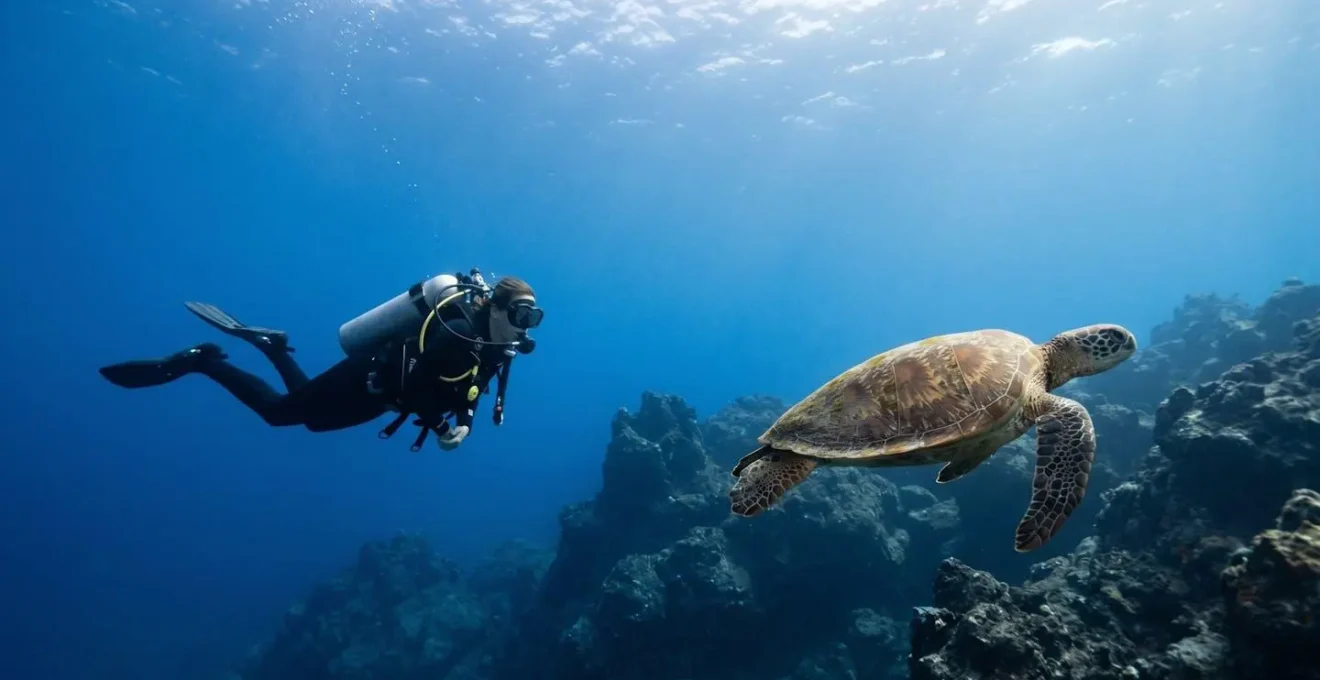
Marine reptiles, particularly sea turtles, are emblematic of Tenerife’s marine fauna and are strictly protected under both Spanish and international law. All species found in Canarian waters are listed as vulnerable or endangered. Harassment is defined broadly and includes any action that alters an animal’s natural behaviour. This includes chasing, touching, blocking their path, or making sudden movements that cause stress.
A critical form of harassment, often committed out of ignorance, is blocking a turtle’s path to the surface. Turtles are air-breathing reptiles and must surface periodically. Obstructing this vital behaviour, even for a moment to get a better photo, can cause significant distress and even lead to drowning. Divers must always be aware of an animal’s position in the water column and ensure they are never positioned between the turtle and the surface.
Case Study: Sea Turtle Species in Canary Islands Waters
Of the six sea turtle species divers might encounter in Tenerife, the loggerhead is most common. However, with luck, five species can be seen migrating through the area: green and hawksbill turtles appear more frequently, while leatherback, olive ridley, and Kemp’s ridley turtles are much rarer. Notably, the Kemp’s ridley is critically endangered on the IUCN Red List. None of these species are known to breed in the Canary Islands, meaning the individuals seen are typically migrating. This makes their protection during transit through Canarian waters absolutely crucial to the survival of their wider populations.
The penalties for harassing these protected reptiles are severe, falling under the same legal framework that imposes fines of up to €3,000 or more for environmental damage. The protected status of these species means that any interference is taken extremely seriously by SEPRONA. The only legally and ethically permissible interaction is passive observation from a respectful distance.
How to Report Sightings to Local Databases Like RedPROMAR?
Moving beyond simple compliance, conscientious divers can play an active role in marine conservation by contributing to citizen science projects. In the Canary Islands, the primary platform for this is RedPROMAR (Network of Marine Observers). This government-supported initiative collects data from divers, fishermen, and other sea-goers to monitor the health of the marine environment.
RedPROMAR functions as an early warning system for ecological changes, such as the arrival of invasive species, the presence of pollution, or unusual shifts in the populations of native species. By submitting your observations, you provide valuable data points that scientists and environmental managers use to make informed decisions about conservation priorities and management strategies. It transforms your dive from a purely recreational activity into a meaningful contribution to scientific knowledge.
RedPROMAR has a platform for recording information about biodiversity that facilitates the monitoring and surveillance of marine life. Thanks to its observers and partner entities, RedPROMAR operates as an early warning system that provides updated information on the health of the sea and changes occurring in ecosystems.
– RedPROMAR Canary Islands Government, RedPROMAR Official Platform Description
The impact of this collective effort is significant. A recent report highlighted that citizen science platforms like RedPROMAR have reported information on 60.8% of all species considered threatened in Spain, filling critical gaps where official monitoring programs are absent. Contributing is straightforward: you simply record key details about your sighting and submit them via the RedPROMAR app or website. This includes the species, number of individuals, depth, location, and any notable behaviour. Your holiday snapshots of marine life can become vital scientific records.
Key Takeaways
- Regulatory Adherence: Compliance with Tenerife’s marine protection laws is a strict legal requirement, not a guideline.
- Financial Penalties: Infractions such as touching wildlife or entering restricted zones are enforced by SEPRONA with fines that can reach €3,000 or more.
- Operator Selection: Your choice of dive centre is critical. Prioritise PADI Green Star awarded operators who demonstrate a verifiable commitment to conservation and legal compliance.
How to Ensure Your Marine Encounters Don’t Harm the Animals?
Ultimately, ensuring your dives do not cause harm comes down to personal discipline and adherence to a strict code of conduct on every single dive. Responsible interaction is entirely passive. The goal is to observe animals in their natural state, behaving as they would if you were not there. This requires a conscious effort to minimise your presence and impact. The following five points form a non-negotiable code of conduct for diving in Tenerife’s sensitive waters.
This code should be internalised and treated as a personal standard operating procedure, regardless of whether a guide is watching. It summarises the legal and ethical obligations discussed throughout this guide into a practical, in-water checklist. These rules are designed to protect both the marine life and you—by keeping you compliant with the law.
The Diver’s 5-Point Code of Conduct for Tenerife
- Point 1 – The 3-Metre Bubble: Maintain a minimum 3-metre distance from all marine life. This respectful observation zone prevents stress and allows animals natural behavior patterns.
- Point 2 – The Path of Least Resistance: Never position yourself blocking an animal’s exit route from a cave, overhang, or their path to the surface. Always leave clear escape routes.
- Point 3 – The Streamlined Diver: Secure all gauges, octopus regulators, and accessories in a streamlined position. Dangling equipment can snag on fragile reef structures or accidentally contact marine life.
- Point 4 – The Patient Observer: Remain neutrally buoyant and stationary, allowing wildlife to approach you on their terms rather than pursuing them. Natural encounters are both safer and more rewarding.
- Point 5 – The Ethical Photographer: Never use flash photography on night dives or with light-sensitive species. Do not manipulate the environment (moving rocks, coral, or sand) to create a better composition. No chasing subjects for the perfect shot.
Adherence to this code is the final and most critical step in responsible diving. It is the practical application of the respect that the local laws are designed to enforce. By following these five points, you actively minimise your disturbance and ensure your presence is not a threat to the marine environment.
To ensure full compliance and contribute to the preservation of Tenerife’s marine ecosystems, internalise this code of conduct and apply it rigorously on every dive. Your actions define the impact of tourism on this precious environment.