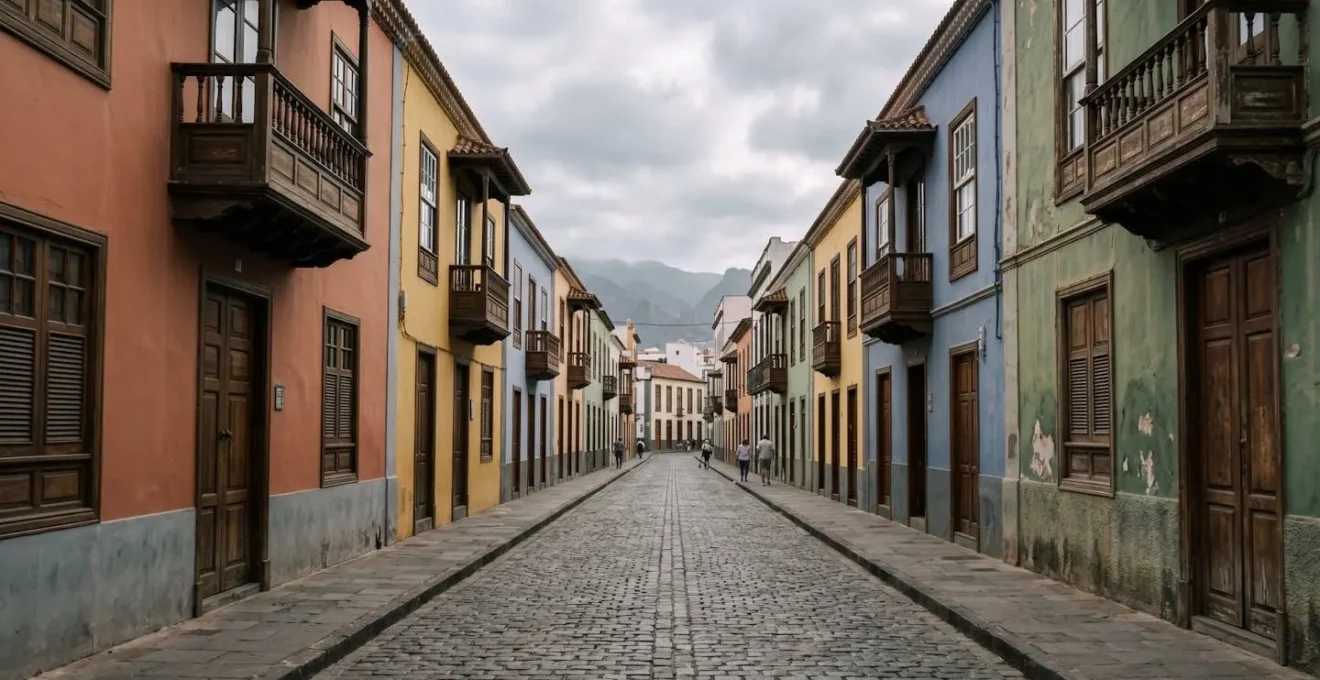
To truly capture the essence of San Cristóbal de La Laguna, a photographer must look beyond the beautiful facades. This guide reveals that the city’s photographic soul lies not in its picturesque scenes, but in understanding the historical narrative told by its specific colours, the dialogue between volcanic stone and pine, and the unique quality of its high-altitude light. Mastering this context transforms your images from simple postcards into compelling visual stories.
As a photographer in Tenerife, the call of the ocean is strong. But on a day when diving is not on the agenda, the island offers another world of depth to explore: the UNESCO World Heritage city of San Cristóbal de La Laguna. It’s easy to wander its grid-like streets and snap photos of the vibrant buildings and famous balconies. Many guides will point you to the main plazas and tell you to wake up for the « golden hour, » but this advice barely scratches the surface.
This approach often results in images that are beautiful, yet interchangeable with other colonial towns. They capture the « what » but miss the « why. » What if the key to truly memorable photographs of La Laguna wasn’t just finding the best viewpoints, but understanding the story behind the aesthetics? What if the colour palette was a map of 17th-century trade, and the texture of a wooden balcony was a testament to a unique botanical resilience?
This guide offers a different perspective. We will move beyond the postcard shot to delve into the historical and material DNA of the city. We’ll explore how to read the architectural language, anticipate the specific qualities of its light, and use its unique, misty atmosphere to our advantage. By the end, you won’t just see a colourful street; you will see a canvas of history, and you’ll have the knowledge to capture its soul, not just its surface.
This article provides a structured approach for the discerning photographer. Below, a summary outlines the key aspects we will explore to transform your understanding and your images of La Laguna.
Summary: A Photographer’s Journey into the Soul of La Laguna’s Architecture
- Why Are Canarian Houses Painted in Such Bright Distinctive Colours?
- Stone vs Wood: Identifying the Materials of the 16th Century
- Golden Hour in La Laguna: When Do the Streets Glow Best?
- Patio Secrets: How to Peek Inside Private Historical Courtyards Respectfully?
- The Risk of Fog and Chill in La Laguna Compared to the Coast
- When to Photograph the Walls for Maximum Texture Relief?
- Baroque vs Neoclassical: Distinguishing Balcony Styles in Orotava
- The Pine Wood Balconies of Tenerife: Why Are They So Famous?
Why Are Canarian Houses Painted in Such Bright Distinctive Colours?
The vibrant hues of La Laguna’s facades are not a modern tourist-driven affectation; they are a direct visual link to the city’s past as a crucial hub in the Spanish colonial empire. The choice of colour was a powerful statement of wealth and access. While simple ochre and white washes were common and used locally available materials, the more brilliant reds, blues, and greens were often derived from expensive pigments. These pigments had to be imported, reflecting the homeowner’s social standing and connection to international trade routes.
For a photographer, this « pigment economy » adds a layer of narrative to every shot. A deep red wall isn’t just red; it’s a symbol of cochineal trade or imported earth pigments. This historical context is supported by modern research; a scientific analysis of a 17th-century mural in a similar Spanish colonial setting identified five distinct colours, linking their chemical makeup to socio-economic hierarchies. When you frame a shot, you are not just composing with colour, but with the echoes of a global trade network.
The intensity of these colours also varies across the archipelago. As Buzztrips Travel Writers note in their overview on the « The colonial charm of the Canary Islands, » some islands developed distinct palettes. While they observe that « La Palma’s colonial buildings tend to be more colourful, » this comparison allows a photographer in La Laguna to focus on the specific shades—the earthy ochres, deep greens, and rich reds—that define its unique character, capturing a specific dialect in the Canaries’ shared architectural language.
Stone vs Wood: Identifying the Materials of the 16th Century
Beneath the layers of colourful lime wash, the architectural identity of La Laguna is defined by a fundamental dialogue between two materials: dark, porous volcanic stone and the warm, resilient heartwood of the Canary Island Pine, or ‘Téa’ wood. Photographing this city is an exercise in capturing the textural and tonal conversation between these two elements. The stone, often a dark grey or black basalt, forms the robust corners (esquinas), door frames (portadas), and foundational layers of the buildings. Its porous, pitted surface tells a story of geological turmoil, a constant reminder of the volcanic island’s origins.
In contrast, the ‘Téa’ wood offers a warm, organic counterpoint. This remarkable wood, harvested from the heart of ancient pines, is naturally saturated with resin. This high resin content makes it extraordinarily durable, capable of lasting for hundreds of years without chemical treatment and resistant to rot and insects. Photographically, it presents as a material with a deep, honey-caramel to reddish hue, its grain glowing under the sun. This material is used for the iconic balconies, intricate latticework (celosías), and structural ceiling beams.
The true photographic challenge lies in capturing the junction where these two materials meet. A close-up shot that frames the rough, dark stone against the smooth, warm grain of the pine can create a powerful abstract composition. This is where you find the material dialogue of La Laguna. It’s a visual narrative of the island itself: the hard, unyielding volcanic landscape tamed and shaped by human craftsmanship using the island’s unique and enduring timber.
Golden Hour in La Laguna: When Do the Streets Glow Best?
The concept of « golden hour » is universal in photography, but in La Laguna, its application requires specific, local knowledge. Due to the city’s grid layout, a legacy of its 16th-century design as a colonial model, the sun’s low-angled light behaves in predictable yet beautiful ways. The east-west and north-south orientation of the streets means that at sunrise and sunset, entire laneways are transformed into corridors of light, creating dramatic chiaroscuro effects perfect for photography.
During the morning golden hour, streets like Calle San Agustín and Calle Obispo Rey Redondo are particularly rewarding. The rising sun from the east illuminates the colourful facades, making the pigments glow with an intense saturation. This is the time for clean, architectural shots, capturing the pristine details of mansions before the city fully awakens. The evening golden hour offers a different character. The light, now coming from the west, often bathes the Plaza del Adelantado in a warm, soft glow, ideal for capturing the atmosphere around the Convento de Santa Catalina or the ornate stone facades of palaces like Casa Salazar.
However, the most sophisticated photographers look for more than just direct light. As noted in a discussion by photographers on DPReview, the magic often happens on the other side of the street. Lance H insightfully points out that when « a row of buildings illuminated by that low light reflect it to the other side of the street. Those illuminated buildings become a gigantic softbox for urban portraits. » For a photographer in La Laguna, this means turning your back on the sunlit side to find beautifully diffused, colour-cast light on the buildings in shadow, creating the perfect setting for environmental portraits or subtle architectural details.
Patio Secrets: How to Peek Inside Private Historical Courtyards Respectfully?
Some of La Laguna’s greatest architectural treasures are hidden from the street. The traditional Canarian house is designed to look inward, organised around a central patio or courtyard. These private spaces are lush, tranquil oases filled with plants, fountains, and intricate tile work, offering a stark contrast to the formal public-facing facades. For a photographer, these patios represent the secret heart of the city, but accessing them requires respect and ingenuity, as the vast majority are private residences.
The key is to adopt a strategy of ethical and respectful photography. The most important rule is to never enter private property. Instead, learn to use the architectural features designed for transition. The ‘zaguán’—a short, often arched entrance hallway—is your best friend. From the public street, you can often frame a beautiful, layered composition by shooting through the dark zaguán into the sunlit patio beyond. This creates a natural vignette and a sense of discovery, all while maintaining a respectful distance.
To experience these spaces without crossing any boundaries, focus on publicly accessible historic buildings. Institutions like the Museo de la Historia de Tenerife (located in the Casa Lercaro) and the Casa de los Capitanes Generales are not just museums; they are perfectly preserved examples of colonial mansions with stunning, accessible courtyards. Visiting them provides an authentic atmosphere and countless photographic opportunities, from the details of the wooden galleries to the interplay of light and shadow on the tiled floors, all without a single privacy concern.
The Risk of Fog and Chill in La Laguna Compared to the Coast
A photographer visiting Tenerife for its sun-drenched coasts will be immediately struck by La Laguna’s distinct microclimate. Situated on a plateau at around 550 meters (1,800 feet), the city is often significantly cooler and more humid than the southern resorts. What many tourists perceive as a « risk »—the frequent appearance of cloud, mist, or even a light drizzle (‘la panza de burro’ or ‘the donkey’s belly’)—is, for the prepared photographer, a remarkable opportunity.
This atmospheric moisture should be embraced as an active element in your compositions. Fog and mist act as a giant natural diffuser, softening the harsh midday sun and creating an ethereal, moody light. This diffused light is incredibly flattering for portraits and has the wonderful effect of desaturating the background while making the vibrant colours of the colonial facades pop with even greater intensity. A street scene that might look busy and cluttered on a clear day can be transformed into a simple, graphic composition by a veil of mist, isolating your subject and adding a profound sense of depth and mystery.
As experienced travel photographers recommend, this unique climate is a key reason to visit early in the morning. A testimonial on Voyagefox highlights this, noting that the cooler mountain climate creates « distinctive photographic opportunities with morning mist and diffused light that enhance the vibrant colors. » Rather than waiting for the sun to burn through the clouds, the savvy photographer arrives early to capture this atmospheric texture. It’s a chance to photograph La Laguna in a state that feels ancient and timeless, the cobblestone streets slick with moisture, the colours of the walls deep and rich against the soft grey of the fog.
When to Photograph the Walls for Maximum Texture Relief?
After considering colour, material, and atmosphere, the final element for the discerning photographer is texture. The ancient walls of La Laguna, whether rough volcanic stone or centuries-old plaster, are canvases of texture. Capturing this tactile quality, however, requires a deliberate and precise approach to lighting. The key is to use ‘raking light’—light that strikes a surface at a very low angle—to create long shadows across every tiny imperfection, crack, and grain, transforming a flat surface into a three-dimensional landscape.
This effect is most pronounced during two specific windows of the day: the first 30 minutes after sunrise and the last 30 minutes before sunset. During these times, the sun is so low in the sky that its rays skim across the vertical surfaces of buildings. To maximize this effect, you should position yourself so the light is coming from the side (perpendicular to your lens axis). A wall that appears flat and uninteresting in the high-noon sun will suddenly reveal a rich tapestry of detail under this raking light. Every bump in the plaster and every pit in the volcanic stone will cast a micro-shadow, creating the ‘texture relief’ you are seeking.
There is another, more opportunistic moment to hunt for texture: the brief window just after a rain shower. When the walls are still damp, the water darkens the stone and plaster, increasing contrast. It also creates a subtle sheen on the surface that can catch the light, further enhancing the perception of depth and texture. To capture these fine details with maximum clarity, it’s often best to use a sharp prime lens, such as a 50mm or 85mm, which can render the minute details more effectively than a standard zoom lens.
Your Action Plan: Timing Guide for Maximum Texture
- Identify the post-sunrise window: Target the 30-minute period after sunrise for low-angle light that creates long, texture-revealing shadows on walls.
- Target the pre-sunset period: Use the 30 minutes before sunset for similar low-angle light conditions that produce dramatic shadow play and depth.
- Exploit the post-rain advantage: Shoot within 15-30 minutes after a shower, when damp walls provide enhanced contrast and reflective sheen.
- Choose side-on shooting angles: Position yourself perpendicular to the wall, not straight-on, to maximize the depth of the shadows.
- Use prime lenses: Opt for a 50mm or 85mm lens at f/2.8-f/5.6 to achieve superior sharpness and capture fine textural details.
Baroque vs Neoclassical: Distinguishing Balcony Styles in Orotava
While the famous balconies are a hallmark of Canarian architecture, not all are created equal. For a photographer looking to add depth to their portfolio, learning to distinguish between the two dominant styles—Baroque and Neoclassical—is like learning to read the architectural DNA of the city. Though this guide focuses on La Laguna, the nearby town of La Orotava is often cited for its pristine examples, and the principles apply across the historic towns of Tenerife. The ability to spot these differences allows you to frame your shots with intent, highlighting the specific features that define each era.
The Baroque style (17th-18th centuries) is all about drama, ornamentation, and movement. Photographically, you are looking for curves, complexity, and a sense of handmade irregularity. The balustrades will feature elaborately turned spindles, and the ‘celosía’ latticework will be dense and intricate, inspired by Moorish designs. The support brackets (‘corbels’) are often sculptural and oversized. To capture the Baroque spirit, you need to get close and focus on these ornate details, using side lighting to emphasize the depth of the carvings. A prime example is the Casa de Los Balcones, which a study of 17th-century construction highlights as a quintessential representation of Canarian pine craftsmanship.
The Neoclassical style (19th-20th centuries), in contrast, was a reaction against Baroque excess. It emphasizes order, symmetry, and restrained geometry. Here, your photographic compositions should be clean, balanced, and often symmetrical. Look for uniform vertical posts, precise linear patterns, and simplified geometric grids in the latticework. These balconies are also more likely to be painted in vibrant colours to match the facade, a feature particularly common in La Laguna. Even, diffused light is often best for Neoclassical balconies, as it emphasizes their clean lines and geometric purity without the distraction of dramatic shadows.
This comparative table will help you identify the key features of each style while in the field.
| Architectural Feature | Baroque Style (17th-18th c.) | Neoclassical Style (19th-20th c.) |
|---|---|---|
| Overall Design Philosophy | Ornate, curved, highly decorative, dramatic | Symmetrical, geometric, simple lines, restrained |
| Balcony Balustrade | Elaborate turned spindles, irregular spacing, flowing curves | Uniform vertical posts, precise symmetry, linear patterns |
| Celosía (Latticework) | Complex Moorish-inspired patterns, dense interlacing, ‘seeing without being seen’ function | Simplified geometric grids, ordered repetition, minimal ornamentation |
| Wood Treatment | Natural ‘Tea’ wood finish with rich honey-caramel tones (especially Orotava) | Often painted in vibrant colors matching facade (especially La Laguna) |
| Corbel/Bracket Support | Sculptural, oversized, sometimes figurative or vegetal motifs | Minimal, geometric, purely functional design |
| Photography Challenge | Requires detail shots to capture ornamental complexity; dramatic side lighting enhances depth | Benefits from straight-on symmetrical compositions; even lighting emphasizes clean geometry |
Key takeaways
- The fame of Tenerife’s balconies stems from the unique ‘Téa’ wood, which is naturally rot-resistant due to its high resin content.
- These balconies are not just architectural features but powerful symbols of Canarian cultural identity, status, and historical trade connections.
- The wood’s properties are so exceptional that it was historically used for other long-lasting applications, such as wine barrels.
The Pine Wood Balconies of Tenerife: Why Are They So Famous?
The wooden balconies of Tenerife, particularly those in La Laguna and La Orotava, have transcended their architectural function to become an iconic symbol of Canarian identity. As one cultural overview on Tenerife Connect notes, they are as emblematic of the islands as Mount Teide. Their fame is rooted in a combination of cultural history, social symbolism, and the extraordinary properties of the material from which they are made: the Canary Island Pine, or ‘pino tea’.
The secret lies in the wood itself. The Plantiary botanical database explains that « The wood of the Canary Island Pine, known locally as pino tea, is so saturated with resin that it is naturally resistant to rot and wood-boring insects. » This natural durability is why centuries-old balconies have survived with minimal maintenance, developing a deep, weathered patina that is a dream for photographers. The wood’s unique properties were so valued that it was used for other items requiring longevity; for example, many traditional ‘tea’ wood wine barrels are over a hundred years old, a testament to the wood’s resilience.
Historically, the presence of a large, ornate balcony was a clear sign of a family’s wealth and social status. Their design, a blend of Portuguese, Andalusian, and even Flemish influences, speaks to Tenerife’s history as a crossroads of Atlantic trade. The intricate latticework, or ‘celosía’, served a dual purpose: it allowed for ventilation while enabling the women of the house to observe the street below without being seen, a custom with Moorish roots. For a photographer, this means a balcony is never just a balcony; it is a layered story of botany, status, culture, and history, all encapsulated in a single, beautiful structure.
Now that you can read the stories etched in La Laguna’s walls, wood, and light, your camera is no longer just a tool for documentation but a device for interpretation. The final step is to synthesize this knowledge and begin crafting your own visual narrative of this historic city.