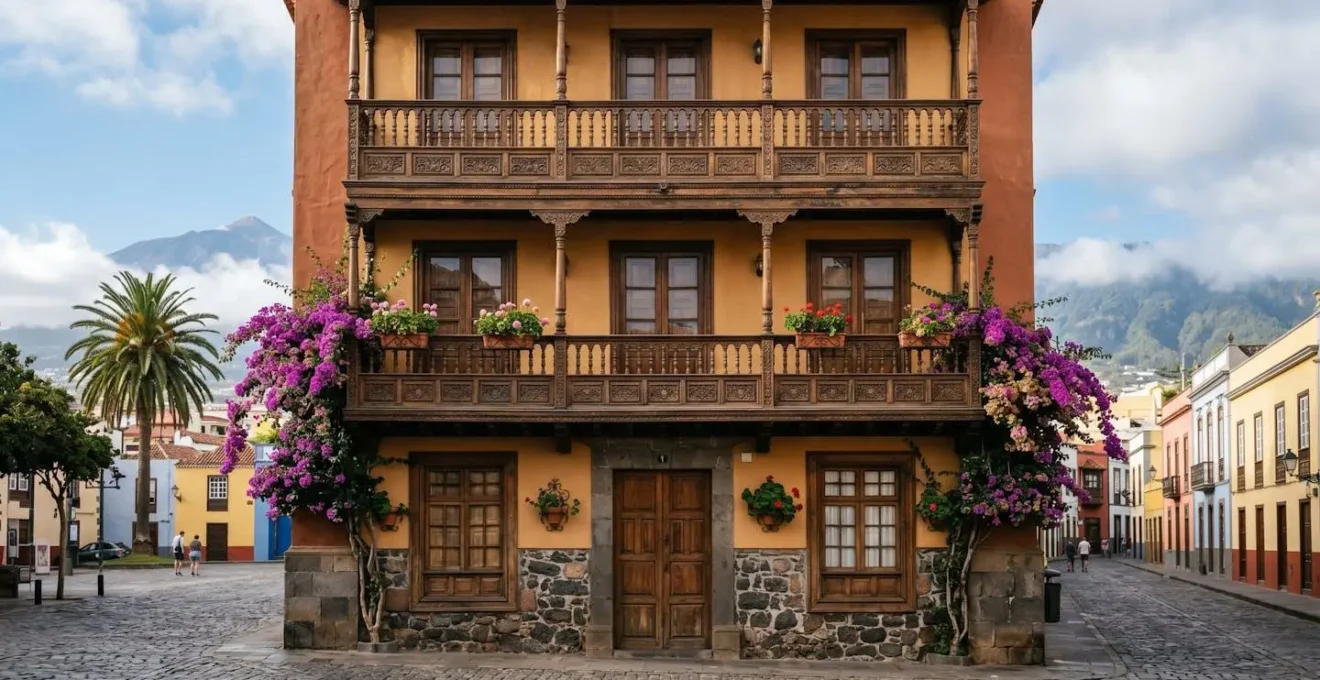
The enduring fame of Tenerife’s balconies is not just about beauty; it is a story carved directly into a remarkable material: the resin-rich heartwood of Canarian Tea Pine.
- This unique timber, dense with resin, provides a natural, built-in defence against the insects and humidity that would destroy lesser woods.
- The craftsmanship tells a story of history and status, from the opulent floral carvings of the Baroque era to the stark simplicity of rural homes.
Recommendation: To truly appreciate these structures, learn to ‘read’ the wood itself. It is the only way to distinguish a centuries-old treasure from a modern replica.
When you walk through the historic towns of Tenerife, from La Orotava to Garachico, your eyes are inevitably drawn upward. They are a defining feature, a signature of the island’s identity. But to see them merely as decorative is to miss the story they tell. As a carpenter who has spent a lifetime with wood, I can tell you that these are not just balconies. They are masterclasses in material science, history, and craftsmanship, all condensed into a single architectural element.
Many guides will point you to the most famous examples, and rightly so, but they often stop at the surface. They speak of beauty but not of the wood’s inherent genius. They mention history but not the subtle language of the chisel marks. The real secret to their longevity and fame lies in a dialogue between an extraordinary local resource—the Canarian Pine—and the skilled hands that knew precisely how to work it. This isn’t just about architecture; it’s about understanding a sustainable relationship between people and their environment, a relationship that has endured for centuries.
This guide will take you beyond the picturesque facade. We will delve into the very fibres of the wood to understand its unique properties. We will learn to distinguish the stylistic flourishes that speak of different eras, understand the balcony’s role in the social fabric, and appreciate the immense effort required to preserve this heritage today. By the end, you won’t just see a balcony; you’ll see a story.
This article explores the deep history and craftsmanship behind Tenerife’s most iconic architectural feature. Follow along as we unpack the secrets held within the wood.
Summary: A Carpenter’s Guide to the Wooden Balconies of Tenerife
- Why Canarian Pine (Tea) Is Termite Resistant and Fire Proof?
- Baroque vs Neoclassical: Distinguishing Balcony Styles in Orotava
- Surveillance vs Ventilation: What Were Balconies Used For Historically?
- The Cost of Maintaining a Historical Wooden Façade Today
- Where to Find the Most Elaborate Balconies Outside of the Guidebooks?
- Stone vs Wood: Identifying the Materials of the 16th Century
- Traditional Canarian Houses vs Concrete Hotels: Identifying the Real Deal
- Exploring La Laguna: A Photographer’s Guide to Colonial Colours
Why Canarian Pine (Tea) Is Termite Resistant and Fire Proof?
The true hero of this entire story isn’t an architect or a wealthy patron; it’s the wood itself. Specifically, the heartwood of the Pinus canariensis, known locally as ‘Tea’. This isn’t your average pine. Over centuries, the tree develops a core so dense and saturated with resin that it becomes almost fossilized. This isn’t just wood; it’s a natural composite material, and its properties are what have allowed these balconies to defy time, pests, and even fire.
The immense concentration of resin acts as a potent, built-in preservative. It makes the wood incredibly resistant to rot and fungal decay in the island’s humid microclimates. More importantly, it is a powerful deterrent to wood-boring insects like termites. The aromatic oils and resins are simply unpalatable to them. As experts in pest control note, this is a common principle in naturally resilient woods. For instance, in a similar vein, Ehrlich Pest Control explains how other woods achieve this resilience:
Cedar contains natural resins and aromatic oils that deter many insects, including termites. While it’s more resistant than many other woods, cedar can still be attacked if it becomes damp or weathered over time.
– Ehrlich Pest Control, Termite-Resistant Wood: What Types of Wood Do Termites Avoid?
Canarian Tea pine takes this principle to an extreme, with its resin content being far higher than most other commercial pines. This resinous heartwood gives it its characteristic dark, reddish-brown colour and its remarkable weight. While no wood is completely fireproof, the high density and resin content of Tea wood mean it chars on the surface, creating a protective layer that slows combustion significantly, giving it a surprising degree of fire resistance. It is this natural durability that made it the material of choice, a perfect marriage of local resources and practical needs.
Baroque vs Neoclassical: Distinguishing Balcony Styles in Orotava
Once you understand the wood, you can begin to ‘read’ the work of the hands that shaped it. The streets of La Orotava are a living museum of woodworking styles, primarily showcasing a shift from the exuberant Baroque of the 17th and 18th centuries to the more restrained Neoclassical that followed. As a craftsman, you learn to spot the difference not in books, but in the tool marks and design choices.
The Baroque style is a celebration of skill and opulence. Look for deep, intricate carvings. The brackets (canecillos) and spindles are not just functional; they are canvases for the artisan’s chisel. You’ll see complex floral motifs, acanthus leaves, volutes, and sometimes even cherubs or fantastical faces. The overall effect is one of movement, drama, and a desire to display wealth and artistry. There is a sculptural quality to a Baroque balcony; every surface seems to have been touched by a carving tool.
A supreme example is the world-famous Casa de los Balcones. As noted in its historical descriptions, this house, built in 1632, is considered the pinnacle of baroque wooden balcony craftsmanship. The magnificent, continuous balcony on the upper floor is a masterpiece of carved Tea pine, showcasing the very floral and figurative details that define the style. In contrast, the Neoclassical style is a reaction against this exuberance. It favors straight lines, geometric patterns, and a sense of order and symmetry. The carvings are shallower, more repetitive, and less ornate. The focus shifts from showcasing sculptural skill to creating an elegant, harmonious facade. Reading these stylistic differences in the wood is like listening to a conversation across centuries.
Surveillance vs Ventilation: What Were Balconies Used For Historically?
A balcony is never just a platform. It’s a liminal space, a bridge between the private interior and the public exterior. To understand their historical function, you have to think about the life of the house. In a time before air conditioning, these structures were essential for natural ventilation, allowing cool breezes to circulate through the house via the central patio, creating a comfortable living environment. The slatted floors (pisos de tablazón) and latticed screens (celosías) were not just decorative; they were functional elements of a passive cooling system.
But their function was equally social. The balcony was the family’s box seat to the theatre of street life. From here, one could observe processions, festivals, and the daily comings and goings of the community. It was a space for socializing with neighbours across the narrow streets. However, this outward gaze was often controlled. The latticework, or ‘jealousy screens’, allowed those inside (typically the women of the house) to see out without being seen, a feature borrowed from Moorish architectural traditions.
Case Study: Balconies as a Language of Power
Beyond their practical uses, Canarian balconies were potent expressions of social standing. According to research on colonial life in Tenerife, the balcony was a family’s public face, a direct and visible declaration of their wealth and influence. The finest mansions, belonging to the landed gentry, featured authentic works of art in carved wood. The size, the intricacy of the carving, and the use of expensive Tea heartwood on the main facade of the ‘planta noble’ (noble floor) were all carefully calibrated to demonstrate sustained social power. A simpler, coarser balcony on a more humble home told a different story. In this way, a walk through a historic town was a lesson in the local social hierarchy, written not in words, but in wood.
So, the balcony was a complex, multi-functional device. It was an air conditioner, a television, a social network, and a status symbol, all in one. Its design reflects a sophisticated understanding of climate, social norms, and human psychology.
The Cost of Maintaining a Historical Wooden Façade Today
The resilience of Tea pine is legendary, but nothing is eternal. Preserving these centuries-old wooden structures is a continuous and costly commitment, requiring not just money, but a dwindling resource: master craftsmen with traditional knowledge. The cost isn’t just in materials; it’s in the skilled hands that know how to repair a 300-year-old joint or replicate a Baroque carving using period-appropriate techniques.
Public institutions recognize this. The Cabildo of Tenerife has made significant financial commitments to safeguard this heritage. For instance, it was recently announced that a substantial programme would support preservation efforts across the island. According to the Cabildo’s plan, an investment of €1.6 million has been allocated for the 2023-2027 period for the conservation of historical heritage, a fund that directly benefits the upkeep of these facades. This public investment is crucial for maintaining the island’s unique architectural character.
For private owners, the responsibility is immense. Restoring a historic wooden facade is not a standard construction job. It’s a specialist task that can be as expensive as building a new high-end home. While figures vary greatly, some experts estimate that, broadly speaking, such restorations can run into many hundreds of euros per square metre. This cost reflects the painstaking, labour-intensive process of sourcing appropriate aged wood, carefully removing damaged sections, and crafting replacement parts that are both structurally sound and aesthetically invisible. It is a testament to the dedication of many Tinerfeños that so many of these irreplaceable assets are still with us today, a living legacy maintained by passion and significant financial outlay.
Where to Find the Most Elaborate Balconies Outside of the Guidebooks?
While La Orotava deservedly holds the crown for its spectacular collection of balconies, the true enthusiast knows that hidden gems are scattered across the island. To find them, you need to step off the main tourist trail and wander the quieter historic centres. These lesser-known examples often possess a raw authenticity, showing their age with a proud patina and visible repairs that tell a story of longevity.
In Garachico, for instance, a town reborn after a volcanic eruption in 1708, the restored cobblestone streets are lined with 17th and 18th-century merchant houses. Look for the solid, handsome balconies here, which reflect the town’s history as a major port. The recent investment in heritage conservation in this area ensures its architectural character is preserved. Head towards the coast and let your eyes wander upwards. In Icod de los Vinos, famous for its Dragon Tree, a stroll along Calle San Agustín reveals mansions with distinct Portuguese influences in their woodwork, including more slender, turned spindles.
Don’t overlook Los Realejos, one of the oldest settlements on the island. The area around the historic town hall (Ayuntamiento) and its adjacent streets is a treasure trove of authentic, lived-in architecture. Here, the balconies may not be as opulent as in La Orotava, but they are honest. You can see the weathering, the traditional repair marks—the signs of a structure that has been serving its family for generations. Finally, while La Laguna is hardly a secret, venture beyond the main thoroughfares like Calle Obispo Rey Redondo. Dive into the smaller side streets of this UNESCO World Heritage zone to discover hundreds of preserved colonial buildings, many with vibrant painted balconies that contrast beautifully with the dark Tea wood.
Stone vs Wood: Identifying the Materials of the 16th Century
A Canarian manor house is a symphony of materials, and wood, for all its glory, is just one instrument in the orchestra. To understand its role, you must look at its relationship with stone. As a woodworker, I have a deep respect for the stonemason’s craft. In the 16th and 17th centuries, the choice of material was a deliberate statement, creating a visual language of wealth, power, and practicality. The facade was a canvas where a family displayed its status to the world.
The foundation and ground floor of these noble houses were almost always built from heavy, dark volcanic stone, often basalt. This provided a strong, solid base, excellent thermal mass for keeping the interior cool, and a sense of permanence and connection to the earth. It was the material of strength and security. Above this solid base, the ‘planta noble’ or main floor is where the artistry truly began. This is where the family lived and entertained, and where the most expensive and expressive materials were used.
Case Study: The Material Hierarchy of Casa Lercaro
The 17th-century Casa Lercaro in La Orotava is a perfect illustration of this strategic use of materials. Its facade is a masterclass in communicating wealth. It starts with a strong stone base. As you move up, the walls feature delicate sgraffito latticework decoration. The windows and side balconies are framed with elaborate Tea woodwork, showcasing the family’s investment in fine craftsmanship. But for the central, most prominent balcony, a different material is chosen: wrought iron, embellished with intricate floral designs. To top it all off, the family’s coat of arms, carved from precious marble, crowns the entire structure. This careful progression—from local volcanic stone to artisan wood, then to forged metal and finally to imported marble—created an unmistakable and sophisticated visual language of social and economic hierarchy.
This dialogue between the robust, heavy stone below and the lighter, intricately carved wood above is a hallmark of traditional Canarian architecture. One provides the unbreakable foundation, the other provides the expressive, human touch. They do not compete; they complement each other perfectly.
Traditional Canarian Houses vs Concrete Hotels: Identifying the Real Deal
In a landscape increasingly dotted with modern concrete structures, training your eye to spot ‘structural honesty’ is a rewarding skill. An authentic Canarian house is more than just a style; it’s a system, an integrated whole where every part has a purpose. A modern replica might copy the look, but it rarely understands the underlying logic. As a craftsman, I look for signs of genuine construction, not just decorative flourishes.
The first clue is the material itself. Authentic Tea pine or Laurel wood has a deep, rich grain and a natural patina that cannot be faked with paint or varnish. Look for the subtle imperfections of hand-carving and traditional joinery, not the perfect, machine-milled lines of a modern imitation. The weight and function are also key. A real Canarian balcony is a load-bearing structure, an extension of the house’s floor joists. It feels solid, permanent. Many modern ‘balconies’ are simply decorative facades, thin wooden screens bolted onto a concrete slab, lacking any structural integrity.
The overall form of the building is another giveaway. Traditional houses are organized around a central open-air patio, the heart of the home that provides light and ventilation to all the surrounding rooms. This is a fundamental design principle that is often absent in modern constructions. By learning to look for these key architectural and material clues, you can move beyond the surface and start to differentiate the living history from the theatrical backdrop.
Your Action Plan: The Authenticity Checklist
- Check for the Central Patio: Does the building have an open-air Canarian patio (L-shaped or square) around which the rooms are arranged? This is a primary sign of traditional design for ventilation.
- Inspect the Wood Grain: Look closely at the balconies and window frames. Is it genuine Tea Pine or Laurel wood with a visible, deep grain and natural patina? Or is it a flat, painted-on imitation?
- Examine the Roof Tiles: Look for traditional ‘teja curva’—curved terracotta clay tiles. Flat, modern, or concrete tiles are a clear sign of a newer or heavily modified building.
- Assess the Wall Thickness: Are the ground floor walls made of thick (40-60cm) volcanic stone? This provides thermal mass and structural integrity, a feature rarely replicated in modern builds.
- Observe the Balcony’s Function: Is the balcony structurally integrated and accessible, clearly able to bear weight? Or is it a purely decorative facade, a thin screen with no real function?
Key Takeaways
- The secret to the balconies’ longevity is the resin-saturated heartwood of the Canarian Pine (‘Tea’), which is naturally resistant to pests and fire.
- Balcony styles tell a story: the ornate, sculptural carvings of the Baroque period represent a display of wealth, while the cleaner lines of Neoclassicism show a shift in aesthetic values.
- Authentic Canarian architecture is a complete system, identifiable by features like a central patio, thick stone walls, and structurally-sound balconies, not just surface decoration.
Exploring La Laguna: A Photographer’s Guide to Colonial Colours
To walk through San Cristóbal de La Laguna is to walk through the blueprint for the Americas. As a UNESCO World Heritage site, it is recognized not just for its beauty, but for being the first non-fortified colonial city with a grid layout—a model that was exported across the Atlantic. This innovative 15th-century plan remains remarkably intact. According to UNESCO documentation, the city’s protected historical centre contains an astonishing collection of heritage architecture, with some 627 historic buildings preserved in their original context.
For a photographer, or anyone with a keen eye, the city is a masterclass in colour, texture, and light. But the ‘colours’ of La Laguna are not just about the vibrant paint on the plaster walls—the ochres, terracottas, and indigo blues. The most important colour is the deep, warm, and honest brown of the Tea pine woodwork. The true visual delight comes from the contrast: the play of the dark, rich wood of the balconies, doors, and window frames against the brightly painted facades. This is where the city’s character comes alive.
To capture this, don’t just take wide shots. Get close. Focus on the texture contrast, where the smooth, painted plaster meets the deep, weathered grain of a centuries-old wooden beam. Use the covered arcades, the ‘soportales’, to frame distant balconies, creating layers and depth. Notice how the famous ‘mar de nubes’ (sea of clouds) that often blankets the city acts as a giant softbox, providing soft, even light that saturates the colours and eliminates harsh shadows. It’s the perfect light for revealing the story written in the wood—the subtle tool marks on a door knocker, the patina on an iron hinge, the intricate joinery of a corner post. This is how you photograph the soul of the city: by focusing on the dialogue between materials.
By learning to see the world through a craftsman’s eyes, you can unlock a deeper appreciation for this unique architectural heritage and begin to identify these timeless details on your own.