The popular stingray « encounter » at Los Cristianos is not a magical interaction with nature; it is a dangerous, man-made circus that inflicts profound and lasting harm on the animals it exploits.
- Organized feeding completely reverses stingrays’ natural nocturnal hunting patterns, creating a dependent and stressed population.
- The « feeding frenzy » environment dramatically increases the risk of injury, with fed rays being nearly three times more likely to be harmed.
- Touching rays strips them of their protective mucus layer, causing « biological sabotage » by exposing them to fatal infections.
Recommendation: As a conscious diver, you must actively boycott these feeding operations and instead choose dive centers that champion ethical, observation-only encounters that respect marine life.
The images are alluring: divers kneeling on the sandy bottom off Los Cristianos, surrounded by a ballet of graceful stingrays. It’s marketed as a once-in-a-lifetime chance to get close to these majestic creatures. Many well-meaning divers, hearing the common advice to « be careful » and « don’t touch, » believe they are participating in a harmless activity. They are told it’s a great way to guarantee a sighting, a reliable thrill in the vast blue.
But what if this entire spectacle is a lie? What if the guarantee comes at a cost so high it threatens the very animals we’ve come to admire? The truth is, the practice of feeding stingrays is not a benign interaction. It is a fundamental corruption of an ecosystem, a form of biological sabotage that prioritizes a fleeting tourist experience over the long-term health and integrity of marine wildlife. This is not an encounter; it is a staged performance, and the animals are its unwilling, and often suffering, stars. It is time for us, the diving community, to stop being passive spectators and become active defenders of the ocean’s true nature.
This article exposes the devastating reality behind the feeding circus. We will deconstruct the damage caused by this practice and provide a clear path forward for those who wish to be true allies to the marine world, showing you how to experience the magic of Tenerife’s underwater realm without contributing to its destruction.
Summary: The Destructive Reality of Stingray Feeding
- Why Organized Feeds Alter the Natural Hunting Behavior of Rays?
- How to Observe Stingrays Naturally Without Baiting Them?
- Stingray vs Eagle Ray Behavior: Which Is More Likely to Approach?
- The Danger of Barbed Tail Injuries in Frenzied Feeding Situations
- Which Dive Sites Offer Natural Ray Encounters Away from the Circus?
- Why Are Certain Coastal Zones Off-Limits to Recreational Divers?
- The ‘No Touch’ Rule Explained: Why Mucus Layers Matter?
- How to Ensure Your Marine Encounters Don’t Harm the Animals?
Why Organized Feeds Alter the Natural Hunting Behavior of Rays?
The core of the problem lies in a process we must call by its true name: behavioral corruption. Wild animals operate on instincts honed over millennia. Organized feeding shatters these instincts in a single generation. Stingrays are naturally nocturnal or crepuscular hunters, using their highly developed senses to find prey hidden in the sand under the cover of darkness. The tourist circus at Los Cristianos forces them into a diurnal, or daytime, schedule dictated entirely by the arrival of boats and paying customers.
This is not a harmless adaptation; it is a complete hijacking of their biological rhythm. A landmark study on the fed stingray population at Stingray City in Grand Cayman provides chilling evidence of this transformation. Researchers found that supplemental feeding completely reversed the rays’ natural activity patterns. The population became unnaturally dense, dominated by females who abandoned their natural migratory behaviors to remain in the small feeding area. This dependency erodes their ability to hunt for themselves, creating a welfare-dependent colony that is less resilient to environmental changes and disease.
This conditioning isn’t unique to rays. Parallel research on marine mammals has demonstrated that conditioned animals are significantly more likely to be injured or killed through human interaction. By teaching a wild animal that humans are a food source, we erase their natural caution and lure them into a cycle of dependency and danger. It is an act of profound ecological irresponsibility.
Ultimately, a fed ray is no longer a truly wild animal. It has become a performer in a spectacle, its natural life sacrificed for the sake of a photograph.
How to Observe Stingrays Naturally Without Baiting Them?
The alternative to the tourist circus is not to avoid stingrays, but to become a Conscious Observer. This requires a fundamental shift in mindset: from seeking a guaranteed, close-quarters thrill to embracing the patience and privilege of witnessing a wild animal in its own environment, on its own terms. A true encounter is one where the animal chooses to be there, not one where it has been lured by a handout.
To achieve this, a diver must cultivate stillness and respect. It means perfecting your buoyancy to hover effortlessly above the seabed, minimizing your movements and your bubble output. It means becoming part of the landscape, an unobtrusive presence that allows marine life to go about its business undisturbed. The goal is to be so still, so patient, that the wildlife forgets you are there.
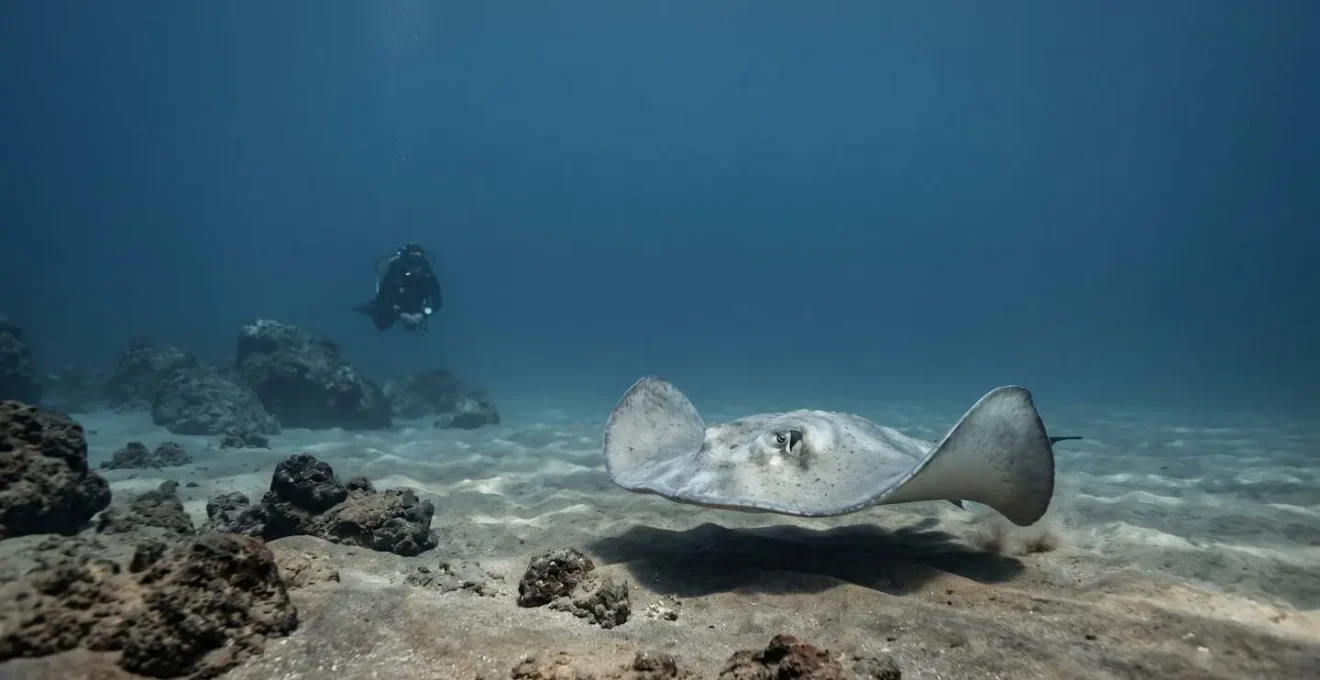
As the image above demonstrates, the art of the Conscious Observer is one of quiet waiting. When you remove the frantic energy of a feeding operation, you are rewarded with something far more profound: the sight of a stingray gliding gracefully over the sand, sifting for crustaceans, or resting under a fine layer of silt. This is the authentic behavior you came to see. By choosing not to participate in feeding, and telling operators why, you vote with your wallet for a more sustainable and ethical form of tourism.
The most magical encounters are never forced. They are earned through respect, patience, and a deep understanding that we are visitors in their world, not the main attraction.
Stingray vs Eagle Ray Behavior: Which Is More Likely to Approach?
Understanding the natural behavior of different ray species throws the artificiality of the Los Cristianos feeding scene into sharp relief. In a wild setting, a diver is far more likely to have a close encounter with a common stingray than a spotted eagle ray. This is not by chance; it is a product of their distinct anatomies and feeding strategies.
Common stingrays are bottom-feeders. Their mouths are located on their underside, perfectly designed for excavating crustaceans and mollusks from the sand. They are naturally curious about disturbances on the seabed, which could signal a potential meal. A diver resting calmly on a sandy patch might attract a curious stingray investigating the area. In contrast, eagle rays are pelagic, feeding in the mid-water column on different prey. Their natural instinct is to be wary of large, unfamiliar shapes below them.
However, the feeding circus completely rewrites these rules. As marine biology experts have noted, the conditioning process fundamentally alters the stingray’s core responses.
Eagle rays are notoriously shy and will almost always flee. Conditioned stingrays have a suppressed flight response, replacing it with a food-driven approach that can quickly turn defensive if they feel threatened.
– Marine biology diving experts, Manta Ray vs Stingray: Differences, Stingers & Dangers Explained
This is the crucial distinction: an unconditioned stingray’s approach is driven by curiosity, while a conditioned stingray’s approach is driven by expectation and demand. This transforms a potentially peaceful interaction into a transaction, one that can quickly escalate if the expected food is not provided. The animals at Los Cristianos are not « friendly »; they are habituated and demanding, a direct result of human interference.
By understanding what is natural, we can more clearly see what is a dangerous perversion of that nature.
The Danger of Barbed Tail Injuries in Frenzied Feeding Situations
Let’s be unequivocally clear: a stingray’s barb is a defensive weapon, used only as a last resort when it feels trapped or threatened. In a natural encounter, where a diver gives the animal space, the risk of injury is infinitesimally small. The ‘stingray shuffle’ taught to beachgoers exists for a reason: the most common incidents occur when someone accidentally steps on a buried ray. But the feeding circus at Los Cristianos creates a scenario that is anything but natural, dramatically amplifying the risk for both animals and humans.
When multiple, large animals conditioned to expect food are concentrated in a small area, it creates a chaotic and stressful feeding frenzy. Rays may bump into each other and into divers, and a perceived threat can come from any direction. In this high-stress environment, a defensive reflex can be triggered with tragic consequences. A stingray’s barb is not just a sharp point; it is serrated and coated in venom-secreting tissue, designed to cause a deep, ragged wound that is intensely painful and prone to infection.
The data paints a terrifying picture of the harm these feeding operations cause the rays themselves. According to a shocking scientific study, the probability of being injured was 85% for tourist stingrays compared to just 30% for those in non-tourist areas. They suffer from boat strikes, damaged fins, and skin lesions from excessive handling. We are not just creating a dangerous situation for ourselves; we are luring these animals into a zone of immense physical harm. While thousands of stingray injuries are reported globally each year, the unique danger at Los Cristianos is that it is a manufactured risk, created entirely for our entertainment.
Participating in a feeding dive is not a brave act of getting close to a dangerous animal; it is the reckless act of entering a chaotic, man-made hazard zone where the animals are the primary victims.
Which Dive Sites Offer Natural Ray Encounters Away from the Circus?
The most powerful action a diver can take is to reject the circus and seek out the authentic. Fortunately, Tenerife’s volcanic coastline is rich with dive sites where you can have beautiful, natural encounters with rays and a wealth of other marine life, all without a single scrap of bait.
Sites like Abades offer a gentle, sloping bay perfect for encountering common stingrays resting in the sand, often accompanied by green turtles. The authentic fishing village of El Poris provides a quieter dive, with volcanic rock formations that shelter moray eels and, if you’re patient, passing rays. For the more adventurous, the dramatic underwater walls of Los Gigantes are a prime location to spot majestic eagle rays gliding in the blue, alongside barracudas and endangered angel sharks. These are not guaranteed sightings, and that is precisely the point. The thrill comes from the possibility, from the privilege of a wild animal choosing to cross your path.
Choosing an ethical encounter starts with choosing an ethical operator. A responsible dive center will be proud of its no-feeding policy and will focus its briefings on animal welfare and respectful observation. They will prioritize small group sizes and guide you in the art of being a Conscious Observer. To ensure you’re making the right choice, you must become an investigator.
Your Action Plan: Vetting an Ethical Dive Operator
- Ask explicitly: ‘Do you feed or bait animals during dives?’ A reputable operator will have a clear and proud ‘no’ as their answer.
- Inquire about group sizes: Responsible centers keep groups small (ideally 6 divers or fewer) to minimize environmental impact and stress on wildlife.
- Analyze the briefing: Does the guide focus on conservation and animal welfare, or just on the entertainment value and getting a photo?
- Verify their philosophy: Look for language like ‘respectful observation’ and check if their guides have a background in marine biology or conservation.
- Look for eco-certifications: While not a guarantee, credentials like SSI’s ‘Mission Deep Blue’ or partnerships with conservation projects are positive signs.
Your money becomes a force for good, rewarding conservation-minded businesses and starving the ones that exploit the ocean.
Why Are Certain Coastal Zones Off-Limits to Recreational Divers?
The existence of strictly regulated marine areas in Tenerife serves as a powerful contrast to the free-for-all at some tourist dive sites. These zones are not off-limits to annoy divers; they are a desperate and necessary attempt to protect what remains of a fragile marine ecosystem. They are sanctuaries, living laboratories, and a crucial baseline against which we can measure the damage occurring elsewhere.
A prime example is the Teno-Rasca Marine Strip, a vast Special Conservation Area (ZEC) on Tenerife’s west coast. As part of the European Union’s Natura 2000 network, this area is recognized for its high ecological value. Its purpose, as stated in its designation, is to conserve threatened habitats and species, including resident populations of short-finned pilot whales and loggerhead turtles. Access and activities within this zone are strictly controlled, prioritizing the long-term survival of the ecosystem over short-term commercial or recreational interests.
These protected zones are an admission of a painful truth: that unregulated human activity, even when well-intentioned, can cause irreparable harm. They are established to give marine life a chance to breed, feed, and exist without the chronic stress of human interference. The very concept of a Marine Protected Area (MPA) is a direct rebuke to the philosophy that underpins the stingray feeding circus. One seeks to preserve wildness, the other seeks to tame and package it for consumption.
When you see a sign that says « No Entry, » it’s not a barrier; it’s a lifeline for the ocean, a testament to the fact that some places are more valuable left alone.
The ‘No Touch’ Rule Explained: Why Mucus Layers Matter?
The « no touch » rule is one of the first and most fundamental principles taught to any new diver, yet it is the one most flagrantly violated in feeding operations. The urge to connect with a wild animal through touch is understandable, but it is an act of profound, if often unintentional, biological sabotage. To understand why, you need to look beyond the visible and into the microscopic world of a fish’s primary defense system: its mucus layer.
This slimy coating, or biofilm, is not just a lubricant to help the fish move through water. It is a complex, living barrier packed with antifungal and antibacterial compounds. It is the animal’s external immune system, trapping pathogens and preventing them from reaching the skin. When you touch a ray, or any fish, you are stripping away this essential protection with the oils and bacteria on your hands. You are leaving it vulnerable to a host of infections that can sicken, and even kill it, long after you’ve posted your photo online.
Furthermore, the stress of being handled and living in a constant state of competition for food takes a devastating physiological toll. As extensive long-term research on provisioned bottlenose dolphins has shown, these interactions create chronic stress. The constant release of the stress hormone cortisol weakens the immune system, reduces reproductive success, and ultimately shortens lifespans. What we perceive as a moment of connection is, for the animal, a moment of physiological trauma.
Every time a hand reaches out to touch a ray during a feeding, it is not an act of affection. It is an assault on its immune system.
Key Takeaways
- Feeding operations cause « behavioral corruption, » turning wild, nocturnal hunters into dependent, diurnal performers.
- The risk of injury to fed stingrays skyrockets, with an 85% probability of harm compared to 30% for wild rays.
- Touching a ray inflicts « biological sabotage, » stripping its protective mucus layer and exposing it to fatal infections and chronic stress.
How to Ensure Your Marine Encounters Don’t Harm the Animals?
Becoming a true ocean ally means moving beyond passive non-harm and embracing a proactive code of conduct. It means holding yourself, your buddy, and your dive operator to the highest possible standard. The goal is simple: to leave the underwater world exactly as you found it, or even better. This philosophy is perfectly encapsulated by the « Leave No Trace » principles, adapted for the marine environment.
This is not a list of suggestions; it is a diver’s creed. It is the minimum standard of behavior we must all adopt if we are to continue having the privilege of visiting this realm. It begins before you even enter the water, with proper planning and gear management, and it extends to every kick of your fins and every breath you take underwater.
Your personal code of conduct should include:
- Perfect your buoyancy: The single most important skill. Stay off the bottom and away from fragile life. Your goal is to be a neutral, weightless observer.
- Secure all gear: Dangling consoles, gauges, and octopus regulators are reef-destroyers. Streamline your profile.
- Observe, don’t interact: This is the golden rule. No touching, no chasing, no feeding. Let wildlife approach you on its own terms. Maintain a respectful distance.
- Take only pictures, leave only bubbles: Never collect « souvenirs, » whether living or dead. Every shell has a role to play in the ecosystem.
- Choose operators who share your values: Support businesses that actively contribute to conservation, as stated by responsible centers who believe « we actively contribute to research and conservation projects to preserve it. »
The choice is yours on every single dive. You can be a mere tourist, a consumer of experiences. Or you can be a guardian, a conscious observer, and an active force for the preservation of the wild, untamed beauty that drew us to the ocean in the first place. Choose wisely.