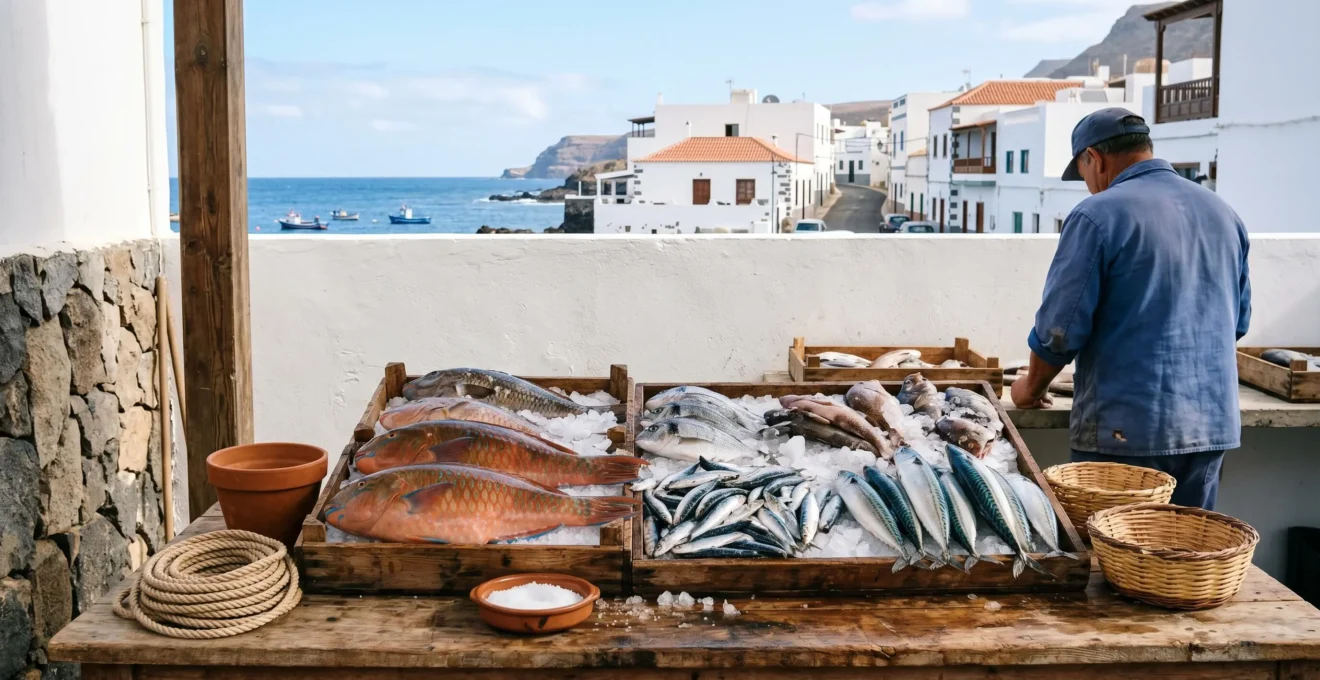
The key to enjoying sustainable seafood in Tenerife isn’t avoiding fish; it’s learning to read the clues on your menu and your plate to make choices that support local ecosystems and communities.
- Prioritize species caught with artisanal methods, like the iconic ‘vieja’ (parrotfish).
- Verify the origin and size of your fish, rejecting undersized catches and questioning frozen imports.
Recommendation: Embrace the role of a “culinary detective.” By choosing to dine at a fisherman’s co-op (cofradía) and asking about the catch of the day, you directly contribute to the preservation of both marine life and local culture.
The salty air, the sound of the waves, and a plate of incredibly fresh fish—this is the essence of dining in Tenerife. But for the eco-conscious traveler, a question often lingers behind the delicious prospect: how do I indulge in this local delicacy without contributing to overfishing or harming the fragile marine environment I’ve come to admire? Many guides offer simple advice like “eat local” or “ask if it’s fresh,” but these platitudes barely scratch the surface. They don’t help you distinguish a truly sustainable local parrotfish from a farmed sea bream, or authentic Canarian ‘chopitos’ from mass-imported squid rings.
What if the solution wasn’t a list of “good” and “bad” fish, but a new way of looking at your plate? This guide proposes a different approach. Forget passive consumption; it’s time to become a culinary detective. We will move beyond the generic to explore the story behind the seafood. We’ll uncover the crucial role of certain species in the ecosystem, the economic importance of traditional fishing communities, and the simple visual cues that separate an authentic, sustainable choice from a detrimental one. This isn’t just about eating fish; it’s about developing an appreciation for the entire system—from the reef to the restaurant—that brings it to your table. By understanding the why and how, you gain the power to make choices that are not only delicious but also deeply respectful of Tenerife’s natural and cultural heritage.
This article provides the tools you need to navigate menus with confidence. We’ll explore iconic local species, reveal how to identify truly fresh catches, and guide you to the places where your meal directly supports the fishing families who are the custodians of these waters. Let’s dive in.
Summary: A Guide to Sustainable Seafood in Tenerife
- Vieja (Parrotfish): Why Is It the Most Iconic Sustainable Catch?
- Frozen vs Fresh: How to Tell if Your Calamari is Local or Imported?
- Why You Should Send Back Undersized Fish at the Restaurant?
- Grilled vs Fried: Which Cooking Method Respects the Fish Flavor Best?
- Tuna Season: When is the Best Time to Order Tuna Steak?
- Cofradía Restaurants: Why Eating Here Supports the Local Community Directly?
- Native vs Alien Algae: How to Spot the Threat on the Reef?
- Tajao and Los Abrigos: Experiencing the Last True Fishing Villages
Vieja (Parrotfish): Why Is It the Most Iconic Sustainable Catch?
When you ask a local for a fish recommendation in Tenerife, one name will inevitably come up: ‘la vieja’. This isn’t just a fish; it’s a cultural emblem. The parrotfish, with its distinctive reddish hue and firm, white flesh, is at the heart of Canarian gastronomy. But its iconic status goes beyond flavor. The vieja represents the soul of sustainable, artisanal fishing that has defined these islands for centuries. This tradition is kept alive by a small-scale fleet that still practices responsible fishing close to shore. In fact, over 800 fishing boats compose the Canary Islands fleet, with a strong emphasis on traditional, low-impact methods.
Choosing vieja is a vote for this heritage. Unlike large-scale commercial operations, artisanal fishers use methods like lines and traps that are selective, minimizing bycatch and damage to the marine floor. This ensures that the fish populations remain healthy for future generations. The cultural importance of this fish is well-documented. As noted in the Canarian Artisanal Fishing Heritage Report:
Parrotfish, a bright reddish-coloured fish, is one of the most abundant species found around the archipelago, and is highly prized by islanders in their gastronomy.
– Hello Canary Islands Cultural Heritage Documentation, Canarian Artisanal Fishing Heritage Report
By ordering vieja, you are not just selecting a delicious meal; you are participating in a living tradition. You are supporting a method of fishing that respects the ocean’s limits and ensures the longevity of both the species and the local fishing culture. It is the perfect starting point for any conscious foodie exploring the island’s culinary landscape.
This direct connection between a specific fish and a sustainable practice makes the vieja the undisputed champion of responsible dining in Tenerife.
Frozen vs Fresh: How to Tell if Your Calamari is Local or Imported?
A plate of ‘calamares fritos’ is a quintessential holiday treat, but not all squid is created equal. This is where your culinary detective skills first come into play. A significant portion of the calamari served in tourist-heavy areas consists of uniform, perfectly round, often bleached white rings. These are tell-tale signs of mass-produced, frozen imported squid, often from the South Atlantic or Pacific. While not inherently “bad,” they lack the flavor, texture, and ecological and economic benefits of their local cousins.
The truly local Canarian squid, known as ‘chopitos’ or ‘puntillas’, tells a different story. These are small, whole specimens caught by the artisanal fleet that returns to port daily. Their appearance is your first clue: they are less uniform, often darker in color with more intense natural pigmentation, and served whole or in rougher pieces, tentacles and all. The flavor is sweeter, the texture more tender and nuanced. Choosing them is a direct investment in the local fishing economy and ensures you’re eating a product that hasn’t traveled thousands of miles.
The visual difference is striking. As the image shows, authentic chopitos are small, retain their natural shape, and have a rich, deep coloration—a world away from homogenous white rings. But how can you be sure? You must look for these signs of authenticity. Expect to pay a little more for this superior quality and freshness; it’s a price that reflects its true value and journey from the nearby sea to your plate, not from a freezer container ship.
When you see genuine chopitos on the menu, you know you’ve found a place that likely values freshness and local sourcing across its entire seafood offering.
Why You Should Send Back Undersized Fish at the Restaurant?
This may be the most powerful action you can take as a sustainable seafood consumer, yet it’s one many travelers feel hesitant to perform. Sending a dish back can feel confrontational, but when it comes to undersized fish, it’s a crucial act of conservation. The principle is simple: fish need to be allowed to grow to maturity and reproduce at least once to ensure the future of their population. This concept is called ‘Lifecycle Integrity’, and it is the cornerstone of all sustainable fishing regulations.
The Canary Islands, like much of Spain, have strict laws governing this. Many species have a legally regulated minimum catch size, or ‘talla mínima’, to protect them. This is not just bureaucratic red tape; it is a vital ecological safeguard. When a restaurant serves a fish that is clearly below this size, it signals a breakdown in the chain of responsibility—from the fisher to the market to the chef. They are either ignorant of the rules or, worse, willfully ignoring them to cut costs, often at the expense of the marine environment.
As documented in official Spanish fishing regulations, these minimum sizes are scientifically determined to protect fish stocks. Politely pointing out that a fish seems too small and questioning if it meets the ‘talla mínima’ sends a powerful economic message. You are not just a passive customer; you are an informed guardian of the resource. You can say, “Perdón, este pescado me parece muy pequeño. ¿Cumple con la talla mínima?” (Excuse me, this fish seems very small. Does it meet the minimum size?). More often than not, a reputable establishment will be horrified at the mistake, while a less scrupulous one will learn that its clientele is vigilant. Your single action can help shift market demand towards responsible practices.
It transforms your meal from a simple transaction into an act of stewardship, ensuring that future visitors—and future generations of fish—can thrive.
Grilled vs Fried: Which Cooking Method Respects the Fish Flavor Best?
In the quest for sustainable and authentic seafood, how the fish is cooked is as important as the fish itself. Canarian culinary tradition is built on a philosophy of simplicity, born from a deep respect for the ingredient. When you have a fish that was swimming in the ocean just hours ago, the last thing you want to do is mask its delicate, fresh flavor. This is why traditional cooking methods are your compass for finding quality.
As the Web Tenerife Official Tourism Portal notes, local species “are prepared simply so as not to detract from their great flavour.” This points to methods like grilling (‘a la plancha’), baking in a salt crust (‘a la sal’), or splitting open and baking (‘a la espalda’). These techniques enhance, rather than hide, the natural taste and texture of the fish. They demand a high-quality product because there is nowhere for a sub-par ingredient to hide. A heavy batter and a deep fryer, on the other hand, can be a great equalizer, making a frozen, less-than-fresh filet palatable. While a good ‘fritura’ has its place, be wary if it’s the only option for prized local species.
Case Study: The Philosophy of ‘A La Plancha’
Traditional Canarian fish preparation emphasizes freshness and simplicity to highlight essential sea flavors. Methods like grilling (a la plancha), salt-baking (a la sal), and traditional techniques (a la espalda, sancochado) are historically linked to local catch and demonstrate respect for the ingredient, in contrast to heavy battering and deep-frying often used to mask lower-quality or frozen fish.
When you see a menu dominated by simple preparations, it’s a strong indicator that the chef is confident in their raw materials. They are showcasing the fish, not the sauce or the batter. This focus on ‘Flavor Authenticity’ is a reliable sign you’re in an establishment that prioritizes quality and, very often, local and fresh sourcing. Ask for your fish ‘a la plancha’ with a drizzle of olive oil, garlic, and parsley—the classic ‘mojo’ sauces are for the potatoes, not the fish—to taste the sea as the locals do.
This simple shift in how you order can dramatically increase your chances of getting a truly fresh and delicious piece of sustainable Canarian seafood.
Tuna Season: When is the Best Time to Order Tuna Steak?
Tuna is a global superstar, but Tenerife has a special relationship with it. The Canary Islands are a critical migratory route, and the local fleet has perfected a highly sustainable fishing method: one-by-one, pole-and-line fishing. This traditional technique is incredibly selective, resulting in zero bycatch and unparalleled quality. The sheer volume is impressive; the Canary Islands catch an average of over 8,000 tons of tuna per year using only these sustainable gears.
However, being a culinary detective means understanding seasonality. While some tuna species like Yellowfin (Albacora) and Bigeye (Patudo) are available year-round, the most prized catch, the Atlantic Bluefin Tuna (‘Atún Rojo’), is highly seasonal. Its peak season in the Canaries is a brief window in the spring, typically from mid-March to mid-May. This is when you’ll find sublime, fresh, locally caught Bluefin steak on the menu. If you see it advertised as ‘fresh’ in October, be skeptical. It’s likely farmed, previously frozen, or mislabeled. Asking about the species and its origin is key.
To navigate the tuna menu like an expert, keep this seasonal guide in mind:
- Bluefin Tuna (Atún Rojo): Look for it in spring (mid-March to mid-May). It’s a highly prized, strictly regulated delicacy.
- Blue Marlin: Season runs from mid-May through August, with some catches possible later in the year.
- Yellowfin (Albacora) & Bigeye (Patudo): These species are the workhorses of the local tuna fleet and can be found fresh throughout the year.
Always ask your server about the specific type of tuna and if it was caught locally by the pole-and-line method (‘caña y liña’). This not only guarantees a superior and sustainable product but also supports the fishers who practice this artful and responsible form of fishing.
Your informed question contributes to a market that values transparency and seasonality, the twin pillars of sustainable consumption.
Cofradía Restaurants: Why Eating Here Supports the Local Community Directly?
Perhaps the most direct and rewarding way to eat sustainably in Tenerife is to seek out a ‘Cofradía de Pescadores’. These are not just restaurants; they are fishermen’s cooperatives. They represent the ultimate “short chain” from sea to table. Here, the money you spend on your meal creates a powerful, positive feedback loop, bypassing intermediaries and flowing directly back to the fishing families who own, operate, and supply the establishment.
The cofradía model is an act of community resilience. The profits are used to maintain boats, buy equipment, fund social security for the fishers, and ensure the long-term sustainability of their fleet and way of life. It’s an ‘Economic Handshake’ where your dinner choice provides tangible support to the custodians of the local marine environment. And Tenerife is uniquely positioned for this experience; data shows that Tenerife has the highest number of Fisherman’s Guilds in Spain, making it a prime destination for this type of authentic dining.
How it Works: The Cofradía de Pescadores Model
Cofradía de Pescadores are fishing cooperatives run by fishermen who provide the fresh catch themselves, prepare the food, and serve it in simple yet authentic settings. These establishments operate with no-frills decor, daily-changing menus often displayed on chalkboards, and pricing based on weight reflecting the day’s catch. Money goes directly to fishing families, funding equipment, social security, and fleet sustainability.
Eating at a cofradía is an experience in authenticity. The décor is often simple and nautical, the menu is usually a chalkboard that changes daily based on what the boats brought in, and the prices are typically by weight. You walk up to a refrigerated counter, choose your fish from the day’s selection, and they cook it for you, usually ‘a la plancha’. It doesn’t get any fresher or more transparent than this. It’s a dining experience that nourishes both you and the local community in equal measure.
You’re not just buying a meal; you’re upholding a tradition and ensuring that these vital coastal communities continue to thrive.
Native vs Alien Algae: How to Spot the Threat on the Reef?
Now, let’s zoom out from the plate to the ecosystem. Why is choosing a specific fish like the ‘vieja’ (parrotfish) so important? Because your choice has ripple effects on the health of Tenerife’s entire underwater world, particularly in the battle against invasive algae. The reefs here face a constant threat from aggressive macroalgae that can smother and kill the native corals. This is where our hero, the parrotfish, comes in. It’s the reef’s natural gardener.
As a herbivore, the parrotfish spends its days grazing on this algae, keeping it in check and allowing the corals to thrive. Their role is so vital that a healthy parrotfish population is directly linked to a healthy reef. Marine biology research confirms this critical function:
Parrotfish are herbivores that fulfil a key role in coral reef health by consuming macroalgae, which inhibits coral growth… By scraping algae from rock and coral, parrotfish also act as a major bioeroder.
– Marine Biology Research Documentation, Results from conservation initiative for parrotfishes
This is the ‘Ecosystem on a Plate’ concept in action. When you choose a sustainably caught parrotfish, you are supporting a fishery that maintains the population of this key herbivore. Scientific studies have shown that on reefs where large parrotfish are overfished, algal cover increases dramatically, leading to the decline of the entire coral community. By contrast, a well-managed artisanal fishery ensures that enough large, effective grazers remain to perform their cleaning duties. Your dinner choice becomes an integral part of the conservation solution.
It’s a powerful reminder that in a healthy ecosystem, consumption and conservation are not mutually exclusive; they are two sides of the same coin.
Key Takeaways
- True sustainability is about more than just the species; it’s about size, season, and source.
- Simple cooking methods like grilling (‘a la plancha’) are a hallmark of fresh, high-quality fish.
- Dining at a fishermen’s co-op (‘cofradía’) is the most direct way to support local fishing communities and ensure freshness.
Tajao and Los Abrigos: Experiencing the Last True Fishing Villages
Now that you are armed with the knowledge of a seasoned culinary detective, it’s time to put it all into practice. Where can you find this perfect intersection of fresh, sustainable fish and authentic community culture? The answer lies in Tenerife’s traditional fishing villages, with Tajao and Los Abrigos standing out as prime examples. These are not tourist resorts with a fishing theme; they are working villages where fishing remains a generational way of life.
In places like Tajao, the modest appearance of the restaurants belies the world-class quality of the dining experience. Here, the focus is entirely on the product. As a visitor, your experience mimics that of a local: you approach the fish counter, inspect the day’s catch glistening on ice—the viejas, samas, bocinegros—and choose your meal by pointing. It is then weighed and prepared simply and exquisitely. This is the culmination of your journey: making an informed choice based on everything you’ve learned.
Action Plan: Your Authenticity Audit for Fishing Village Restaurants
- Observe the setting: Look for simple, no-frills decor with sea-related items, not polished, generic tourist design.
- Check the menu: Is it a dynamic chalkboard that reflects the actual daily catch, or a laminated menu with fixed items?
- Analyze the pricing: Are prices based on weight (per kilogram), indicating variability of the catch, or fixed per dish?
- Watch the clientele: Is the restaurant filled with local families and Spanish speakers, or exclusively tourists?
- Note the location: Authentic spots are often right at the harbor or on the waterfront, not tucked into a commercial shopping center.
These villages offer an immersive experience that goes beyond the food. It’s about watching the small boats come and go, seeing the nets being mended, and feeling the rhythm of a community tied to the sea. It’s the perfect environment to apply your new skills, to distinguish a true cofradía from a tourist trap, and to savor a meal that is as honest and authentic as the village itself.
By making the trip to one of these villages, you are not just finding the best seafood on the island; you are finding the soul of coastal Tenerife.