The choice between Tenerife and Lanzarote for a technical diver hinges not on which island is ‘better’, but on which one’s specific logistical infrastructure—from road gradients to luggage policies—aligns with your dive plan.
- Tenerife offers world-class, steep drop-offs accessible from the shore but demands powerful rental vehicles and careful site selection during trade winds.
- Lanzarote provides unique volcanic seascapes and deep wrecks, but moving heavy technical gear between islands via regional flights presents significant weight and cost challenges.
Recommendation: Base your decision on a thorough analysis of your transport logistics. For gear-intensive, shore-based technical diving, Tenerife’s combination of accessible depth and a robust (if demanding) road network often provides a more predictable operational base.
As a technical diver, you know the question « Tenerife or Lanzarote? » goes far beyond holiday brochures. Your decision isn’t about the number of pools at the hotel; it’s about bathymetric charts, gas logistics, and whether a 1.0-litre rental car will die on a 20% gradient with 200kg of gear in the back. While others compare beaches, we compare shore entry feasibility with a twinset and deco stages. The common advice often misses the point, focusing on generic tourist attractions or recreational diving depths.
This isn’t a recreational holiday; it’s an expedition. The discussion needs to shift from simple « what to see » to « what is operationally feasible. » The real challenge lies in the infrastructure. It’s in the nuances of inter-island airline baggage policies for equipment weighing far more than a standard suitcase. It’s in understanding how a 3,718-metre volcano on one island creates a weather shadow that makes or breaks a decompression schedule, a luxury the other island may not afford in the same way.
The core premise of this analysis is that the better island is the one whose infrastructure creates the fewest points of failure for your specific dive plan. We are not just planning dives; we are planning the complex logistics that make those dives possible. We’ll dissect the critical factors—from shore access and gear transport to vehicle torque and weather patterns—to provide a decision framework built for the realities of technical diving.
Summary: A Technical Diver’s Guide to Tenerife vs. Lanzarote
- Why Tenerife Has Steeper Drop-Offs Accessible from Shore?
- How to Travel Between Islands with Heavy Scuba Gear?
- Angel Sharks in Tenerife vs Groupers in Lanzarote: What Will You See?
- The Risk of Luggage Weight Limits on Canaryfly Inter-Island Flights
- When to Choose Tenerife Over Lanzarote Based on Trade Winds?
- North vs South: Which Side Offers Better Visibility During Trade Winds?
- 1.0L vs 1.4L Engine: Which Will Fail You on the Masca Road?
- Renting a Car in Tenerife: Why You Need More Horsepower for Volcanic Roads?
Why Tenerife Has Steeper Drop-Offs Accessible from Shore?
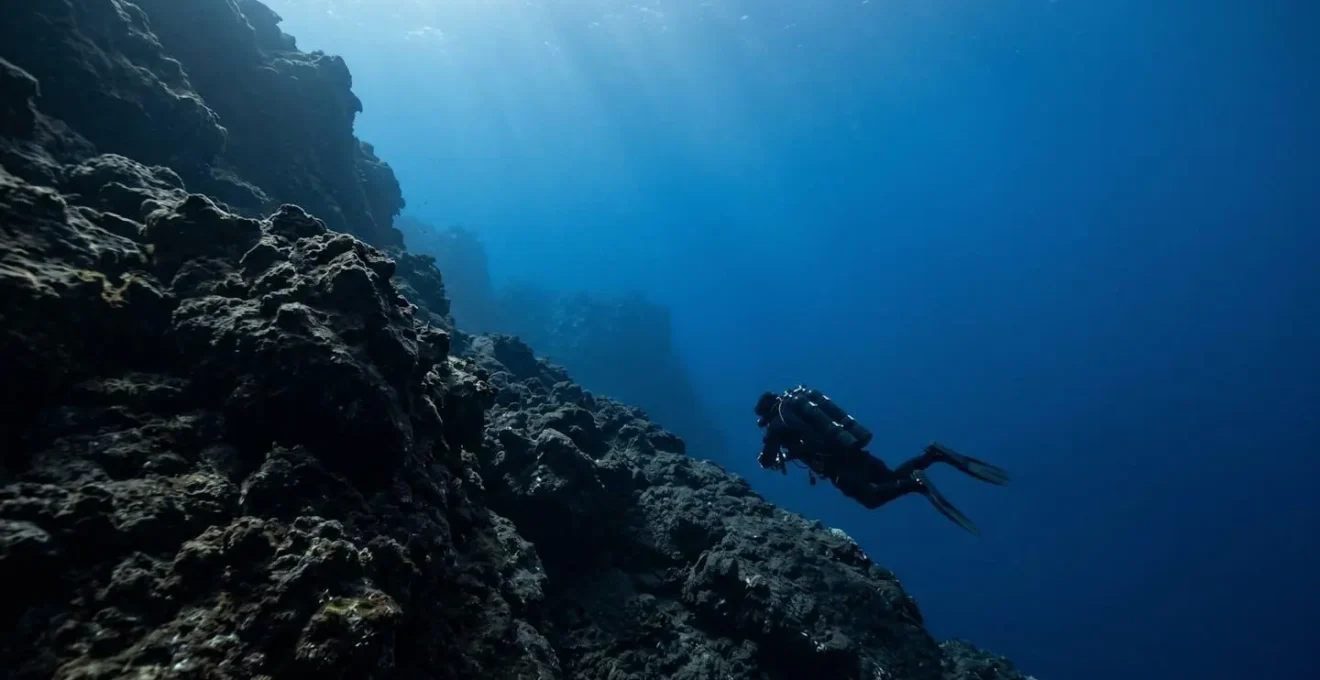
Tenerife’s geological advantage is its dramatic volcanic formation, creating exceptionally steep underwater drop-offs that begin just meters from the coastline. For a technical diver, this means deep walls and wrecks are often accessible without the need for a boat, a significant logistical and cost benefit. Sites like Tabaiba and Radazul offer direct access to depths suitable for technical profiles, but « accessible » is a relative term when you’re carrying a twinset, bailout bottles, and a scooter.
The challenge shifts from finding depth to managing the shore entry itself. These entries are not sandy beaches; they are often rocky platforms, small harbour steps, or narrow paths over volcanic terrain. Your physical fitness and equipment configuration (sidemount often being more manageable than back-mounted doubles) become critical success factors. While the depth is close, the price of admission is the physical effort of hauling 50kg+ of gear over uneven ground.
This is the fundamental trade-off of Tenerife’s shore diving. The island gives you direct access to the deep, but it demands careful planning and physical exertion in return. Here’s a breakdown of some key sites:
- Tabaiba Wreck (Easy): The entry is via a ladder or a natural pool, with the wreck starting at 33m. Gear portage from the car park is minimal, making this a very popular and straightforward tec-friendly shore dive.
- Radazul (Moderate): Entry from the harbour is convenient, but navigating the steps with heavy doubles requires balance and strength. The site offers a great depth range from 5m to 40m+.
- El Poris (Moderate): An authentic fishing village setting provides access to stunning volcanic formations between 8m and 22m. However, the narrow paths to the entry points require careful navigation, especially if you’re carrying multiple stage bottles.
How to Travel Between Islands with Heavy Scuba Gear?
The dream of diving both Lanzarote and Tenerife in one trip quickly meets the harsh reality of logistics. Transporting a full technical diving setup—twinset, regulators, drysuit, fins, lights, and multiple deco cylinders—is a monumental challenge. Your gear can easily exceed 50-70kg, making standard airline travel a costly and complex nightmare. Inter-island flights with airlines like Binter Canarias or Canaryfly are fast, but their baggage policies are designed for tourists, not mobile dive teams.
While Binter Canarias offers a sports equipment allowance, it is often minimal and the excess baggage fees can be exorbitant. A 40-minute flight can turn into a multi-hundred-euro expense just for your equipment. This forces a critical decision: either you drastically downsize your gear (not an option for most serious tec dives), rent equipment on the other island (which introduces variables in quality and configuration), or you find an alternative to flying.
The only truly viable solution for moving a complete technical diving rig between islands is the ferry, specifically one that allows you to take a rental car on board. This transforms the problem. With a vehicle, your weight limit is effectively the car’s carrying capacity. You can load your twinsets, rebreather, and crates of gear without a second thought. The trade-off is time. A direct flight takes 40 minutes; a ferry journey with a car can take 10 hours or more and is often indirect. This logistical friction is a primary factor in deciding whether to treat the Canaries as a two-island destination or to focus on mastering one.
The following table breaks down the realistic options. For any serious technical diver, the « with Rental Car » options are the only ones that provide the necessary certainty and capacity.
| Transport Method | Weight Allowance | Cost Structure | Duration (Tenerife-Lanzarote) | Key Advantage |
|---|---|---|---|---|
| Binter Canarias Flight | 20kg standard + 5kg extra for sports equipment | Base fare + excess baggage fees per kg | ~40 minutes | Speed |
| Fred Olsen Express Ferry (foot passenger) | Standard passenger allowance (~23kg) | Passenger ticket + baggage fees | Not direct route | Faster than conventional ferry |
| Naviera Armas Ferry with Rental Car | Virtually unlimited in vehicle | Passenger + vehicle ticket (~€48-119 depending on route) | 10-20 hours (indirect) | No weight restrictions |
| Fred Olsen Express Ferry with Rental Car | Virtually unlimited in vehicle | Passenger + vehicle ticket | Varies by route | No weight limits + moderate speed |
Angel Sharks in Tenerife vs Groupers in Lanzarote: What Will You See?
The marine life you encounter is directly tied to the type of diving each island’s infrastructure supports. Tenerife, with its accessible deep sandy flats adjacent to drop-offs, is a world-renowned hotspot for Angel Sharks (Squatina squatina). These critically endangered predators are a bucket-list encounter for many divers. They are most reliably found between December and March in depths of 15-30m, camouflaged on the sand. This depth range puts them well within reach for an advanced recreational diver, but the ability to do longer, more thorough searches on a technical profile (or with a rebreather) significantly increases your chances of a quality encounter.
Lanzarote, by contrast, is famous for its dramatic volcanic underwater landscapes and, from a technical perspective, its impressive collection of deep wrecks off the coast of Puerto del Carmen. The marine life here is often associated with this artificial structure. Large dusky groupers, barracuda, and thick schools of fish are common inhabitants of these wrecks. The focus here is less on searching a sandy bottom for a specific species and more on exploring a man-made habitat in deep water. In Lanzarote, the technical diving infrastructure supports dives beginning at 40m and can extend beyond 100m for certified trimix divers. This capability is geared towards deep wreck penetration and exploration.
So the choice is not just about sharks versus groupers. It’s about the type of dive you want to do. Do you want to perform long, methodical searches over sand flats in the 20-40m range for a chance to see an iconic, rare shark? That points to Tenerife. Or do you want to descend onto massive, silent wrecks in the 60-70m range, exploring their structures and observing the ecosystem that has grown around them? That points to Lanzarote. Your target species is ultimately a reflection of your target depth and environment.
The Risk of Luggage Weight Limits on Canaryfly Inter-Island Flights
For the gear-heavy technical diver, the inter-island flight is the point of maximum risk. An airline agent enforcing a strict baggage policy can single-handedly derail your dive plan or add hundreds of euros to your budget. Relying on the hope of a lenient check-in agent is not a strategy. You must plan for the worst-case scenario: a strict enforcement of the 20-23kg checked bag limit and a tiny hand luggage allowance (often as low as 6kg). When a single regulator set can weigh 2-3kg and a rebreather head is priceless, this creates a serious logistical puzzle.
The solution is a ruthless carry-on strategy. You must identify the components of your rig that are either mission-critical, irreplaceable, or too fragile to check. These items must be prioritized for your hand luggage. Everything else is secondary. This is not just about protecting your gear; it’s about ensuring you can execute the dives you came to do. Arriving in Lanzarote to find your rebreather electronics were damaged in transit is a trip-ending event. Likewise, you cannot fly with sorbent or oxygen cylinders, so confirming availability and pre-booking these consumables with your destination dive center is a non-negotiable part of your pre-flight checklist.
Ultimately, you must calculate the true cost of flying. It’s not the ticket price. It’s the ticket price plus the pre-paid fee for one checked bag, plus the pre-booked sports equipment fee, plus the potential (and likely) excess weight fees. When you run these numbers, you often find that the cost of flying your gear approaches the cost of a ferry ticket for you and a car, with none of the flexibility.
Action Plan: Critical Gear Carry-On Strategy
- Dive Computers: Always pack your primary and backup dive computers in your carry-on. The 6kg max on Binter/Canaryfly means you must be strategic.
- Regulator First and Second Stages: All your life-support breathing apparatus components must be in your carry-on. This ensures your primary gear arrives with you.
- Rebreather Electronics/Heads: Due to their sensitivity and the impossibility of rapid replacement, essential rebreather components must travel with you in the cabin.
- Confirm Sofnolime & O2 Availability: These consumables cannot be transported by air. Contact your destination dive center well in advance to pre-book and guarantee they are available upon your arrival.
- Calculate Total Flight Cost: Sum the base fare, checked bag fee (typically for a 23kg limit), and any pre-booked sports equipment fee. Compare this total cost against rental options or taking a ferry.
When to Choose Tenerife Over Lanzarote Based on Trade Winds?
The Canary Islands are dominated by the near-constant northeast « Alisios » trade winds. For a technical diver, these winds are not a minor inconvenience; they generate swell and surface chop that can make shore entries dangerous and boat diving uncomfortable or impossible. Understanding how each island’s geography interacts with these winds is key to planning a successful trip and maximizing your diveable days. This is where Tenerife reveals a major strategic advantage: the Teide massif.
The colossal 3,718-metre volcano at the center of Tenerife acts as a massive shield, protecting the south and southwest coasts from the prevailing northeasterly winds. This creates a large, sheltered area with dozens of dive sites. When the north coast is being battered by wind and swell, conditions in the south (around Las Galletas, Costa Adeje, and Alcalá) can be perfectly calm. This provides an almost guaranteed safe haven for diving operations, which is critical when you have a rigid decompression schedule to follow. A cancelled dive is not just a missed opportunity; it can disrupt an entire multi-day plan.
Lanzarote, being lower and less mountainous, offers less of a large-scale wind shadow. However, it has its own pockets of shelter. The main technical diving hub of Puerto del Carmen is strategically tucked into a large bay on the southern coast, which provides excellent protection from the same northeast winds. This ensures that its famous deep wrecks remain accessible for much of the year. The choice, therefore, is not about which island is « windy, » but about the scale and variety of the shelter offered.
most dives take place on the south and west coast, sheltered by the Teide massif. In strong winds, the southern sites generally remain diveable.
– Dive With Lau diving guide, Complete Guide to Diving in Tenerife
Tenerife’s advantage lies in the sheer size of its sheltered coastline, offering a wider variety of sites if you need to escape the wind. Lanzarote’s advantage is the high concentration of premier technical sites within its primary sheltered bay.
North vs South: Which Side Offers Better Visibility During Trade Winds?
The trade winds do more than just create waves; they can also impact water clarity. While both islands generally boast good visibility, the most stable and predictable conditions are found on the leeward (sheltered) sides. In Tenerife, this means the south and southwest coasts consistently offer the best conditions. Here, it is common for Tenerife’s diving conditions to feature 20m average visibility, with water temperatures ranging from 18-24°C and generally mild currents.
The north coast of Tenerife is a different story. While it holds spectacular, less-dived sites with dramatic basalt column formations like La Rapadura, it is fully exposed to the Atlantic swell and northeasterly winds. Access is highly weather-dependent and requires specific, calm windows. For a technical diver on a planned trip, relying on the north coast is a gamble. You cannot build a multi-day decompression plan around sites that have a high probability of being inaccessible.
This is why the heart of Tenerife’s diving industry, particularly for technical and training operations, is firmly planted in the south. The area from Las Galletas to Costa Adeje is home to over 30 dive sites, many with easy shore access, and a concentration of dive centers with the infrastructure (gas blending, etc.) to support technical diving. The south offers predictability. You can be reasonably certain that even if the wind picks up, you will be able to get in the water and execute your planned dive profile.
In essence, the north offers a wilder, more opportunistic diving experience for those with the flexibility to wait for a weather window. The south offers the reliability required for a planned technical diving expedition where hitting your target depths and times is paramount. For the traveling technical diver with limited time, the strategic choice is almost always the side of the island that guarantees access.
Key takeaways
- Tenerife’s steep volcanic roads make engine torque a critical, non-negotiable factor for rental cars carrying heavy dive gear.
- Inter-island flights are logistical traps for tec divers; the ferry-with-car method is the only practical way to transport a full rig.
- The Teide massif provides Tenerife’s south coast with a significant weather advantage, offering more reliable diving conditions during trade wind periods compared to more exposed areas.
1.0L vs 1.4L Engine: Which Will Fail You on the Masca Road?
This question isn’t academic; it’s a practical test of your logistical planning. The infamous road to Masca in Tenerife, with its hairpin turns and extreme gradients, is a worst-case scenario that every technical diver should consider when choosing a rental car. Now, imagine that road with four divers and 200kg of equipment in the back. A standard, budget-friendly 1.0L petrol engine rental car is not just a poor choice; it is a point of failure. It will struggle, overheat, or simply fail to make the climb, leaving you stranded in a dangerous and inconvenient location.
A 1.4L petrol engine might seem like a reasonable upgrade, but it’s still marginal. It will likely manage the ascent, but only by screaming at high RPMs, consuming an enormous amount of fuel, and putting extreme stress on the clutch and transmission. You’ll make it to the top, but the vehicle will have been operating at its absolute limit, a condition that is neither safe nor sustainable for the duration of your trip.
The correct choice, the one that provides a margin of safety and operational reliability, is a 1.5L (or larger) diesel engine. The critical factor is not peak horsepower, but low-end torque. Diesel engines naturally produce more torque at lower RPMs, which is exactly what you need to pull a heavy load up a steep incline without constant gear changes and engine strain. The diesel option provides the necessary power for loaded ascents while maintaining reasonable fuel economy and without pushing the vehicle to its breaking point. The « hidden cost » of an underpowered petrol car is very real, manifesting in wasted fuel, premature wear, and the significant risk of a trip-disrupting breakdown.
Renting a Car in Tenerife: Why You Need More Horsepower for Volcanic Roads?
While the previous section highlighted a specific failure point, the general principle applies across Tenerife: the island’s topography demands a more capable vehicle than the average tourist destination. The need for « horsepower » is really a need for sufficient torque and boot space. Your rental vehicle is a core piece of your diving infrastructure, as vital as your regulators or dive computer. Choosing the wrong one introduces a constant source of stress and limitation.
The priority for a technical diver is not a sporty convertible but a practical, robust vehicle. Van-style models like a Citroën Berlingo or Fiat Doblò, or small SUVs like a Dacia Duster, are ideal. These vehicles prioritize boot space and a utilitarian design over aesthetics. A minimum boot capacity of 500 liters is a good benchmark for two fully-equipped technical divers. This allows you to lay twinsets down horizontally, which is safer and more space-efficient than stacking them vertically. Before booking, you should perform the « twinset test »: check the boot dimensions online to verify your primary gear will actually fit.
While Lanzarote’s terrain is generally flatter, reducing the extreme demands on the engine, the boot space requirement remains identical. You still need to transport the same bulky equipment. Therefore, the selection criteria should remain focused on capacity first. In Tenerife, you simply add the requirement for a capable, torque-rich engine to the list. Neglecting this part of your planning is a classic mistake that can compromise your mobility and access to the island’s best dive sites.
Your Action Plan: Vehicle Selection for Technical Divers
- Recommended Vehicle Categories: Prioritize van-style vehicles (e.g., Citroën Berlingo) or small SUVs (e.g., Dacia Duster) for their superior boot space.
- Minimum Boot Capacity: Aim for a minimum of 500 liters to accommodate gear for two fully-equipped technical divers.
- Engine Specification Priority: Focus on low-end torque. Diesel engines are generally superior for climbing steep, loaded coastal roads.
- The Twinset Test: Verify the vehicle’s boot dimensions can accommodate your twin-tank configurations laid horizontally.
- Lanzarote Comparison: The terrain is flatter, reducing engine demands, but the 500L+ boot space requirement for bulky equipment is identical.
Now that you have analyzed the core logistical pillars—shore access, gear transport, weather, and vehicle capability—you can build a robust decision matrix. The right choice is the island that presents the fewest logistical hurdles for your specific diving objectives, ensuring your time is spent exploring the depths, not solving problems on the surface.