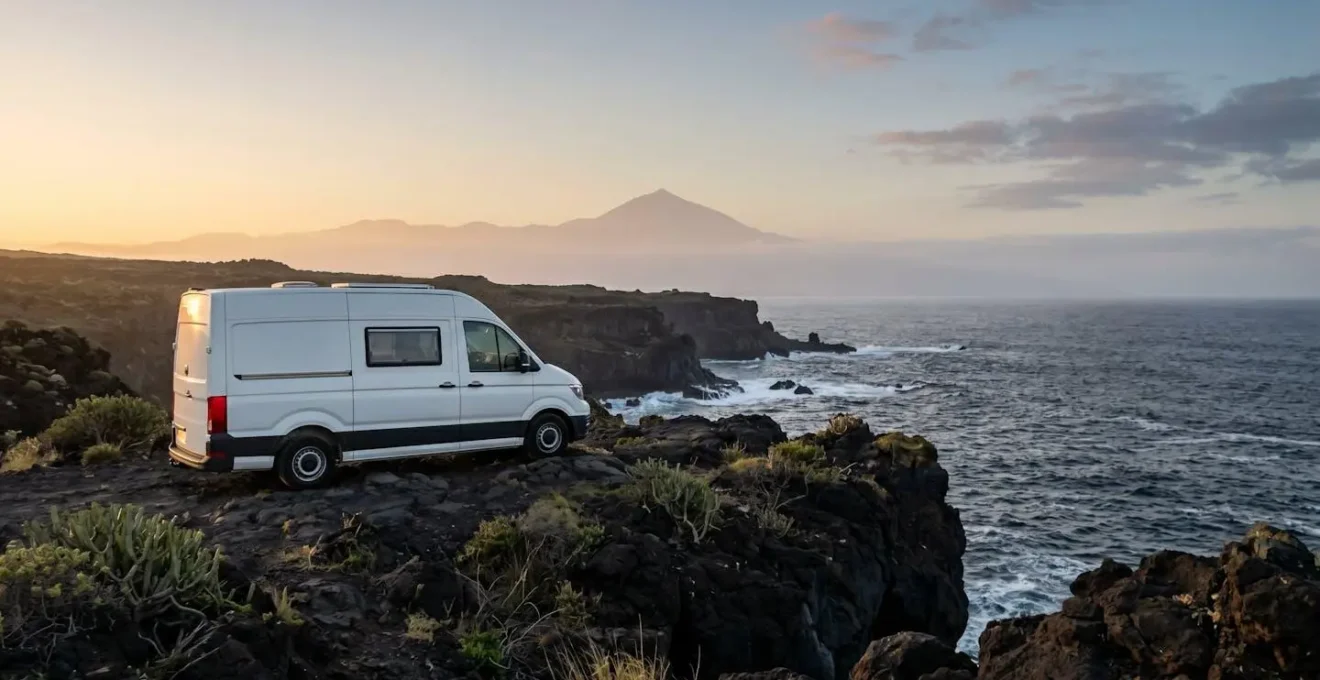
Contrary to the ‘freedom’ narrative, successful van life in Tenerife is not about finding hidden spots; it is a legal and logistical challenge. This guide decodes Spanish law to distinguish permissible overnight parking from illegal camping, revealing how understanding regulations on coastal access, waste disposal, and vehicle choice is the only way to avoid administrative sanctions, break-ins, and costly damages.
The dream of waking up to the sound of waves in a campervan, with the silhouette of Mount Teide in the distance, draws countless adventurers to Tenerife. This vision of ultimate freedom, however, clashes with a complex and strictly enforced legal reality. Many arrive believing they can park anywhere, a misconception fuelled by social media that often ignores the critical difference between « parking » a vehicle and « camping. » This distinction is the absolute cornerstone of a successful and fine-free van life experience on the island.
While generic advice encourages discretion, it fails to explain the legal framework that makes it necessary. The true key to navigating Tenerife is not a map of secret spots, but a firm grasp of the underlying regulations, from the national Coastal Law to local ordinances and the unwritten rules of vehicle integrity and security. But what if the real secret wasn’t just avoiding a fine for putting a chair outside, but understanding how regulations create liability black holes for everything from roof damage in a historic town to diving alone in protected waters?
This guide provides a legalistic and practical framework for the aspiring van lifer. We will deconstruct the laws, assess the real-world risks, and provide actionable strategies to manage them. By understanding the rules of the game, you can navigate the island’s stunning landscapes with confidence, ensuring your adventure remains a dream, not a legal nightmare.
To navigate these complexities, this article breaks down the essential legal and practical challenges you will face. The following table of contents outlines the key areas where a lack of knowledge can lead to significant problems, from coastal parking laws to vehicle choice.
Contents: A Legal and Practical Guide to Van Life in Tenerife
- Why the ‘Ley de Costas’ Prohibits Parking Overnight Near the Beach?
- Where to Empty Your Chemical Toilet Legally in Tenerife?
- Isolated Spots vs Campsites: Assessing the Risk of Break-Ins
- The Height Limit Mistake That Can Ruin Your Rental Roof
- How to Plan a Route That Avoids Low Emission Zones in Cities?
- How to Check if Your Holiday Rental Has Secure Gear Storage?
- Is Solo Diving Legal in Spanish Waters Without Specific Certification?
- Renting a Car in Tenerife: Why You Need More Horsepower for Volcanic Roads?
Why the ‘Ley de Costas’ Prohibits Parking Overnight Near the Beach?
The single most important piece of legislation governing van life in Spain is the Coastal Law, or ‘Ley de Costas’. Its primary purpose is to protect the coastline’s environmental integrity and ensure public access. A common misconception is that it flatly bans all overnight stays near the sea. The reality is more nuanced and pivots on the legal distinction between parking (estacionar) and camping (acampar). You are generally permitted to sleep inside a legally parked vehicle. However, the moment you extend an awning, set up chairs and a table, or even open a side window outwards in a way that exceeds the vehicle’s perimeter, you are legally considered to be camping. This act is what triggers the prohibition.
This is not a matter of local police discretion; it is a foundational rule. As the Spanish Coastal Law (Ley 22/1988, de Costas) explicitly states, pitching tents on dunes or beaches is almost always prohibited, and authorities extend this interpretation to any activity that constitutes setting up a temporary residence. Enforcement, particularly by the Guardia Civil’s environmental protection service (SEPRONA), is strict in protected natural areas. Deploying camping equipment can result in an administrative sanction, with fines ranging from minor penalties to several hundred euros. The core principle is clear: your vehicle is for transit, not for habitation in a public space. Confining all your living activities, including cooking and sleeping, strictly within the vehicle’s footprint is the only legally sound way to park overnight near the coast.
Where to Empty Your Chemical Toilet Legally in Tenerife?
Beyond the legalities of parking, the most pressing logistical challenge is waste management. Illegally dumping grey water (from sinks and showers) or black water (from the chemical toilet) is a serious environmental offence with hefty fines. Unfortunately, finding functional and accessible disposal points in Tenerife can be a frustrating exercise. Many points listed on popular apps are often out of order, private, or have been closed down. This makes pre-planning an absolute necessity, not an option.
The operational reality is that you cannot simply drive until your tanks are full and expect to find a convenient solution. Designated service points, known as « áreas de servicio para autocaravanas, » are the only legal places to empty your tanks. These can be found at some larger petrol stations, official campsites, and a few council-run areas. Campsites will almost always charge a fee or require an overnight stay for access to their facilities, which usually include fresh water refills. The challenge lies in verifying which of these are currently operational. Relying on outdated information can lead to long, fruitless drives with full tanks, a stressful and unsanitary situation.
Your strategy must be proactive. Regularly check recent user comments on apps like CamperContact or iOverlander before heading to a location. Maintain a buffer, aiming to empty your tanks when they are no more than two-thirds full to give you time to find a working alternative if your first choice fails. Proper waste disposal is a non-negotiable aspect of responsible travel.
Action Plan: Finding Functional Disposal Points
- Verify Before Driving: Check CamperContact or iOverlander apps for the most recent user comments on a disposal point’s status to confirm it’s operational.
- Identify Paid Options: Locate campsites that offer chemical disposal and grey water drains; most require payment but often include a package with water, showers, and power.
- Scan Service Stations: Search for large service stations, particularly those catering to lorries, as they are more likely to offer waste disposal facilities.
- Locate Public Areas: Look for public or semi-public camper areas (managed by an ayuntamiento) that may allow waste disposal for a small fee or even for free.
- Confirm in Communities: Always double-check status via active online van life communities for Tenerife, as facilities can close or change without warning.
Isolated Spots vs Campsites: Assessing the Risk of Break-Ins
While the allure of a secluded, beautiful spot is strong, it comes with a significant and often underestimated risk: vehicle break-ins and theft. While Tenerife is generally a safe island, rental campervans are prime targets for opportunistic thieves. They are easily identifiable and presumed to contain valuable tourist belongings like cameras, laptops, and passports. Official statistics paint a stark picture of the broader national context; an average of 90 vehicles per day were reported stolen in Spain according to a 2024 crime report.
The choice between an isolated spot and a populated area or campsite is a direct trade-off between solitude and security. An isolated beach parking lot may offer stunning views, but it also provides thieves with cover and time. A break-in can not only ruin your holiday and result in financial loss but can also leave you stranded with a damaged vehicle and a mountain of paperwork. Conversely, parking in a well-lit area, near other vans, or in a paid campsite significantly reduces your risk. The principle of « safety in numbers » is paramount. Thieves are less likely to target a vehicle when there are potential witnesses nearby. Even informal van-life gatherings offer a degree of community surveillance that deters crime.
You must adopt a security-first mindset and implement preventative measures. Simple, low-tech solutions are often the most effective deterrents. The goal is to make your van appear as a less attractive target than the next one.
- Never leave high-value items like surfboards, bikes, or electronics visible from the windows.
- Use a visible steering wheel lock; it’s a strong psychological deterrent.
- Consider covering or removing rental company logos that scream « tourist with valuables inside ».
- Create a « lived-in » look by leaving curtains slightly open or a book on the dashboard to suggest the vehicle is occupied.
- Join a local Tenerife van life WhatsApp or Telegram group for real-time alerts on suspicious activity in specific areas.
The Height Limit Mistake That Can Ruin Your Rental Roof
A significant, yet frequently overlooked, risk in Tenerife is vehicle height. The danger lies not in modern tunnels or underpasses, which are clearly marked, but in the island’s charming and historic towns. Places like La Orotava, Garachico, and Icod de los Vinos feature narrow cobblestone streets and traditional Canarian architecture with beautiful, low-hanging wooden balconies. These architectural features, designed long before campervans existed, create unmarked and potentially disastrous height restrictions.
A standard campervan or a van with a pop-top roof can easily exceed the clearance of these balconies, which can be as low as 2.5 to 3.0 meters. A moment of inattention while navigating a tight street can lead to a collision, causing thousands of euros in damage to the roof, air conditioning unit, or solar panels. This type of damage creates a liability black hole. Standard Collision Damage Waiver (CDW) insurance provided by rental companies almost universally excludes damage to the vehicle’s roof or undercarriage. This means the full cost of the repair will be charged directly to you, a devastating and entirely avoidable holiday expense.
The only effective mitigation strategy is extreme vigilance. Before entering any historic town center, it is imperative to park on the outskirts and scout the route on foot. Use Google Street View during your planning phase to visually inspect the streets you intend to drive. If a road looks tight or features prominent balconies, do not risk it. This is a situation where your GPS has no data and your caution is the only safety system. Assume every unmarked, narrow, historic street is a potential hazard until proven otherwise.
How to Plan a Route That Avoids Low Emission Zones in Cities?
The regulatory landscape for vehicles in Spain is continuously evolving, and a key recent development is the mandatory implementation of Low Emission Zones (Zonas de Bajas Emisiones – ZBE) in all cities with over 50,000 inhabitants. On Tenerife, this directly affects major urban centers like Santa Cruz de Tenerife and San Cristóbal de La Laguna. Driving a vehicle that does not meet the required environmental standards into a ZBE can result in an automatic fine, captured by camera systems. For van lifers, this adds another layer of complexity to route planning, especially if you are in an older rental van.
The specific boundaries and enforcement rules of these zones can change, and they are not always clearly marked with physical signs far in advance. Therefore, relying solely on road signs is an unreliable strategy. The most effective way to avoid inadvertently entering a ZBE and incurring a fine is to use modern navigation apps that are actively updated with this information. Applications like Waze or Google Maps now include options to display and route around LEZs. Before starting any journey into or around a major city, you must ensure your app’s settings are configured to avoid these zones or to verify that your vehicle’s environmental sticker (distintivo ambiental) permits entry.
This trend towards increased regulation is not limited to city air quality. The Canary Islands government is in the process of establishing a comprehensive decree for camping and campervans. As confirmed by authorities and reported by local press, the new framework will establish designated transit areas and authorized overnight stays while explicitly prohibiting free camping outside regulated establishments. This shows a clear governmental direction towards a more structured, and less free-form, model for van life. Understanding and adapting to these evolving rules, from ZBEs to new camping laws, is essential for future travel on the island.
How to Check if Your Holiday Rental Has Secure Gear Storage?
For many visitors to Tenerife, the van is not the only valuable piece of equipment. Surfers, divers, cyclists, and photographers often travel with thousands of euros worth of specialized gear. If your plans include staying in a holiday rental or apartment for part of your trip, verifying the security of its gear storage is as crucial as checking the bedroom count. A listing that advertises « storage » can mean anything from a dedicated, private, locked room to a dusty corner in a shared, unsecured garage.
Relying on vague descriptions is a recipe for disaster. You must become a forensic analyst of rental listings, scrutinizing photos and descriptions for clues. A truly secure storage space is for your exclusive use and features a proper deadbolt, not a flimsy padlock. The risk of theft in shared spaces is high, not just from outsiders but potentially from other building residents. Furthermore, consider the practicalities: ground-floor access is vital if you’re lugging heavy dive tanks or a surfboard. An outdoor shed might be lockable, but it could expose your gear to the damaging effects of humidity and salt air, causing rust or mildew.
To avoid disappointment and potential loss, you must be proactive in your communication with the host before booking. Do not ask a generic « Is there storage? ». Instead, ask specific, targeted questions and look for visual evidence.
- Examine photos: Look for evidence of other people’s belongings in storage areas; this indicates a shared, less secure space.
- Verify the lock: Scrutinize images for proper deadbolt locks, not simple luggage-style or cabinet locks.
- Assess accessibility: Check for photos that show ground-floor access to avoid carrying heavy gear up multiple flights of stairs.
- Pre-write a query: Send a message like, « Is the storage room for my exclusive use with a private lock? Is it on the ground floor? Could you please provide a photo of the lock? »
- Consider alternatives: For extremely high-value gear, research local « trastero » (self-storage unit) rental options as a guaranteed secure alternative.
Is Solo Diving Legal in Spanish Waters Without Specific Certification?
For experienced divers, the freedom of exploring Tenerife’s rich underwater world alone can be a powerful draw. However, the question of its legality is a perfect example of the gap between law and operational reality. While Spanish maritime law does not explicitly forbid a certified recreational diver from diving alone, the practical reality is that it is almost impossible to do so through official channels without a specific solo diving certification.
This barrier is not legal but institutional. The island’s dive centers operate under strict insurance and liability policies. To manage their risk, virtually all of them will refuse to rent tanks to a diver intending to go ashore unaccompanied, or to allow a diver to go solo on a boat trip. They will insist on pairing you with a buddy or a guide. This policy creates another liability black hole. Even if you are a highly experienced diver, their insurance will not cover an un-buddied dive, so they will not permit it. This restriction is even tighter in marine protected areas where guided dives are often mandatory.
Holding a recognized ‘Self-Reliant Diver’ or ‘Solo Diver’ certification from an agency like PADI or SDI is the only potential way around this. However, even with this certification, you may find that individual dive centers still have their own internal policies that require buddying. The operational reality is that solo diving in Tenerife is operationally difficult to arrange. A more effective strategy for the solo traveling diver is not to insist on diving alone, but to become adept at finding a buddy.
- Visit dive centers in person during mid-morning (9-11 AM) when staff are preparing trips and can easily slot you into a group.
- Clearly present your certification card and logbook to build credibility.
- Ask specifically: « Can I join an existing group for a shore or boat dive? » rather than asking to dive solo.
- Be flexible with dive sites and times to make pairing easier for the shop.
- Consider booking a multi-dive package, which makes you a more attractive client to accommodate.
Key Takeaways
- The ‘park vs. camp’ distinction under Spanish law is the single most important rule to avoid fines; any activity outside your van’s footprint is considered illegal camping.
- Real-world risks go beyond legal fines, including theft in isolated spots, vehicle damage from unmarked height limits in historic towns, and insurance ‘liability black holes’.
- Proactive planning is non-negotiable: use apps to verify waste disposal points, scout routes on Street View, and use modern GPS to avoid Low Emission Zones.
Renting a Car in Tenerife: Why You Need More Horsepower for Volcanic Roads?
The final, and perhaps most underestimated, aspect of a successful Tenerife road trip is vehicle choice. Many visitors, accustomed to flat terrain, opt for the cheapest « Economy » or « Mini » rental car category. On Tenerife, this is a critical and potentially dangerous mistake. The island’s topography is dominated by the massive Teide volcano, and its roads feature sustained, steep gradients of 8-12% over many kilometers. A vehicle’s engine power is not a luxury here; it is a fundamental safety requirement.
The routes ascending to Mount Teide from the north, south, and west are a brutal test for any engine. As detailed in analyses of the ‘Teide Triangle’, an underpowered vehicle with a small 1.0L engine will struggle dangerously. The combination of the steep climb, high altitude (which reduces engine power due to lower air density), and constant traffic leads to severe strain. Engines overheat, power output plummets, and drivers are forced into prolonged, inefficient operation in first or second gear. This not only causes excessive fuel consumption but can also lead to mechanical failure or create hazardous situations by forcing unsafe overtaking maneuvers from frustrated drivers behind you.
The danger is not limited to ascents. On steep descents, like the infamous road to Masca, an underpowered car with an automatic transmission is a liability. It lacks the engine braking capacity of a manual car in a low gear, forcing the driver to rely solely on the brakes, which can lead to them overheating and failing—a terrifying prospect on a road with sheer drops. To navigate the island safely and enjoyably, you must decode the rental car categories.
- Avoid Category A/B (Economy/Mini): These typically have engines under 1.2L (e.g., Fiat Panda, Hyundai i10) and are unsuitable for mountain roads.
- Target Category C/D (Compact/Intermediate): Specifically seek models with 1.2L to 1.4L engines (e.g., Seat Ibiza, VW Polo).
- Prefer Manual Transmission: If you can drive one, a manual gearbox offers superior control for both climbing and descending.
- Consider Upgrading for Teide/Masca: If these routes are on your itinerary, upgrading to a Category E/F with a 1.5L+ engine is a wise investment in safety.
Therefore, before booking your flight, the most critical step is to shift your mindset from a tourist seeking freedom to a prepared operator managing a portfolio of legal, logistical, and mechanical risks. This preparation is the true key to freedom on the roads of Tenerife.