For a diver, choosing the wrong holiday rental isn’t an inconvenience; it’s a logistical nightmare that can damage gear, void insurance, and ruin your trip before you even hit the water.
- Standard rentals lack secure, ventilated storage, leading to gear degradation and theft risk.
- The daily routine of hauling heavy, wet equipment creates unnecessary stress and can lead to fines for water damage in common areas.
Recommendation: Prioritize ground-floor access or a property with verified, purpose-built secure storage. This single choice eliminates the biggest source of logistical friction for any dive trip.
You’ve just surfaced from an incredible dive. You’re exhilarated but tired, and your gear, now weighing what feels like a ton, is dripping saltwater. The last thing you want is the dawning dread of hauling 50kg of equipment up three flights of stairs to an apartment with no space to properly rinse or dry anything. For traveling divers, this scenario is all too common and highlights a critical flaw in how we often choose accommodation.
Most travel advice focuses on proximity to the marina or the best restaurants. While helpful, this overlooks the single greatest source of stress for a self-sufficient diver: gear logistics. The daily grind of managing heavy, wet, and expensive equipment in a space not designed for it creates what can only be described as logistical friction. It’s the cumulative stress from a thousand tiny annoyances that chips away at the joy of a dive holiday.
But what if the solution wasn’t just to « make do, » but to fundamentally change how we select our home base? The real key to a seamless dive trip lies not in being a block closer to the action, but in securing a space that eliminates logistical friction entirely. This guide moves beyond the obvious to uncover the hidden costs of poor planning—from damaged gear to security risks—and provides a practical framework for choosing a rental that works for you, not against you.
We’ll break down the essential, yet often overlooked, elements of truly « dive-ready » accommodation. By understanding these key logistical pressure points, you can ensure your home base is a sanctuary for recovery and preparation, not another source of stress.
Summary: Your Guide to a Frictionless Dive Holiday
- Why Hotel Balconies Are Terrible Places to Dry Wetsuits?
- How to Check if Your Holiday Rental Has Secure Gear Storage?
- Walking Distance vs Taxi Ride: Calculating the Morning Commute
- The Risk of Fines for Dripping Salt Water in Communal Hallways
- Why a Good Kitchen Is Essential for Divers with Special Dietary Needs?
- Why Automatic Transmission Is a Lifesaver on 20% Gradients?
- Why Proximity to the Marina Saves You Stress Before the Dive?
- Renting a Car in Tenerife: Why You Need More Horsepower for Volcanic Roads?
Why Hotel Balconies Are Terrible Places to Dry Wetsuits?
The sunny hotel balcony seems like the perfect, obvious place to hang your dripping wetsuit. It feels purpose-built for the task. This is a costly mistake. Balconies are, in fact, one of the worst places for your gear, exposing it to two primary enemies: UV radiation and theft. Neoprene is highly susceptible to sun damage; research shows that exposure to UV radiation and heat can take a brand new wetsuit from pliable to cracked and useless in a matter of weeks. You are actively shortening the life of your expensive suit with every sun-drying session.
Beyond the physical damage, there’s a significant security risk. A balcony is a public billboard advertising thousands of dollars of dive equipment. Regulators, dive computers, and BCDs are prime targets for opportunistic thieves. What’s worse is that most divers don’t realize this creates a hidden liability with their insurance. Standard travel insurance policies often contain clauses that exclude coverage for items left in ‘non-secure’ or publicly visible areas. An insurer can argue that a balcony is not a secure storage location, potentially leaving you with no recourse and a total financial loss if your gear is stolen.
How to Check if Your Holiday Rental Has Secure Gear Storage?
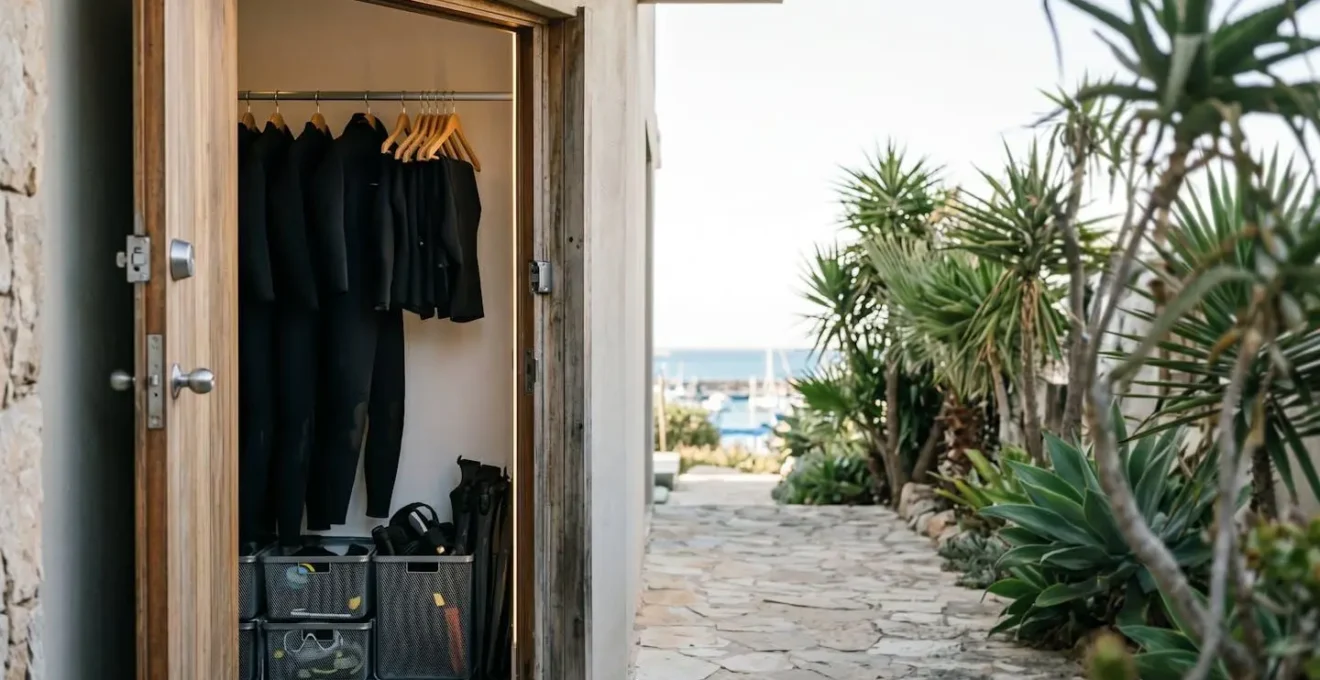
The term « storage » in a rental listing can mean anything from a dusty broom closet to a dedicated, ventilated room. For a diver, getting this detail right is paramount. A true dive-ready storage space isn’t just about a lock on a door; it’s about preserving gear integrity and making your daily routine effortless. The ideal space is a secure, well-ventilated area on the ground floor with a freshwater source for rinsing, ample room to hang BCDs and wetsuits without creasing them, and enough floor space for heavy gear boxes.
As you can see, a proper facility is designed to prevent mildew and allow gear to dry thoroughly and safely overnight. But how do you verify this before you book? You need to become an expert interrogator. Don’t accept vague assurances. Ask specific, targeted questions and request photographic proof. A host who understands divers’ needs will have no problem providing this information; a host who doesn’t will be revealed by their vague answers.
Your Pre-Booking Security Checklist
- Privacy & Access: Ask who has access (private or shared) and how it’s secured (key, code).
- Visual Verification: Request current photos or a video walkthrough of the storage space, including dimensions and ventilation.
- Rinse Station: Confirm the proximity and availability of a freshwater source (hose or tap) for cleaning gear.
- Hanging Space: Inquire about the specific hanging mechanisms—are there sturdy hooks and wide hangers suitable for heavy BCDs and wetsuits?
- Security Measures: Ask if the area is monitored by CCTV or other security systems.
Walking Distance vs Taxi Ride: Calculating the Morning Commute
The morning of a dive should be a time of calm preparation and anticipation. It should not be a frantic struggle with logistics. The choice between an apartment within walking distance of the dive boat versus one a short taxi ride away seems minor, but for a diver with full kit, the difference is monumental. Let’s calculate the true cost of that « short taxi ride. » It’s not just the fare; it’s the logistical friction of hauling two heavy gear boxes, weight belts, and tanks to the roadside, hoping the taxi that arrives is large enough.
Imagine the stress: you’re trying not to drip saltwater in the upholstery, the meter is running while you load and unload, and you’re constantly worried about damaging your gear or the vehicle. This frantic shuffle adds a significant layer of anxiety to your pre-dive routine. Now, contrast that with a five-minute walk. You can load your gear onto a trolley, enjoy a leisurely stroll to the marina, and arrive at the boat calm and collected. You have full control over your timeline and your equipment.
The premium paid for a rental within easy walking distance isn’t a luxury; it’s an investment in pre-dive serenity. When you factor in the saved taxi fares, the reduced stress, and the elimination of hassle, the slightly higher rental cost often represents better overall value.
The Risk of Fines for Dripping Salt Water in Communal Hallways
After a dive, your gear is saturated with corrosive saltwater. Transporting it from the car or marina back to your apartment is a messy process. Dripping water in elevators, hallways, and stairwells isn’t just a minor housekeeping issue; it can be a serious breach of your rental agreement. Many apartment complexes and holiday resorts have strict rules regarding common areas, and for good reason. Saltwater can damage flooring, stain carpets, and create slip hazards, leading to another hidden liability for the traveling diver.
A complaint from a neighbor or a building manager can result in a warning, or worse, a direct fine deducted from your security deposit. This creates an awkward and entirely avoidable conflict. The solution is to have a robust « Wet Zone Strategy » for moving and containing your gear from the moment you leave the water until you are inside your rental’s designated wet area (ideally the shower).
Your strategy should be a multi-layered defense to keep saltwater contained:
- Invest in a large, durable waterproof bag to act as your primary transport container for all wet gear.
- Immediately upon entering your rental, place the entire bag and all dripping items directly into the shower or bathtub.
- Perform all initial rinsing and draining within this designated « wet zone » before moving gear to its drying location.
- Use a microfiber towel to wipe down the exterior of your transport bag before carrying it through any communal interior spaces.
- Proactively check your rental agreement for clauses related to ‘water damage’ or use of ‘communal areas’.
Why a Good Kitchen Is Essential for Divers with Special Dietary Needs?
For a diver, food is fuel. Proper nutrition and hydration are critical for performance, safety, and recovery. While a holiday is a time to enjoy local cuisine, relying solely on restaurants presents a significant challenge for divers. The number one reason? Timing. As professional dive operators confirm, most dive boats depart between 6:00-7:30 AM, long before most local cafes and restaurants open their doors. Without a kitchen, you risk starting your dive day under-fueled or relying on convenience snacks.
A well-equipped kitchen provides the autonomy to manage your own schedule. It allows you to prepare a high-protein breakfast at 5:30 AM, pack a specific post-dive recovery snack, or cater to special dietary requirements (like gluten-free, vegan, or low-fodmap) without the stress of finding a suitable restaurant. This control over your nutrition is not just about comfort; it directly impacts your physical well-being and ability to enjoy multiple days of diving.
Furthermore, hydration is key. Having access to a freezer for ice packs and a refrigerator for cold drinks is essential for post-dive recovery. A kitchen transforms from a simple amenity into a central part of your dive support system, empowering you to manage your diet, hydration, and schedule with precision.
Why Automatic Transmission Is a Lifesaver on 20% Gradients?
Many of the world’s best diving destinations are volcanic islands or coastal regions characterized by dramatic, steep terrain. Renting a car is often a necessity, but choosing the wrong car can introduce a massive amount of stress. Specifically, opting for a manual transmission in a place with 20% gradients is a recipe for a white-knuckle holiday. Imagine this: you’re in a narrow lane, a car is tight on your tail, and you have to perform a hill start. With 200kg of passengers and dive gear in the back, even a skilled driver will feel the pressure of a potential stall or rollback.
This isn’t an exaggeration; it’s the reality of navigating places like Tenerife, Madeira, or the Amalfi Coast. The constant shifting, clutch control, and fear of the dreaded hill start drains your mental energy. It adds a layer of logistical friction to every single journey, whether you’re heading to a remote shore dive entry point or just going to the supermarket. An automatic transmission completely eliminates this stressor.
With an automatic, there are no rollbacks. There is no burning clutch smell. There is no frantic legwork. You simply press the accelerator, and the car moves forward smoothly. In this specific environment, an automatic transmission is not a feature of convenience or luxury; it is a critical safety and stress-reduction tool. It frees up your mental bandwidth to focus on navigating the unfamiliar roads, not on fighting with your own vehicle.
Why Proximity to the Marina Saves You Stress Before the Dive?
While on-site logistics like secure storage are the number one priority, the value of proximity to the marina should not be underestimated once those primary needs are met. Being close to the dive center or boat departure point serves a crucial secondary function: it acts as « forgotten item insurance. » No matter how meticulous your preparation is, mistakes happen. It’s easy to leave a dive computer on the charging station, forget your certification card, or realize you’re out of mask defog just minutes before departure.
Case Study: The 5-Minute Dash That Saved a Dive Trip
An analysis of dive travel logistics highlights the critical role of proximity. In one common scenario, a diver realizes at the boat that they’ve forgotten their dive computer. If their accommodation is a 30-minute drive away, the trip is a disaster; the boat will not wait. However, as research on dive trip preparation shows, if the rental is a 5-minute walk away, this major catastrophe becomes a minor inconvenience. The diver can quickly run back, retrieve the item, and rejoin the group with minimal disruption, preserving both their investment and their pre-dive calm.
This proximity allows for a more relaxed pre-dive morning. You can afford a last-minute check of your gear, knowing that a trip back to the apartment is a viable option. It allows you to casually visit the dive center the evening before to check conditions or chat with the crew. This transforms the marina from a point of departure into a part of your local environment, fostering a sense of calm and control that is the hallmark of a well-planned trip.
Key takeaways
- Drying gear on a balcony exposes it to UV damage and theft, potentially voiding your insurance.
- Always verify secure storage before booking using a detailed checklist; do not rely on vague descriptions.
- The right rental car (automatic transmission, sufficient power) is a critical piece of dive equipment that reduces stress on steep roads.
Renting a Car in Tenerife: Why You Need More Horsepower for Volcanic Roads?
When renting a car for a dive trip on a volcanic island like Tenerife, the choice often comes down to the cheapest, most basic model. This is a false economy. The critical factor isn’t just the steep gradients we’ve discussed, but the sustained nature of the climbs. A small, underpowered engine will constantly struggle when loaded with dive gear and passengers. It’s not about driving fast; it’s about having enough torque to ascend long, winding mountain roads without the engine screaming or overheating.
An engine that is constantly working at its maximum capacity is inefficient, stressful to drive, and less safe. You need the confidence that your car can handle the load and the terrain without a struggle. A vehicle with a bit more horsepower and torque provides this capability. It allows for smoother acceleration, less gear-shifting (even in an automatic), and a much more relaxed and secure driving experience. You are not paying for speed; you are paying for competence and the reduction of mechanical stress, both on the car and on the driver.
Your rental car is as much a piece of your dive equipment as your fins. It needs to be fit for purpose. Combining a car with an automatic transmission and a capable engine with accommodation that offers ground-floor access and secure storage creates a « logistics-proof » ecosystem for your holiday. This holistic approach, where your transport and your lodging work in harmony, is the secret to eliminating friction and unlocking a truly restorative and enjoyable dive trip.
Now that you know exactly what to look for, you can approach your next booking with the confidence of an expert. Ask these specific questions, demand the convenience you deserve, and build the foundation for a truly perfect dive holiday.