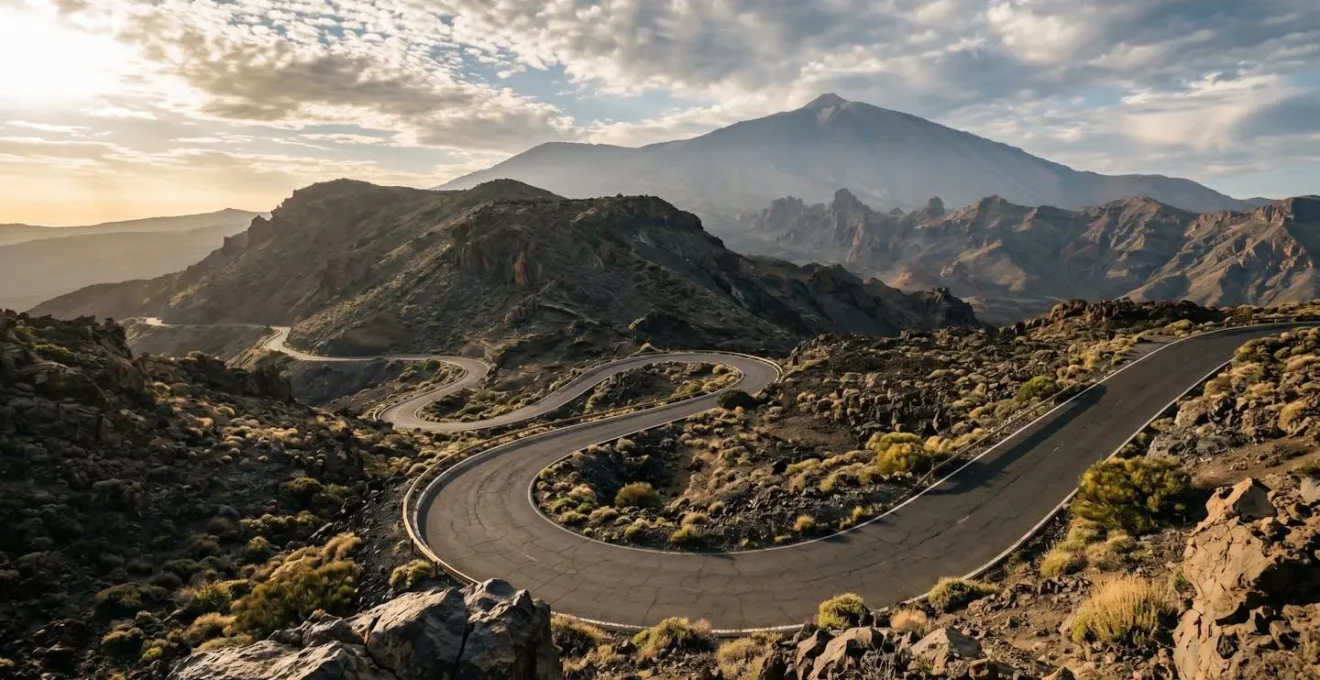
Choosing the cheapest rental car in Tenerife is a false economy that exposes you to significant mechanical and safety risks on its steep volcanic roads.
- An underpowered engine (like a 1.0L) loses significant power at altitude, struggling on inclines and causing dangerous situations.
- Standard insurance often excludes common damage from narrow streets, leaving you liable for an excess that can exceed €1,400.
Recommendation: Prioritise a car with at least a 1.4L engine and an automatic transmission. This is a crucial safety investment, not a luxury upgrade.
That €15-a-day rental car deal looks irresistible online. You picture yourself cruising along Tenerife’s coastline, sun shining, with money to spare for an extra round of tapas. This is the dream. The reality for many drivers, especially those accustomed to flat terrain, is a white-knuckle grip on the steering wheel, the smell of a burning clutch, and the unnerving feeling of a car struggling to conquer a 20% gradient.
Most travel guides offer generic advice: book in advance, get full insurance, watch for narrow streets. While true, this advice barely scratches the surface of Tenerife’s unique driving challenges. It fails to address the fundamental physics at play when you pair a low-powered vehicle with extreme elevations and tight, historic village roads. It’s not just about your driving skill; it’s about the mechanical limits of the machine you’ve chosen.
This guide takes a different approach. As an honest broker in the rental world, my job is to ensure your safety and prevent costly surprises. Forget the platitudes. We are going to talk about the engineering, the mechanical stress, and the strategic decisions that turn a potentially stressful holiday into a smooth adventure. This isn’t about upselling you; it’s about equipping you with the technical knowledge to understand why a bit more horsepower isn’t a luxury, but a critical safety feature on this volcanic island.
We’ll dissect the real-world performance differences between engines, decode insurance policies to reveal their blind spots, navigate the pitfalls of GPS in remote valleys, and even consider the logistical needs of specialist visitors like divers. Let’s ensure the car you rent is a reliable partner for your exploration, not a source of anxiety.
Summary: Your Technical Guide to Renting a Car in Tenerife
- 1.0L vs 1.4L Engine: Which Will Fail You on the Masca Road?
- Full Comp vs Excess: Analyzing the Risk of Scratches in Narrow Streets
- Google Maps vs Waze: Which Works Better in Remote Canarian Valleys?
- The Parking Fine for Yellow Lines That Tourists Always Miss
- Why Automatic Transmission Is a Lifesaver on 20% Gradients?
- Why Hotel Balconies Are Terrible Places to Dry Wetsuits?
- Where to Park in Las Galletas Without Getting Towed While Diving?
- Accommodation for Divers: Why You Need a Ground Floor Apartment or Secure Storage?
1.0L vs 1.4L Engine: Which Will Fail You on the Masca Road?
The first choice you make, the engine size, is the most critical. A 1.0-litre or 1.2-litre engine is perfectly adequate for city driving on the mainland. In Tenerife, it can be a liability. The issue isn’t about speed; it’s about torque and the ability to handle sustained, steep inclines, especially with passengers and luggage. The infamous road to Masca village is a perfect case study in mechanical stress. A small engine will require you to constantly stay in first or second gear, revving high just to maintain momentum, leading to overheating and significant strain.
This problem is compounded by altitude. As you climb towards Teide National Park, the air thins, and a naturally aspirated engine loses power. Automotive engineering calculations show an engine can suffer a 3% power loss per 1,000 feet of elevation. At Teide’s base (around 7,000 feet), your tiny 70-horsepower engine is already operating with significantly reduced capacity. A 1.4L or 1.6L engine has the extra reserve to handle these conditions without constant, damaging strain. As noted by travel experts, while small engines « handle the roads fine…you’ll need to use lower gears and expect slower acceleration uphill. » The question is whether « fine » is good enough when you’re on a narrow cliffside road.
Think of horsepower not as a measure of top speed, but as a measure of reserve power. This reserve is what allows the engine to pull you up a steep hill without screaming, what gives you the confidence to overtake a slow-moving bus safely, and what ultimately provides a much safer and less stressful driving experience. The small premium for a more powerful engine is an investment in reliability and peace of mind.
Full Comp vs Excess: Analyzing the Risk of Scratches in Narrow Streets
The term « full comprehensive insurance » can be misleading. While it covers major incidents, the real financial danger for tourists in Tenerife lies in the « excess » or deductible—the amount you pay out-of-pocket for any damage. The historic centres of towns like La Orotava or Garachico are filled with incredibly narrow streets, often with stone walls that seem to close in on you. A minor miscalculation, a moment of distraction, and you hear that gut-wrenching sound of metal scraping against stone.
This is where the insurance « blind spots » appear. A simple long scratch or a dented wing mirror might seem minor, but the repair bill can easily run into hundreds of euros. Your standard rental agreement might come with an excess of up to €2,000 depending on the vehicle, which the rental company will hold on your credit card. That small scratch means you could forfeit a significant portion, if not all, of that deposit. Zero-excess (or « Super CDW ») insurance eliminates this risk. It costs more per day, but it covers the common types of damage that tourists are most likely to incur.
The differences are stark when you compare policies side-by-side. Standard insurance often has numerous exclusions that are prime risks in Tenerife’s environment.
| Coverage Aspect | Standard Insurance (With Excess) | Zero-Excess Insurance |
|---|---|---|
| Excess Amount | €600 – €1,400 | €0 |
| Deposit Required | Yes (blocked on credit card) | Varies by company |
| Wheels & Tires | Often excluded | Usually included |
| Undercarriage Damage | Excluded | May be included |
| Glass & Windows | Excluded | Often included |
| Key Loss/Damage | Not covered | May be covered |
| Unpaved Road Clause | Voids coverage | Check terms carefully |
As this comparative data from rental companies shows, aspects like tires, windows, and undercarriage are frequently not covered by standard policies. Hitting a pothole on a rural road or getting a flat tire could become a very expensive problem. Opting for the zero-excess policy is a strategic decision to cap your financial risk in a high-risk environment.
Google Maps vs Waze: Which Works Better in Remote Canarian Valleys?
In Tenerife, your GPS is not just a convenience; it’s a critical safety tool. However, blindly trusting any single app can lead you into serious trouble. The algorithms for Google Maps and Waze are optimized for different purposes, and knowing when to use each is key. Waze is brilliant on the main TF-1 and TF-5 motorways for real-time traffic alerts, police sightings, and accident reports. Its core function, however, is finding the *fastest* route, which in rural Tenerife often means directing you down perilously narrow, steep, single-lane farm tracks (caminos rurales) completely unsuitable for a standard rental car.
Google Maps, particularly with its offline map feature, is far more reliable for navigating the island’s complex network of mountain roads and villages. Its routing tends to be more conservative, prioritizing main roads over dubious shortcuts. The most important technique is to use the satellite view before committing to a route suggested by any app. A quick visual inspection can reveal if a « road » is actually a paved, two-lane road or a glorified goat track. Remote areas like the Anaga and Teno massifs are notorious for mobile data black spots, making pre-downloaded offline maps a non-negotiable prerequisite.
A disciplined navigation strategy is essential for both safety and peace of mind. It prevents you from getting stuck, damaging the car on an unpaved road (which instantly voids all insurance), or simply losing hours of your holiday trying to backtrack from an impossible route.
Your Action Plan: GPS Strategy for Tenerife
- Pre-Trip Download: Before leaving your hotel’s Wi-Fi, download the entire island of Tenerife for offline use in Google Maps. This is your primary safety net.
- Visual Verification: Before following a GPS route into an unknown rural area, switch to Satellite View. Scrutinize the road’s width, surface, and hairpin turns. If it looks like a footpath, ignore the GPS.
- Primary vs. Secondary Use: Use the offline Google Maps as your main navigation tool. Only activate Waze on major motorways (TF-1, TF-5) specifically for its real-time traffic and hazard alerts.
- Distrust Shortcuts: Be deeply suspicious of any « clever shortcut » Waze suggests to bypass traffic in a rural or mountainous area. It is almost always a trap leading to an unsuitable road.
- Integrate & Decide: Combine the reliable routing of Google Maps with the live alerts from Waze. You are the final decision-maker; the GPS is an advisor, not a commander.
The Parking Fine for Yellow Lines That Tourists Always Miss
Parking in Tenerife can be a source of immense frustration and unexpected expense. The system of coloured lines is simple in theory, but often misinterpreted by visitors in a hurry. The single most expensive mistake is parking on a solid yellow line. This signifies a strict no-parking zone, and enforcement, especially in tourist hotspots and natural parks, is swift and unforgiving. It’s not a matter of ‘if’ you’ll get a ticket, but ‘when’. The consequence is often a double penalty: an approximate €100 parking fine plus a €50 towing fee, not to mention the time and hassle of retrieving your vehicle from the municipal depot.
The rules for other colours are also crucial:
- Blue Lines (Zona Azul): This is paid parking. You must find the nearby meter, purchase a ticket for your desired duration, and display it clearly on your dashboard. Pay attention to the times; parking is often free during the traditional siesta hours (e.g., 2 PM to 4 PM) and on Sundays.
- White Lines: This is where it gets tricky. In many town and city centres, white-lined bays are reserved for residents (« Solo Residentes »). Always check for nearby signs before assuming a white-lined space is free for all. In more rural villages without markings, the unwritten rule is to use common sense: ask yourself, « Can a bus or a large delivery truck easily pass? » If the answer is no, find another spot.
The authorities have particularly increased enforcement in high-traffic areas. As Pedro Millán of the Tenerife Weekly reported regarding recent enforcement spikes, « Individuals who owned or rented vehicles were penalised for parking in spaces designated for people with disabilities, buses, or on yellow lines. » Teide National Park is a major hotspot for fines, as visitors desperate for a parking spot often ignore clear signage.
Individuals who owned or rented vehicles were penalised for parking in spaces designated for people with disabilities, buses, or on yellow lines.
– Pedro Millán, Tenerife Weekly
Why Automatic Transmission Is a Lifesaver on 20% Gradients?
For drivers not accustomed to mountain terrain, opting for an automatic transmission is the single best decision you can make after choosing the right engine size. The steep gradients of Tenerife’s roads place immense stress on the clutch of a manual car, especially in stop-start traffic or during hill starts. A driver unfamiliar with the precise balance of clutch and throttle required can easily burn out a clutch in a single afternoon—a repair that is almost never covered by insurance and can cost you dearly.
An automatic transmission eliminates this risk entirely. But its biggest safety benefit lies in descending, not ascending. The long, winding descents from Teide National Park can be treacherous. A common mistake is to « ride the brakes » continuously, causing them to overheat. This leads to a dangerous condition known as brake fade, where the brakes become progressively less effective, potentially leading to a total loss of braking power. The correct technique is to use engine braking, and an automatic gearbox makes this simple. By shifting into a lower gear (often marked as ‘L’, ‘2’, or ‘S’ for Sport mode), you use the engine’s resistance to control the car’s speed, saving the brakes for when you really need them.
Mastering this is easy and transforms your driving experience from one of anxiety to one of confident control. It’s a professional driving technique that an automatic gearbox makes accessible to everyone. Here’s how to do it:
- Identify Lower Gears: Before you set off, locate the lower gear options on your rental’s automatic shifter (‘L’, ‘2’, ‘S’, or paddle shifters).
- Engage Before Descent: Before starting a long, steep downhill section, shift the car into one of these lower gears.
- Listen and Feel: You’ll hear the engine revs rise, and you’ll feel the car naturally slowing down without you touching the brake pedal. This is engine braking.
- Use Brakes Sparingly: Use the brake pedal for short, firm applications to reduce speed further when needed, then release to let them cool. Do not keep your foot resting on the pedal.
Why Hotel Balconies Are Terrible Places to Dry Wetsuits?
For visiting divers, managing wet gear is a daily logistical challenge. The hotel balcony might seem like the most obvious place to hang a dripping wetsuit, but it’s one of the worst choices you can make for several reasons. Firstly, the saltwater residue is highly corrosive. Dripping onto metal balcony railings can cause rust and staining, leading to potential damage claims from your hotel. The runoff can also drip onto the balconies or patios of guests below you, causing annoyance and potential complaints.
Secondly, direct, prolonged exposure to the sun’s UV rays is incredibly damaging to neoprene, the material your wetsuit is made of. It causes the material to become brittle, lose its flexibility, and degrade much faster, significantly shortening the life of your expensive gear. A shady, well-ventilated area is always preferable. Finally, there is a security aspect. A wetsuit hanging on a balcony is a clear advertisement that there is expensive dive equipment nearby. It can make your room or rental car a more attractive target for thieves.
Many hotels and apartment complexes with a high volume of tourist divers have specific rules against drying equipment on balconies for these very reasons. Ignoring these rules can lead to warnings or even fines. The correct approach is to plan ahead and choose accommodation that caters to the needs of divers, or at the very least, find a discreet, shaded, and secure place to dry your gear indoors, perhaps in a well-ventilated bathroom with the extractor fan running.
Where to Park in Las Galletas Without Getting Towed While Diving?
Las Galletas, a hub for many of the island’s top dive centers, presents a specific parking nightmare for divers on a tight schedule. Arriving for an 8:30 AM boat departure only to spend 25 minutes searching for a parking spot is a stressful way to start your day. The area around the marina (Marina del Sur) is a maze of restrictions and resident-only zones. Parking on the main promenade is virtually impossible, and a wrong move will almost certainly result in a fine or your car being towed.
A strategic approach is essential. The most reliable option for free parking is the large, unpaved dirt lot located just to the east of the marina. However, this is no secret, and it fills up quickly. Arriving before 9:00 AM is critical to secure a spot here. If you’re arriving later, your best bet is to hunt for white-lined spaces on the perpendicular streets away from the seafront, such as Calle la Ballena, and be prepared for a 5-10 minute walk back to your dive center, potentially carrying heavy gear.
Many divers overlook the simplest solution: ask your dive center. They have the most current, hyper-local knowledge of the parking situation and may have arrangements for customer parking or be able to direct you to a little-known spot. For those who value certainty over cost, using the paid underground parking at the marina is the ultimate stress-free option. It provides security for your vehicle and any items left inside, shade from the sun, and guarantees you’ll make your boat on time. The small cost is often worth the peace of mind.
Key Takeaways
- Engine Power Is Safety: On Tenerife’s steep roads, a 1.4L engine or greater isn’t for speed; it’s for the necessary torque to climb safely and avoid mechanical failure.
- Zero-Excess Is Non-Negotiable: The risk of scratches and minor damage in narrow historic streets is extremely high. Standard insurance leaves you exposed to a large excess; a zero-excess policy is essential financial protection.
- Logistics Are Paramount for Divers: Your choice of accommodation and your parking strategy are as important as your dive plan. Prioritise ground-floor access and secure storage to protect your gear and your rental car.
Accommodation for Divers: Why You Need a Ground Floor Apartment or Secure Storage?
The choice of rental car is intrinsically linked to your choice of accommodation, especially for those with specialist hobbies like diving. The logistical burden of hauling heavy, wet, and sandy dive gear can turn a dream holiday into a chore. Carrying two full sets of equipment, plus tanks, up three flights of stairs to an apartment is not only exhausting but also dangerous. It creates the powerful temptation to take the « easy » route: leaving expensive gear in the rental car overnight.
This is a critical mistake. A car with dive school stickers, visible moisture on the windows from wet gear, or a forgotten fin on the back seat is a beacon for thieves. Rental cars are prime targets, and insurance will not cover the loss of personal belongings. The solution is to think about gear management when booking your accommodation. A ground-floor apartment, a villa with a private patio, or a ‘casa rural’ is vastly superior to a room in a multi-story hotel. These options provide easy access and, crucially, a secure space to rinse and dry your equipment.
When searching on booking platforms, you need to be strategic. The features you are looking for are essential for a smooth and secure dive trip.
Your Action Plan: Vetting Diver-Friendly Accommodation
- Filter Your Search: Actively use booking site filters for « ground floor, » « patio, » « private entrance, » or « garden. » These are strong indicators of suitable properties.
- Verify Rinse Facilities: Before booking, contact the host to confirm the presence of an outdoor tap or hose. You need a designated area to rinse saltwater off your gear without flooding a bathroom.
- Assess Secure Storage: Look at photos or ask the host about a lockable garage, a secure shed, or a walled-off patio where gear can be left to dry safely and out of sight.
- Check the Parking Situation: Use Google Street View to look at the accommodation’s parking. Is it on a busy street or in a private, more secure area? Avoid properties that rely solely on vulnerable street parking.
- Prioritise Proximity: If possible, choose accommodation close to your dive center to minimise the time you need to transport wet gear in the car, reducing moisture and security risks.
Now that you understand the mechanical realities and logistical challenges of driving in Tenerife, you are equipped to make an informed choice for your next rental. View the specifications of your rental car not as a list of features, but as a checklist for safety and reliability. Your peace of mind, and the car’s well-being, depend on it.