In summary:
- Boat etiquette isn’t about arbitrary rules; it’s about understanding the boat’s operational flow to ensure safety and efficiency.
- Your personal space is limited. Keep gear compact and assembled to respect the shared deck space.
- Punctuality is critical. A small delay can mean missing the optimal tide window, compromising the dive for everyone.
- Respect the firm line between wet and dry areas to protect personal belongings and sensitive boat electronics.
- Acknowledge the crew’s hard work. Tipping is a standard and appreciated practice in the dive industry.
You can read a tide chart, navigate a reef, and nail your buoyancy. You’re a competent diver. But the moment you step onto a crowded dive boat for the first time, it’s a different world. Suddenly, the confidence you have underwater evaporates on the deck. You’re surrounded by seasoned regulars who move with an easy familiarity, while you’re nervously trying to figure out where to put your fins without tripping someone. You’ve heard the basic advice, of course: be on time, don’t make a mess, listen to the briefing. But that’s just the surface.
The truth is, those « rules » are the bare minimum. They don’t teach you the rhythm of the boat, the unspoken language of the crew, or the logic behind the layout. They don’t explain *why* your neatly packed gear bag is a sign of respect, or how five minutes of tardiness can jeopardize the entire day’s operation. The real gap isn’t in your diving skills; it’s in understanding the boat as a workspace, a vehicle, and a temporary home for a dozen other people. It’s about grasping the operational flow that a professional crew works hard to maintain.
This guide isn’t another list of « don’ts. » I’m here to give you the captain’s perspective. We’re going to break down the ‘why’ behind the unwritten rules. My goal is to transform you from an anxious guest into a respected diver who moves with purpose and understands their role in a smooth, safe, and enjoyable day on the water. Forget just avoiding annoyance; this is about earning your place as part of a well-oiled machine.
This article breaks down the crucial aspects of boat diving etiquette, from managing your personal gear to understanding your role in the boat’s overall safety system. Each section tackles a common pain point and provides the rationale behind the proper conduct, ensuring you’re prepared for any situation.
Summary: Boat Diving Etiquette: The Unspoken Rules That Separate Pros from Amateurs
- Why Spreading Your Gear All Over the Bench Is a Rookie Mistake?
- How Being 5 Minutes Late Delays the Tide Window for Everyone?
- Dry Area vs Wet Area: Keeping the Cabin Salt-Free
- The Expectation of Tipping Crew Members in Spanish Culture
- How to Vomit Respectfully Without Ruining the Trip for Others?
- RIBs vs Hard Boats: Which Vessel Suits Your Comfort Level?
- Alpha Flag Rules: Who Is Responsible for Displaying It?
- Choosing a Dive Centre in Las Galletas: 3 Red Flags to Watch Out For
Why Spreading Your Gear All Over the Bench Is a Rookie Mistake?
Listen up. The deck of a dive boat is not your personal workshop. When you arrive and explode the contents of your gear bag across the bench, you’re not just being messy; you’re creating a hazard and broadcasting your inexperience. Every square inch of that boat is prime real estate, especially on a full charter. A sprawling kit means other divers have to step over your fins, shove your mask aside, and struggle to find a sliver of space to set up their own life-support equipment. This isn’t just an inconvenience; it’s a breakdown in the shared space mentality that defines a good dive boat.
A pro understands the operational flow. They keep their gear contained within the footprint of their tank and a small dry bag tucked underneath the bench. This discipline isn’t about being tidy; it’s about efficiency and safety. When the crew needs to move quickly, they can’t be navigating an obstacle course of your making. Your disorganized gear can get kicked, damaged, or even knocked overboard. The goal is to build your kit as it comes out of the bag and secure it immediately. A compact, vertical setup shows respect for your fellow divers and the crew’s workspace.
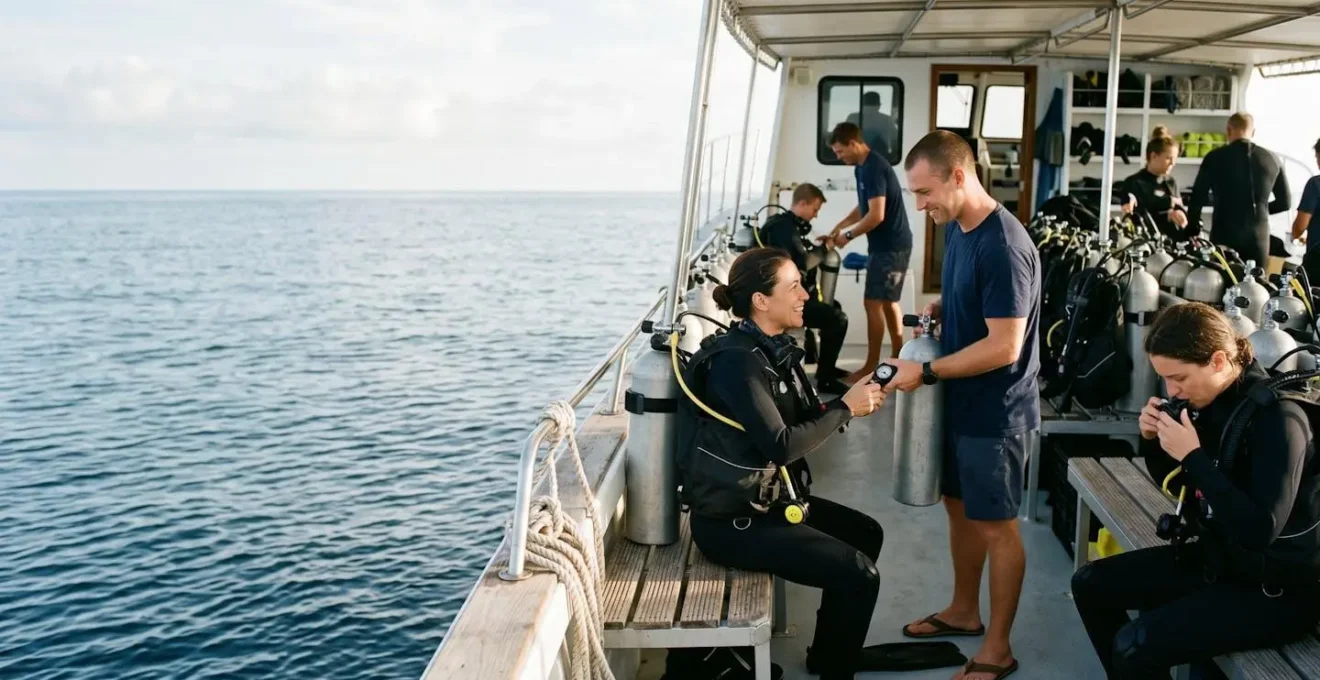
Look at this image. This is what competence looks like. The BCD is already on the tank, the regulators are attached, and everything is secured. There’s room for three more divers to do the same on that bench. This diver isn’t just organized; they’re ready. They’ve reduced the crew’s burden by being self-sufficient and spatially aware. Aim for this level of compact readiness. Your gear should occupy one vertical slot, not an entire horizontal surface. Mark your gear, keep it contained, and you’ll immediately earn a nod of approval from the captain.
How Being 5 Minutes Late Delays the Tide Window for Everyone?
You think five minutes is nothing? On land, maybe. At sea, five minutes can be the difference between a spectacular dive and a cancelled trip. Many of the best dive sites are only accessible during very specific tidal conditions. We’re not just waiting for you; we’re in a race against the moon. The crew has planned the entire day around hitting a dive site at « slack tide »—the period of minimal water movement between high and low tide. This is our window of opportunity for a safe and enjoyable dive.
This window is incredibly short. For many sites, the ideal conditions last for an approximately 1 hour window, which gives us about 30 minutes on either side of the peak. If the boat is scheduled to depart at 8:00 AM to reach the site for an 8:45 AM slack tide, your 8:05 AM arrival means we’ve already lost precious time. By the time we get out there, the current may have already started to pick up, drastically reducing our safety margin. Fighting a current is exhausting, dangerous, and burns through your air, shortening the dive for everyone who was on time.
Case Study: The Domino Effect of a Minor Delay
Dive operations in tidal regions are a lesson in precision timing. As noted in analyses of tidal dive planning, operators must align departures to hit high-water slack periods. A mere 10-minute delay in leaving the dock can cause the boat to miss this optimal window. This forces the captain into a difficult choice: either cancel the dive, disappointing every paying customer, or proceed into stronger currents. The latter option not only increases the physical strain on divers but significantly elevates the crew’s workload and stress levels as they work to manage divers in challenging, and potentially unsafe, conditions.
So when the captain says be here at 7:45 for an 8:00 departure, it’s not a suggestion. It’s a critical operational parameter. Being punctual is the first and most fundamental way you show respect for the crew, the other divers, and the powerful forces of the ocean we’re all here to enjoy. Your tardiness doesn’t just make you look bad; it actively puts the entire operation at risk.
Dry Area vs Wet Area: Keeping the Cabin Salt-Free
Every dive boat has an invisible line you need to see: the boundary between the wet area and the dry area. The wet area—the open deck where you gear up and where water splashes freely—is built for it. The dry area, typically the cabin or wheelhouse, is not. It’s where people store their phones, wallets, car keys, cameras, and warm clothes. Treating this space with anything less than total respect is one of the fastest ways to infuriate everyone on board.
The rule is simple: if you are wet, you do not enter the dry area. This doesn’t just mean when you’re dripping right after a dive. It means your damp wetsuit, your wet hair, or even the spray off your gear bag. Saltwater is incredibly corrosive. It ruins electronics, damages personal items, and makes every surface sticky and unpleasant. As the publication Dive Compare aptly puts it in their guide to boat etiquette:
A dry area is exactly as it sounds — an area of the boat that is designed to keep all of our belongings completely dry. You should try your hardest to not get this area wet if possible, as doing so could be very costly to another diver.
– Dive Compare, A Simple Guide to Boat Diving Etiquette
If you need something from your dry bag, either dry off completely first or, better yet, ask a dry crew member to get it for you. That’s part of their job. They would much rather fetch your sunglasses for you than spend the afternoon dealing with a fellow passenger’s water-damaged phone. A pro diver anticipates their needs, keeping essentials like a water bottle and sunglasses in the wet area. They understand that protecting the dry zone is a collective responsibility, and they act accordingly.
The Expectation of Tipping Crew Members in Spanish Culture
The title of this section mentions a specific culture, but let’s be clear: while customs can vary, the principle of acknowledging a crew’s hard work is universal in the diving world. Your dive crew—the captain, the divemaster, the deckhands—are service professionals. They are responsible for your safety, for getting you to the best sites, and for making your day run smoothly. Their work often involves long hours, heavy lifting, and immense responsibility, frequently for modest pay. Tipping is not just a gesture; it’s a standard and respected part of the industry’s compensation structure.
So, how much is appropriate? While local norms can differ slightly, a general guideline is to tip based on the quality of service and the price of the charter. Industry standards suggest a tip of around 15% to 20% of the charter rate, or about $5-10 per tank for each diver. If the crew went above and beyond—finding rare marine life, handling a tricky situation with professionalism, or providing exceptional assistance—tipping on the higher end of that scale is a great way to show your appreciation. Most boats will have a tip jar for the crew, which is typically pooled and split among everyone. If you’re unsure, just ask the captain what the standard procedure is.
A tip is a tangible « thank you » for the crew’s expertise and effort. It acknowledges the skill involved in navigating to the perfect drop-off point, the strength required to help you back on board, and the sharp eyes that spotted that hidden octopus. A pro diver budgets for a tip just as they budget for the dive itself. It’s a sign of respect for the profession and an understanding of the ecosystem that makes our sport possible. For a more detailed breakdown, this table offers clear guidelines for various scenarios, as outlined in a comparative analysis by dive professionals.
| Trip Type | Recommended Amount | When to Tip | Distribution Method |
|---|---|---|---|
| Day Boat (2-tank dive) | $10-20 total ($5-10 per tank) | End of each dive day | Tip jar or directly to crew, typically pooled and split |
| Liveaboard (multi-day) | 10-20% of total trip cost | End of trip, can tip daily for exceptional service | Envelope system, often divided between guides, deckhands, chef, and captain |
| Private Charter | 15-20% of charter cost | End of charter | Directly to captain who distributes, or individual envelopes |
| Guided Specialty Dive | $10-20 per dive (higher for rare sightings or technical dives) | Immediately after dive | Directly to divemaster/guide |
How to Vomit Respectfully Without Ruining the Trip for Others?
Seasickness happens. It can hit a 20-year naval veteran just as easily as a first-timer. There’s no shame in it. The only shame is in how you handle it. Vomiting in the boat’s head (the toilet) or, even worse, in a trash can inside the cabin, is an unforgivable sin. It creates a disgusting, lingering smell in an enclosed space that will ruin the trip for every single person on board. Handling it correctly is a matter of basic respect and situational awareness.
The number one rule is simple: feed the fish. If you feel nausea coming on, don’t be a hero and hope it passes. Act immediately. Your destination is the leeward (downwind) side of the boat. This is crucial. If you get sick on the windward (upwind) side, the spray will blow right back onto the boat and your fellow divers. Get to the edge, hold on tight, and lean as far overboard as you can. As Scuba Diving Magazine bluntly advises, « If you do get sick, get downwind and lean overboard. Your fellow passengers will appreciate it. » Nobody will judge you; in fact, they’ll be grateful you handled it like a pro.
Of course, the best approach is prevention. Don’t wait until you feel sick to act. If you’re prone to motion sickness, or even if you’re not sure, take preventative measures. It shows foresight and a respect for your own well-being and the comfort of others. Being prepared is the difference between a minor personal issue and a major group problem.
Your Action Plan: Pre-emptive Seasickness Management Protocol
- Take anti-nausea medications like Dramamine at least 30 minutes before the boat departs, not after symptoms start.
- Eat a light meal before departure; avoid heavy, greasy foods but don’t dive on an empty stomach.
- Position yourself in the middle of the boat where the motion is least pronounced, and avoid the bow (front) or stern (back).
- Keep your eyes trained on the stationary horizon rather than looking down at your gear or phone.
- Stay away from diesel engine fumes, which can trigger or worsen nausea.
- If you feel nausea coming on, move immediately to the leeward (downwind) side of the boat.
- Lean far overboard to be sick. Never, ever use the head (toilet) or an interior trash can.
RIBs vs Hard Boats: Which Vessel Suits Your Comfort Level?
Not all dive boats are created equal. Showing up for a ride on a Rigid Inflatable Boat (RIB) expecting the spacious deck and amenities of a large hard-hulled vessel is a recipe for a bad day. Understanding the type of boat you’ve booked is critical because it dictates everything from gear management to the social dynamic on board. A « pro mindset » means knowing the difference and preparing accordingly.
Hard boats are the larger, more stable vessels you probably picture when you think of a dive charter. They offer more space, benches for gearing up, storage underneath, dedicated camera tables, and often a head (toilet) and a dry cabin. The atmosphere is generally more social. On the other hand, RIBs, often used for smaller « 6-pack » charters with a maximum of 6 divers, are the sports cars of the sea. They are fast, nimble, and can get you to sites larger boats can’t reach. But the trade-off is space and comfort. There’s no storage, no dry area, and no room for error. You typically sit on the inflatable tubes, fully geared up for the entire, often bumpy, ride out. Your gear must be 100% self-contained and ready to go.
The etiquette required for each is vastly different. On a hard boat, you have time and space to prepare. On a RIB, you must be a model of efficiency. There’s no room for a sprawling gear bag or a slow setup. As this comparative table from dive training agency TDI/SDI shows, the operational demands on the diver are significantly higher on a RIB.
| Aspect | RIB (Rigid Inflatable Boat) | Hard Boat (Traditional Dive Vessel) |
|---|---|---|
| Typical Capacity | 6-12 divers (6-pack operations) | 12-30+ divers |
| Gear Storage | Minimal – one dive bag only, gear stays assembled and ready | Benches with under-storage, separate dry areas, camera tables |
| Entry Method | Backward roll or side entry, simultaneous entries common | Giant stride from platform, sequential entries managed by crew |
| Personal Organization Required | High – must be self-sufficient and fast, minimal crew assistance | Moderate – crew can assist, more time for preparation |
| Social Dynamics | Close quarters, quiet focus, experienced diver atmosphere | More social, multiple groups, varied experience levels, multiple briefings |
| Motion & Comfort | More bouncing, wetter ride, less shelter | Smoother, covered areas, restroom facilities |
Before you book a trip, ask what kind of boat will be used. Choosing the vessel that matches your comfort level and organizational skills is a key part of ensuring you have a good experience. A RIB is not the place for a first-time boat diver who is still figuring out their system.
Alpha Flag Rules: Who Is Responsible for Displaying It?
Here’s a question I get a lot: who is responsible for the dive flag? The simple answer is: the captain. Legally, the vessel’s operator is required to display the « Alpha » flag (a white and blue swallow-tailed flag) to signal to other boat traffic that they have a diver in the water and have restricted maneuverability. This is a non-negotiable rule of the sea. However, a pro diver knows that safety isn’t about passing the buck. It’s about shared responsibility.
While the captain has the boat covered, your personal responsibility for being seen doesn’t end there. What happens if you surface far from the boat? What if you get separated from your buddy or the group in low visibility? This is where your role in the « dive flag system » comes into play. You are responsible for your own surface visibility. This means carrying, and knowing how to use, a Delayed Surface Marker Buoy (DSMB), often called a « safety sausage. »
Deploying a DSMB from depth before you ascend makes you a bright, visible target on the surface. It signals your exact position to your own boat captain, making their job of tracking and retrieving you infinitely easier. It also alerts any other boat traffic in the immediate vicinity to your presence. Thinking of your DSMB as your personal dive flag is the right mindset. It’s an essential piece of safety equipment, not an optional accessory.
Shared Responsibility: The DSMB as a Personal Dive Flag
As highlighted in safety equipment analyses, the diver’s duty extends beyond just relying on the boat’s flag. While the captain is legally obligated to fly the Alpha flag, a diver’s active participation in their own safety is paramount. Leading dive safety protocols stress that every diver should carry and be proficient in deploying a DSMB from depth. This simple action transforms the diver from a passive participant into an active agent of their own safety, providing precise location information to the crew and upholding the spirit of the dive flag rule through personal accountability.
Key Takeaways
- True boat etiquette is about understanding the boat as an operational system, not just following a list of rules.
- Efficiency and spatial awareness (compact gear, punctuality, respecting zones) are forms of respect for the crew and other divers.
- Safety is a shared responsibility; from missing a tide window to deploying a DSMB, your actions directly impact the safety margin of the entire group.
Choosing a Dive Centre in Las Galletas: 3 Red Flags to Watch Out For
The name in the title is specific, but the lesson is universal. The easiest way to have a great boat diving experience is to choose a great dive operator from the start. All the personal etiquette in the world can’t make up for a poorly run, unsafe, or unprofessional charter. A seasoned diver learns to spot the red flags long before they hand over their money. You can tell a lot about an operation by the questions they answer—and the ones they can’t.
When you’re vetting a new dive center, go beyond asking about prices and dive sites. Ask operational questions. A quality operator will have clear, confident answers because they have established systems. A disorganized operator will hesitate or give you vague, non-committal replies. For example, ask them: « How is gear space managed on the boat? » A pro center will describe their bench allocation and storage protocols. A red flag operator will say something like, « Oh, there’s plenty of room. » Also, ask about their emergency procedures. They should be able to instantly confirm they have oxygen, first aid kits, and communications equipment on board and that their crew is trained to use them.
One of the biggest indicators of a shop’s professionalism is the condition of its rental gear. Ask to see it. Is it neatly stored and well-maintained, or is it a jumbled pile of worn-out equipment? As Scuba Diving Magazine warns, « Poor gear maintenance increases risks of dangerous failures and is a telltale sign that corners may be cut elsewhere. » Don’t be shy about inquiring about their service schedule. A reputable center will be proud to show you their commitment to safety. Trust your gut. If a place feels chaotic and disorganized on land, it will be ten times worse at sea.
Now that you know what to look for, use this knowledge on your next trip. Choose your dive operator wisely, ask the right questions, and step aboard any boat with the quiet confidence of a diver who belongs there. Your fellow divers, and especially the crew, will thank you for it.