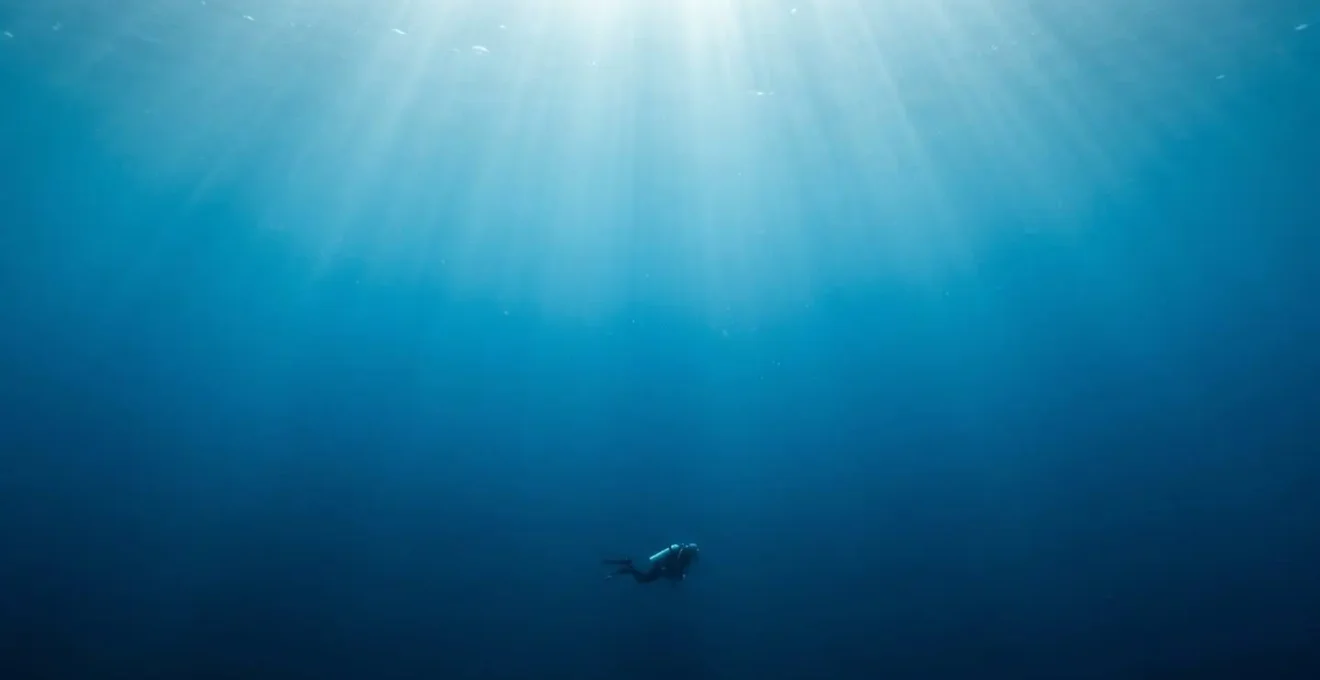
Locking in 30-metre visibility isn’t about lucky timing; it’s about predictive analysis of key oceanographic and atmospheric events.
- Understanding the impact of Saharan dust (Calima) and tracking its plumes is the single most important factor for avoiding poor winter visibility.
- Mastering swell forecasts, not just wind speed, is crucial for predicting how seabed sediment will affect clarity on specific coasts.
Recommendation: Shift from asking « which month is best? » to using the analytical tools in this guide to predict ideal dive windows with confidence.
For the dedicated diver, the quest for 30-metre visibility is the holy grail. It’s the difference between a good dive and an unforgettable underwater flight. Most guides offer a simple answer: « dive in the summer. » While not entirely wrong, this advice misses the complex, dynamic systems that truly govern water clarity in the Atlantic, particularly around the Canary Islands. It ignores the meteorological phenomena that can turn a promising dive trip into a murky disappointment, even in high season.
The common wisdom fails to account for specific, predictable events. It doesn’t explain why February can be a lottery, how powerful ocean swells differ from surface chop, or why the warmest water arrives long after the hottest days of summer. Relying on the calendar alone is a strategy of hope, not precision. For those of us who plan trips around specific photographic or technical goals, hope is not enough. We need a more analytical approach.
This is where the paradigm shifts. The key to consistently finding crystal-clear water is not in picking a lucky month, but in understanding the « why » behind the conditions. It’s about learning to read the signs—from satellite dust forecasts to the subtle metrics on a weather chart. This guide moves beyond generic advice to provide a data-driven framework. We will deconstruct the primary factors influencing visibility, empowering you to forecast your own perfect dive conditions.
To help you navigate these complex factors, this article breaks down the essential elements for predicting and achieving perfect visibility. The following summary outlines the key systems and strategies we will explore to transform your dive planning from a game of chance into a calculated science.
Summary: A Diver’s Guide to Atlantic Visibility
- Why the Calima Dust Phenomenon Ruins Underwater Visibility in February?
- How to Read Windguru Forecasts specifically for Tenerife’s South Coast?
- North vs South: Which Side Offers Better Visibility During Trade Winds?
- The Vertigo Risk of Blue Water Diving with No Visual Reference
- How to Choose Mask Lenses That Enhance Contrast in High Visibility?
- Why September Offers the Warmest Water of the Year?
- When to Dive El Condesito to Avoid Strong Currents at the Point?
- How the Atlantic Subtropical Currents Influence Water Temperature in February?
Why the Calima Dust Phenomenon Ruins Underwater Visibility in February?
The single greatest variable impacting winter visibility is the Calima, a phenomenon where strong southeasterly winds carry dense plumes of Saharan dust over the Atlantic. While creating dramatic orange skies on land, its effect underwater is devastating for clarity. The fine particulate matter suspended in the water column scatters sunlight, drastically reducing visibility and casting a greenish-yellow hue. This isn’t just a minor haze; severe events can reduce underwater visibility to less than five metres for several days.
The scale of these events can be immense. In late February 2020, one of the most intense Calima episodes in recent history blanketed the Canary Islands. This event was so severe it forced the closure of all airports, with winds gusting up to 120 kilometres per hour. Satellite data provides a stark picture of these dust storms; NASA reports show that during severe calima events, atmospheric visibility can drop to just 1.6 kilometers at airports, a clear indicator of the density of airborne particulates that will eventually settle into the ocean. Once the dust settles, it can take 3 to 5 days for the water to clear, and even then, the iron-rich dust can trigger a secondary phytoplankton bloom, further impacting clarity.
For the data-driven diver, tracking these events is key. You can monitor the Copernicus Atmosphere Monitoring Service for dust forecasts and use Sentinel-3 satellite imagery, which often shows dust plumes approaching up to a week in advance. Spain’s meteorological agency, AEMET, also issues formal warnings. Ultimately, planning dives outside the peak Calima season of February and March is the safest bet for avoiding this visibility-killer.
How to Read Windguru Forecasts specifically for Tenerife’s South Coast?
A generic weather forecast is insufficient for dive planning; a specialized tool like Windguru is essential. For Tenerife’s south coast, looking at a station like Las Galletas or Costa Adeje provides the localized data needed to predict conditions. The most common mistake is focusing solely on wind speed. For underwater visibility, the critical metrics are related to swell, not local wind waves.
You must learn to distinguish between ‘Wind waves’ and ‘Swell’. Wind waves are the local surface chop caused by immediate winds, which might affect boat comfort but has less impact on deep visibility. The real visibility-killer is the swell. Pay close attention to two key metrics: Swell Period and Wave Energy. A swell period above 10 seconds indicates powerful, long-period waves generated by distant storms. This deep energy churns the seabed at considerable depths, kicking up sand and sediment that can obliterate visibility, even on a day with no local wind. Wave Energy, measured in kilojoules (kJ), quantifies this power; values exceeding 300 kJ are a strong indicator that visibility at most shore and near-shore sites will be compromised.
This abstract chart represents the key elements a diver must analyze. The flowing lines symbolize the distinction between local wind-driven chop and the powerful, deep-reaching energy of ocean swells that truly determine underwater clarity.
Furthermore, swell direction is paramount. A powerful swell from the north will be blocked by the island’s massive topography, leaving the south coast completely calm. However, a less powerful swell from the south will directly impact all dive sites along that coast. Cross-referencing swell direction with wind direction allows for precise site selection. An easterly wind might make Las Galletas choppy, but a site like Palm-Mar, sheltered by the headland, will remain perfectly diveable.
North vs South: Which Side Offers Better Visibility During Trade Winds?
The Canary Islands are dominated by near-constant northeasterly trade winds. This prevailing weather pattern creates a fundamental difference between the island’s north and south coasts, making the choice of location critical for maximising visibility. The simple rule, driven by the island’s geography, is that the south coast is almost always the better choice for clarity and calm sea conditions.
The massive volcanic structure of Mount Teide acts as a giant natural barrier, shielding the southern coastline from the brunt of both the wind and the waves generated by the trade winds. This creates a « wind shadow » effect, resulting in significantly calmer seas and less churn. This observation is echoed by experienced divers and publications.
The south coast is sheltered from the waves and winds that blast the north.
– Scuba Diving Magazine, Canary Islands Travel Guide
While the north coast can offer spectacular and rugged diving, it is far more exposed and subject to rougher conditions that stir up sediment and reduce visibility. The south, by contrast, benefits from this shelter, allowing finer particles to settle and leading to more consistently clear water. While exceptional days can be found in the north, for a diver planning a trip specifically for 30-metre visibility, the south offers a much higher probability of success. The general consensus, according to PADI’s Canary Islands diving guide, is that visibility is at its peak from May to October when calm seas are most prevalent across the archipelago, a condition most reliably found on the sheltered southern shores.
The Vertigo Risk of Blue Water Diving with No Visual Reference
Achieving the goal of 30+ metre visibility introduces a surprising and counter-intuitive risk: sensory-deprivation vertigo. When diving in the deep, featureless blue—often called « blue water diving »—the very clarity you sought can become a source of profound disorientation. Without the seafloor, a reef wall, or even suspended particles to provide a visual frame of reference, the brain can struggle to process your body’s orientation in space.
The Challenge of the Blue Water Void
Open-ocean dives present a unique challenge due to the lack of visual references. The vestibular system in your inner ear detects motion and orientation, but in the infinite blue, your visual system has no fixed points to confirm this information. This sensory conflict is a classic trigger for vertigo. The phenomenon is paradoxically most pronounced in crystal-clear water. In this « sensory vacuum, » even experienced divers can suddenly feel as though they are tumbling or lose their sense of up and down, which can be a precursor to panic if not managed correctly.
This is not a sign of inexperience but a physiological response to an unnatural environment. The human brain is not wired to function in a three-dimensional, monochromatic void. Fortunately, this is a known challenge with established management techniques. It requires a shift in focus from external observation to internal and relative awareness. Maintaining a solid reference point, whether physical or psychological, is the key to staying oriented and comfortable in the big blue.
Action Plan: Managing Blue Water Vertigo
- Establish a Buddy Reference: Actively use your dive buddy’s fins as a horizontal reference line. Consciously position yourself to keep their body in your peripheral vision to serve as a fixed orientation point.
- Deploy a Downline: Utilize a personal weighted line (downline) deployed from the boat or a surface marker buoy. This provides an essential physical and visual reference throughout the entire water column.
- Trust Your Bubbles: If disorientation begins, make a conscious effort to watch your exhaled bubbles. They will always travel directly towards the surface, providing an infallible « up » direction.
- Practice Body Scanning: Use mindfulness techniques to ground yourself. Systematically focus on physical sensations: the feel of the regulator in your mouth, the pressure of the mask on your face, the position of your fins. This reinforces spatial awareness.
- Use a Fixed Personal Reference: In a moment of disorientation, focus intently on your dive computer or a specific point on your own equipment. Holding this single, stable visual reference can help your brain « reset » and overcome the sensory conflict.
How to Choose Mask Lenses That Enhance Contrast in High Visibility?
Once you’ve successfully found 30-metre visibility, your standard equipment can be optimised to make the most of it. In the vastness of the blue, enhancing contrast and colour becomes the next frontier. The choice of dive mask lens technology is no longer just about clear glass; it’s about using optical physics to improve what you see. Different lens tints and coatings are designed to filter specific wavelengths of light, which can dramatically alter the underwater scene.
In extremely clear, deep blue water, the colour spectrum is heavily skewed. Red and orange wavelengths are filtered out within the first few metres. A rose or magenta-tinted lens works to restore these lost colours, making coral formations and marine life appear more vibrant and natural. Conversely, in conditions that are slightly greener due to plankton (such as after a Calima event), an amber or yellow lens can increase apparent brightness and significantly boost contrast, helping you pick out details that would otherwise be lost in the haze. Furthermore, anti-reflective (AR) coatings are essential for high-visibility diving, as they reduce internal glare and reflections from the surface, eliminating visual noise and maximising light transmission to your eyes.
The following table, based on an analysis of color-corrected masks, breaks down how different lens types perform in various Atlantic conditions, allowing you to select the right tool for the specific environment you anticipate.
| Lens Type | Best Conditions | Primary Benefits | Atlantic Application |
|---|---|---|---|
| Amber/Yellow Tint | Green, particulate-rich water | Increases contrast by up to 25%, brightens low-light conditions | Ideal for post-calima dives or plankton-rich coastal waters |
| Rose/Magenta Tint | Clear blue water at depth | Restores red/orange colors lost below 10 feet, enhances coral and marine life vibrancy | Perfect for 30+ meter visibility days to bring back warm color spectrum |
| Blue Mirrored | Bright, sunny surface conditions | Amplifies light, provides higher contrast, reduces surface glare | Best for safety stops and shallow reef dives in tropical sunlight |
| Anti-Reflective (AR) Coating | All conditions, especially high-vis | Maximizes light transmission, reduces internal glare and reflections | Essential for eliminating visual noise in crystal-clear Atlantic water |
| Clear HD Lenses | Night dives, cave exploration, artificial light use | Maximum light gathering, no color distortion | Recommended for wreck penetration and low ambient light environments |
This macro view of a lens underwater illustrates the importance of optical quality. Light refracting through the water and glass creates prismatic effects, a reminder that your mask is the single most important piece of optical equipment for appreciating the clarity you’ve worked so hard to find.
Why September Offers the Warmest Water of the Year?
It’s a common misconception that water temperature peaks in July or August, in line with the hottest air temperatures. In reality, the ocean experiences a phenomenon known as thermal lag. Water has a much higher heat capacity than air, meaning it takes a great deal more energy and time to heat up. Throughout the long, sunny days of summer, the Atlantic is constantly absorbing solar radiation. This process is slow and cumulative.
The result is that the peak water temperature occurs much later in the season. While air temperatures may start to cool in September, the ocean has just reached its maximum heat accumulation from the preceding three months. This is why September and even early October consistently offer the warmest and most comfortable diving conditions of the year. For divers, this translates to longer bottom times, less need for thick wetsuits, and generally more pleasant surface intervals.
This seasonal peak is well-documented. For instance, diving operators in the Canary Islands report that water temperature ranges between 18°C and a peak of 24°C, with that maximum warmth consistently arriving in the September-October window. This period often coincides with calmer sea states as the strong summer trade winds begin to subside, creating a perfect convergence of warmth and clarity, making it the statistical prime season for Atlantic diving.
When to Dive El Condesito to Avoid Strong Currents at the Point?
The El Condesito wreck is one of Tenerife’s most famous dive sites, but its location on an exposed point makes it highly susceptible to strong currents. Timing your dive here is not optional; it is essential for both safety and enjoyment. Simply showing up is a recipe for a difficult, high-exertion drift dive. The key to a calm and controlled exploration of the wreck lies in understanding and diving during the slack tide window.
Slack tide is the short period at the peak of high or low tide when the water is still as the current reverses direction. However, at a site like El Condesito, there’s a crucial lag. Due to local underwater geography (bathymetry), the strongest current often occurs 1-2 hours *after* the listed tide time. The true slack window is a narrow, predictable period centred around the exact moment of high tide. Aiming to be in the water 30 minutes before high tide and finishing the dive within 60 minutes after is the standard operating procedure for minimal current.
To further increase your window of opportunity, planning your trip during neap tides (during the quarter moon phases) is a savvy move. During neap tides, the difference between high and low tide is smallest, resulting in weaker currents and a longer, more forgiving slack water period compared to the powerful currents of a spring tide (during full or new moons). Before even entering the water, experienced divers read the surface for clues: a lack of ‘boils’ on the surface, a mooring buoy hanging vertically, and the absence of distinct tidelines all indicate that slack conditions have arrived.
Key Takeaways
- September and October consistently offer the best combination of warm water (up to 24°C) and calm seas, representing the statistical peak season for diving.
- The Calima dust phenomenon, most prevalent in February and March, is the single greatest atmospheric threat to underwater visibility and should be actively tracked and avoided.
- Mastering predictive tools like Windguru (for swell energy) and tide charts (for slack tide windows) is non-negotiable for planning dives at specific sites and coasts.
How the Atlantic Subtropical Currents Influence Water Temperature in February?
February marks the nadir of water temperature in the Canary Islands, a direct consequence of large-scale oceanic systems. The primary driver is the Canary Current, a cold-water current that flows southward from the North Atlantic along the African coast. In winter, its cooling effect is amplified by a process called coastal upwelling, where trade winds push surface water away from the African continent, drawing deep, cold, nutrient-rich water to the surface.
This cold, upwelled water mixes into the Canary Current, significantly lowering its temperature before it reaches the islands. Records confirm this sharp drop; dive center records from Gran Canaria show that the water temperature can drop to approximately 17°C towards the end of February. While this temperature is invigorating, to say the least, it brings a silver lining for marine life enthusiasts. The nutrient-rich water from the deep fuels the entire marine food web, attracting large pelagic species and game fish closer to the islands.
This illustration visualizes the stratification of the ocean, where different water masses with distinct temperatures and clarities interact, driven by large-scale currents like the Canary Current.
However, the system is not static. The Canary Current sheds large, rotating bodies of water called ‘eddies.’ These can be either cold-core or warm-core. The passage of a warm-core eddy can cause a sudden, temporary increase in water temperature, from 18°C to 21°C in a matter of days. This dynamic explains the temperature fluctuations experienced during the winter months and highlights the importance of understanding the ocean as a complex, ever-changing system rather than a static body of water.
By synthesising these distinct data streams—atmospheric dust, swell dynamics, tidal cycles, and current systems—you move from being a passive tourist to an active, informed diver. The ultimate goal is to build an analytical framework that allows you to look at a forecast and confidently predict the conditions at a specific dive site several days in advance. This is the difference between hoping for a good dive and ensuring one. For your next trip, start by applying this framework: analyse the long-term seasonal data to pick your month, then use the short-term forecasting tools to select the perfect day and dive site.