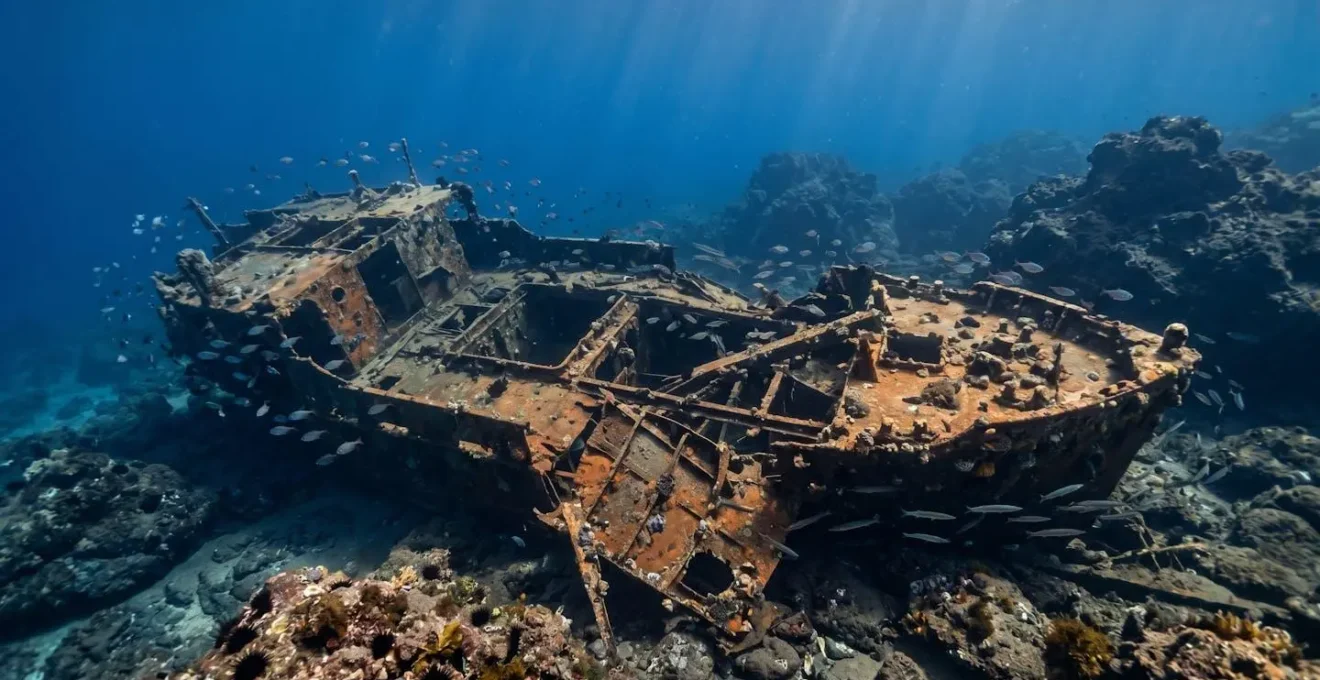
Diving the El Condesito is no longer a simple wreck visit; it’s an exercise in assessing a structure in active collapse, where historical knowledge is less valuable than real-time observation.
- Accelerated corrosion in its shallow, high-current location means the wreck’s structure is unpredictable and failing faster than ever.
- Standard wreck diving skills must be adapted to account for unique hazards like « rust-out » conditions and deceptive overhead environments that appear open but are unstable.
Recommendation: Shift your mindset from a tourist to a forensic investigator. Your primary goal is not to see the wreck, but to understand its moment-to-moment stability before proceeding with extreme caution.
For years, the El Condesito has been a staple of the Tenerife diving scene—a reliable, accessible wreck dive. Many certified divers have explored its broken hull, a former cement hauler that foundered off Punta Rasca in 1972. The common advice has always been the same: watch your buoyancy, bring a torch, and enjoy the marine life. But the El Condesito of today is not the wreck of a decade, or even five years, ago. It is a dynamic, rapidly changing environment where the old rules no longer fully apply.
The core of the issue is the wreck’s accelerated state of decay. Its relatively shallow depth, which makes it accessible, also exposes it to powerful forces that are tearing it apart. This is no longer a static historical site but a structure in active collapse. The purpose of this guide is not to repeat the generic tenets of wreck diving that you, as a certified diver, already know. Instead, we will adopt the mindset of a wreck conservationist and forensic expert to analyze the specific, evolving risks of the Condesito today. We will explore why it is deteriorating, how that changes the hazards within, and what specific adaptations are required to make an informed and safe assessment of this iconic, yet increasingly fragile, site.
This article provides an in-depth analysis for the experienced diver, examining the wreck’s structural decay, the necessary skills to navigate it, and the critical differences between this environment and other overhead sites. By understanding the forces at play, you can make a more informed decision about whether and how to approach the dive.
Summary: A Guide to Diving the El Condesito Wreck: Safety in Active Decay
- Why the El Condesito Wreck Is Breaking Apart Faster in Recent Years?
- How to Adapt Your Kicking Style Near Sharp Rusty Iron?
- Engine Room vs Cargo Hold: What Remains Recognizable Today?
- The Risk of Snagging Hoses on Exposed Metal Ribs
- When to Dive El Condesito to Avoid Strong Currents at the Point?
- How to Frog Kick Through Narrow Lava Tunnels Without Silt-Outs?
- The Risk of Diving Beyond Your Card Limits in Spanish Waters
- Navigating Tenerife’s Lava Tubes: Safety Protocols for Recreational Divers
Why the El Condesito Wreck Is Breaking Apart Faster in Recent Years?
The perception that the El Condesito is decaying more rapidly isn’t just an anecdote; it’s a reality grounded in marine science. The wreck lies in a perfect storm of corrosive forces. As a fundamental baseline, research shows that ship hulls in shallow water deteriorate at a rate of 0.1–0.4 mm per year due to electrochemical reactions with saltwater. However, the Condesito’s location significantly accelerates this process. Lying at a relatively shallow depth of around 18-20 meters, its steel structure is constantly bathed in oxygen-rich water, a key catalyst for oxidation—rust.
Furthermore, its position off Punta Rasca exposes it to consistent and sometimes powerful currents. This constant flow of water not only delivers more oxygen to the metal surfaces but also physically abrades the wreck. It strips away the protective layers of marine growth and oxidized material, exposing fresh steel to the corrosive process over and over. This phenomenon creates a cycle of accelerating decay.
Case Study: The Chuuk Lagoon Lessons
Scientific analysis of WWII shipwrecks provides a powerful parallel. A study on wrecks in Chuuk Lagoon confirmed that shallower wrecks, exposed to more oxygen and stronger currents, deteriorate much faster than their deeper counterparts. The study also highlighted how physical damage—in their case from dynamite fishing—shattered protective rust layers, leading to massively increased corrosion. For the El Condesito, every storm surge and strong current acts as a similar force, flexing weakened metal plates and causing structural failures that expose new surfaces to rapid decay.
The result is a transition from a stable structure to one experiencing active decay. Joints and plates that were reliable a few years ago may now be dangerously loose. Sections are collapsing, creating new entry and exit points, but also new overhead hazards and entanglement risks. Understanding this accelerated process is the first step in appreciating that the Condesito is not a static landmark but a dynamic, and therefore more hazardous, environment.
How to Adapt Your Kicking Style Near Sharp Rusty Iron?
Navigating the jagged, crumbling interior of the El Condesito demands more than just good buoyancy; it requires a complete adaptation of your propulsion techniques. The standard flutter kick, taught in open water courses, is a liability here. Its vertical motion stirs up sediment and, more dangerously on the Condesito, a cloud of fine rust particles. More importantly, it creates a wide, uncontrolled arc that can easily bring your fins into contact with razor-sharp, corroded metal edges.
The key is to adopt techniques that provide precise control and minimize water disturbance. The goal is to move like a surgeon, not a swimmer. This involves mastering finning styles that direct thrust backward, not down, and allow for minute positional adjustments without using your hands, which should be kept close to your body to avoid snagging.
As the illustration demonstrates, perfect horizontal trim is the foundation. From this stable platform, you can employ advanced kicks. The frog kick is paramount, creating propulsion in a single, controlled backward push, followed by a long glide. This minimizes water movement and keeps your fins within a predictable, narrow profile. For navigating tight spaces or backing out of a compromised area, the backward kick (a reverse frog kick) is an essential skill. For turning in place without stirring the environment, small sculling motions known as helicopter turns provide unparalleled control.
These are not just « nice-to-have » skills; on a deteriorating wreck like the Condesito, they are fundamental safety equipment. Practicing these techniques until they are second nature is as crucial as checking your air gauge. They allow you to maintain a safe distance from hazards while still exploring, respecting the wreck’s fragile state and protecting yourself from its sharpest dangers.
Engine Room vs Cargo Hold: What Remains Recognizable Today?
As the El Condesito continues its journey of structural collapse, navigating its interior has become an exercise in historical interpretation. What were once distinct compartments are now merging into a more chaotic, albeit fascinating, jumble of steel. The wreck lies on its side, broken into at least two major sections, which grants divers wide access but also obscures the original layout. Local experts confirm this transformation.
As noted by a local operator, the progressive breakup is a key feature of the modern dive experience. Aquarius Dive Center Tenerife explains:
Over the years the wreck has broken up into more than one piece, this allows you to investigate all around it
– Aquarius Dive Center Tenerife, El Condesito wreck dive site description
The cargo hold, which once carried bags of cement, is now the most open and accessible area. The bags themselves have long since solidified into a solid mass, forming a unique, undulating geological feature within the wreck. This area is broad and generally well-lit by ambient light from large openings where the hull plates have fallen away. However, these openings are framed by exposed, corroded metal ribs that pose a significant snagging hazard.
In contrast, the engine room area is a more complex and hazardous environment. While much of the machinery is still present, it is heavily encrusted and increasingly obscured by collapsing decking and bulkheads. Identifying specific components of the engine requires a keen eye and prior knowledge of the wreck’s layout. This section is darker, more confined, and holds more potential for disorientation. The « open » feel of the cargo hold can create a false sense of security, making the transition to the tighter, more complex engine room a point of increased risk for the unprepared diver.
The Risk of Snagging Hoses on Exposed Metal Ribs
In a pristine environment, a dangling hose or a loose console is an inconvenience. Inside the deteriorating structure of the El Condesito, it’s a critical emergency waiting to happen. The wreck’s ongoing collapse has turned it into a three-dimensional web of entanglement hazards. Every broken plate, exposed rebar, and hanging wire is a potential snag point. As the experts at TDI/SDI grimly observe, this is a universal risk in overhead environments.
Their experience in cave and wreck diving provides a stark warning:
wreck divers who penetrate wrecks often have a horde of cables, nets, wires, and ropes ready to reach out and grab at passing dive gear
– TDI/SDI Training Agency, Cave diving 101: Avoiding Entanglement safety article
This is not hyperbole. The primary risk is not that you will get stuck, but that a snagged hose will cause a catastrophic gear failure—ripping a mask off, dislodging a regulator, or causing a BCD to auto-inflate. Therefore, the most important safety procedure for the Condesito happens before you even enter the water: rigorous gear streamlining. Every single piece of equipment must be secured tightly to your body, creating a clean, snag-free profile. Nothing should dangle, loop, or protrude. This is a non-negotiable prerequisite for safely approaching the wreck.
Your Pre-Dive Streamlining Checklist
- Secure all hoses: Clip your SPG hose to a D-ring and secure it with a bungee loop to prevent dragging. Route your alternate air source under your arm and secure it snugly against your body.
- Eliminate dangling equipment: Place all accessories, such as lights, DSMBs, and cutting tools, in BCD pockets or secure them with bolt snap clips close to your body. Avoid carabiners, which can snag easily.
- Check D-ring attachments: Ensure all clipped items make contact with your body or BCD using bungee cord. Nothing should hang freely or extend beyond your body profile.
- Optimize hose lengths: Consider replacing excessively long regulator and low-pressure inflator hoses with shorter versions that allow a full range of motion without creating large loops.
- Tuck away excess straps: Secure all dangling straps, buckles, and webbing ends from your BCD and mask to prevent them from becoming entanglement hazards in confined spaces.
Treating your gear configuration with this level of detail is the embodiment of the proactive safety mindset required for this dive. It transforms your equipment from a collection of parts into a single, integrated, and safe system for a hazardous environment.
When to Dive El Condesito to Avoid Strong Currents at the Point?
The structural hazards of the El Condesito are compounded by a powerful environmental factor: current. Its location off Punta Rasca, a prominent headland, means it is often swept by strong tidal flows and oceanic currents. Fighting a current while trying to navigate sharp, rusty metal is a recipe for disaster. It depletes your gas supply, increases stress, and makes precise buoyancy and finning control nearly impossible. Therefore, timing the dive is as critical as any in-water skill.
The single most important rule is to dive the Condesito during slack tide. This is the short period, typically lasting about 30-60 minutes, between the outgoing and incoming tides when the water movement is at its minimum. A reputable dive operator will plan their trips meticulously around the local tide tables to hit this window. Your pre-dive briefing should explicitly state the tide conditions and the plan to dive during the slack period. Be wary of any operation that treats this as an afterthought.
You can also make your own assessment from the boat. Look at the surface of the water. Choppy, turbulent water or a strong current pulling on the mooring line are clear indicators of moving water. A calm, « glassy » surface, as depicted in the image, often signals the arrival of slack tide. While the best overall diving season in Tenerife for visibility is often cited as May to July, with conditions analysis suggesting visibility can exceed 30 meters, this macro-level planning does not replace the micro-level necessity of timing your dive to the daily tidal cycle. No matter how clear the water is, a strong current makes the dive unsafe.
As one expert resource confirms, « The ideal time for diving considering tidal movements is generally during slack tide when currents are at their weakest ». Choosing to dive at any other time is an unnecessary and dangerous gamble. It multiplies every other risk associated with the wreck, transforming a challenging dive into a hazardous one.
How to Frog Kick Through Narrow Lava Tunnels Without Silt-Outs?
To understand the level of precision required for the Condesito, it is useful to look at another of Tenerife’s unique underwater environments: its volcanic lava tubes. While geologically stable, these tubes present a similar overhead challenge—the risk of a silt-out. The floor of a lava tube is often covered in fine, light sediment. An undisciplined flutter kick can instantly reduce visibility to zero, a dangerous situation in any enclosed space. For this reason, cave and cavern divers have perfected techniques to prevent this.
The solution, as in the Condesito, is the frog kick and other modified finning styles. By keeping in horizontal trim and pushing water directly backward, divers can glide through these tunnels without disturbing the delicate sediment on the floor. This skill, honed in the predictable environment of a lava tube, is directly transferable to the unpredictable one of the wreck. However, on the Condesito, the threat is not just from the floor, but also from the ceiling.
From Silt-Out to Rust-Out: A Lesson from DAN
The Divers Alert Network (DAN) highlights a critical, often-overlooked hazard in overhead environments. A DAN analysis of wreck hazards documents how a diver’s own exhaust bubbles can cause a silt-out by hitting the ceiling and dislodging accumulated sediment. On an old steel wreck like the El Condesito, this creates an even more pernicious problem: a « rust-out. » Your bubbles can dislodge loose rust, flaking paint, and small, sharp metal fragments from the corroded ceiling. This cloud of particles not only obliterates visibility but also fills the water column with sharp, hazardous debris that can be inhaled or damage equipment.
This is why the lessons from lava tube diving are so vital. You must not only master the frog kick to avoid disturbing the floor but also be acutely aware of your position relative to the ceiling. This includes managing your breathing to create slow, gentle bubbles and positioning your body so that your exhaust does not percolate directly onto a fragile, rust-covered surface. The skill is the same, but the awareness must be three-dimensional.
The Risk of Diving Beyond Your Card Limits in Spanish Waters
The El Condesito’s accessibility is a double-edged sword. Because it starts in relatively shallow water, it is sometimes marketed as a dive suitable for Open Water divers. However, the moment you contemplate any form of penetration, even into the « open » cargo hold, you are operating in an overhead environment that demands skills and a mindset far beyond introductory training. Diving beyond the limits of your certification is not just a violation of agency standards; in a complex environment like this, it is a critical safety failure.
A Wreck Diver certification is the absolute minimum prerequisite for even considering entry. This training provides the foundational skills for line handling, emergency procedures, and the specialized propulsion techniques we’ve discussed. Simply having the card, however, is not enough. You must be an active, critical consumer. Before committing to a dive, you have a responsibility to vet the dive center’s protocols for this specific site. Do not assume their standard procedures are adequate for the evolving risks of the Condesito.
You must ask probing, specific questions to gauge their level of professionalism and their respect for the wreck’s current condition. A professional operation will welcome this scrutiny.
- Certification Requirements: Ask, « What is the minimum certification level you require for the El Condesito dive, and do you enforce restrictions on penetration versus external observation? »
- Site-Specific Briefings: Inquire, « What is your detailed pre-dive briefing protocol for the Condesito, including current structural hazards and known collapse zones? »
- Emergency Procedures: Question, « What is your specific contingency plan for an entanglement or disorientation event in any of the enclosed spaces? »
- Equipment Checks: Verify, « Do you conduct formal gear streamlining assessments before the dive to ensure our equipment configuration is appropriate for this deteriorating wreck? »
Ultimately, you are the final arbiter of your own safety. This includes carrying the right equipment. As one technical guide states simply, » Cutting tools are essential for managing entanglements in confined spaces ». If the dive plan, the operator’s attitude, or your own gut feeling raises any red flags, the only correct decision is to call off the dive or opt for an external-only swim-by. No dive is worth compromising your safety or that of your buddy.
Key Takeaways
- The El Condesito is in a state of active, accelerating decay, making it fundamentally more hazardous than a stable wreck.
- Advanced, precise finning techniques (like the frog kick) and rigorous gear streamlining are not optional; they are mandatory survival skills for this environment.
- A « rust-out » from bubbles hitting the ceiling is a unique and serious hazard that can destroy visibility with sharp metal particles, requiring three-dimensional environmental awareness.
Navigating Tenerife’s Lava Tubes: Safety Protocols for Recreational Divers
To truly grasp the unique risk profile of the El Condesito, it is immensely valuable to compare it directly with Tenerife’s other famous overhead diving environments: the natural lava tubes. On the surface, both seem to present a similar challenge—a roof over your head. However, this superficial similarity creates a deceptive sense of security on the wreck. Divers who are comfortable in the island’s lava tubes might dangerously underestimate the fundamentally different and more complex nature of the Condesito’s hazards.
A lava tube is a geologically ancient and stable structure. Its walls and ceiling are solid rock, formed thousands of years ago. The navigation is typically linear, with clear entrances and exits. The primary hazard is a potential silt-out from the floor, which can be managed with proper technique. The environment, while dark and enclosed, is predictable.
The El Condesito is the polar opposite. It is an artificial, unstable structure undergoing active, unpredictable collapse. Its hazards are not just from the floor, but from all directions: entanglement from wires, impalement from sharp metal, and collapse from a ceiling that may look solid but is weakened by decades of corrosion. The risk profile is not only more severe but also constantly changing. The following comparison highlights the critical distinctions.
The data below, adapted from an analysis of wreck diving risks, starkly illustrates the difference in the required mindset and skill level.
| Risk Factor | Lava Tubes (Tenerife) | El Condesito Wreck |
|---|---|---|
| Structural Stability | Geologically stable, formed over thousands of years, predictable structure | Actively collapsing, metal fatigue accelerating, unpredictable structural failures |
| Overhead Environment | Clearly defined ceiling and walls, known exit paths, linear navigation | Deceptive overhead hazards, sections appear open but have unstable ceilings, complex exit paths that may disappear |
| Entanglement Hazards | Minimal unless guidelines present, smooth rock surfaces | High risk: exposed cables, hanging wires, rebar, corroded metal edges, net fragments |
| Visibility Threats | Silt-out from fine sediment disturbance, predictable and manageable | Rust-out from metal particle disturbance, sharp flakes reduce visibility and create injury risk |
| Psychological Perception | Dark and enclosed, divers naturally recognize danger and exercise caution | Open and well-lit appearance creates false sense of security, danger is underestimated |
| Required Skill Level | Advanced/cavern certification mandatory, proper training enforced | Often marketed to Open Water divers despite requiring advanced wreck skills, training gaps common |
This comparison is not academic; it is the core of a safe approach to the Condesito. You must consciously discard any assumptions based on experience in natural overhead environments and approach the wreck as the unique, dynamic, and man-made hazard that it is.
The only safe way to dive the El Condesito today is to approach it with the cautious, analytical mind of a forensic investigator. Assess the conditions, evaluate the structure from a distance, have a non-negotiable and conservative dive plan, and be ready to call the dive at the first sign of instability—either in the wreck or in your own comfort level. This is how you honor the wreck and, most importantly, ensure you are able to dive another day.