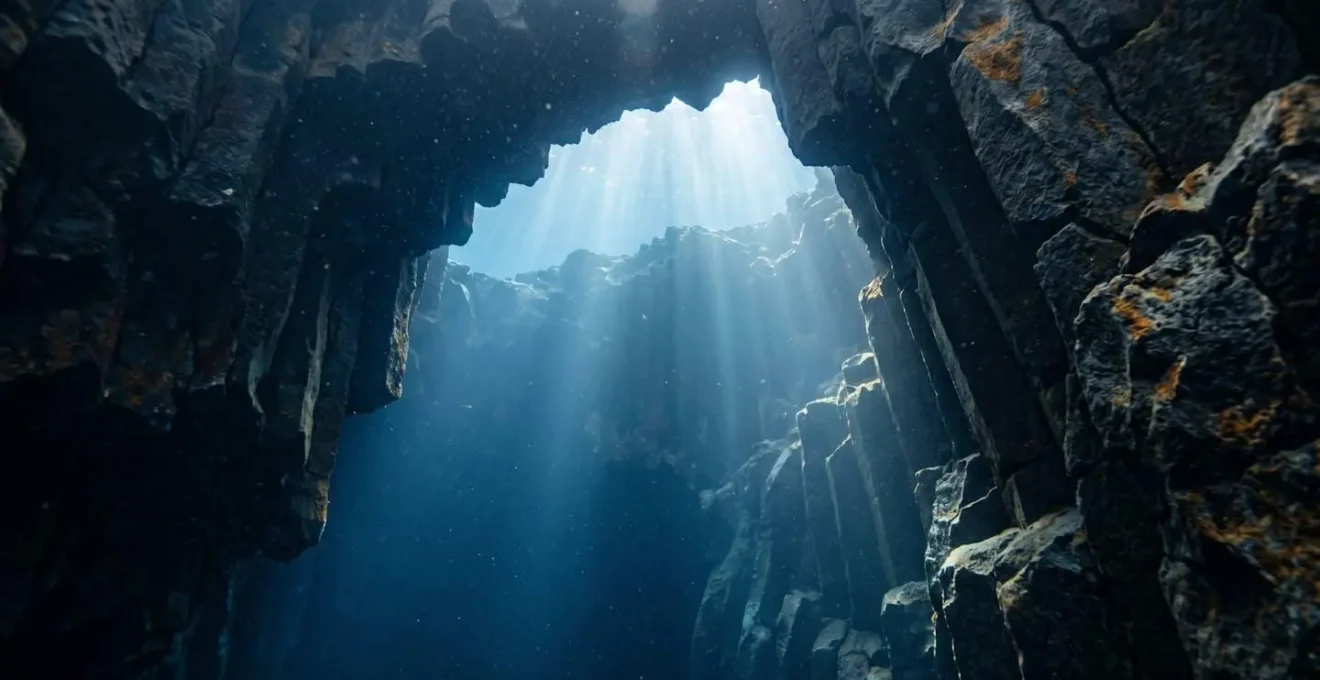
The Cathedral is not just a deep dive; it’s a test of mental fortitude that certifications alone do not prepare a novice diver for.
- Psychological pressures like darkness and overhead environments critically compound the physical risks of depth and narcosis.
- Advanced techniques like Nitrox or complex descents add cognitive load, dangerously shrinking safety margins for the inexperienced.
Recommendation: Gain significant experience (well beyond 20 dives) in challenging, deep, open-water environments before even considering this specific site.
The images of Tenerife’s Cathedral Reef are intoxicating. A vast underwater cavern, shafts of light piercing the dark, and the promise of a truly epic dive. It’s a siren call for any ambitious diver, especially those newly certified and eager to build their logbook. You’ve probably been told the standard advice: get your Advanced Open Water certification to go to 30 metres, watch your air, and stick with a guide. This advice is not wrong, but it is dangerously incomplete. It treats the dive as a simple depth challenge, a box to be ticked once you have the right plastic card.
The truth is far more complex. For a diver with fewer than 20 logged dives, the Cathedral is not a playground; it is an examination room for which you have not yet studied. The primary risk isn’t the depth itself, but the relentless cognitive load it imposes. It’s a rapid-fire sequence of stressors—darkness, depth, narcosis, overhead enclosure, and complex navigation—that can overwhelm an unprepared mind. An AOWD certification teaches you the ‘how’ of a deep dive, but it cannot give you the one thing you truly need for this site: the ingrained, instinctual calm that comes only from experience.
This guide isn’t here to scare you, but to give you the realistic briefing you deserve. It’s a shift in perspective from « Can I physically go there? » to « Am I mentally prepared for what happens when things go wrong there? ». We will dissect the specific pressure points of this dive, from the insidious effects of narcosis in the dark to the critical mistakes made in volcanic caves, to give you a clear-eyed understanding of why waiting is not a sign of weakness, but of a smart diver who plans to have a long and safe diving career.
This article breaks down the compounding risks of the Cathedral for a novice diver. The following sections will provide a clear, unvarnished look at each challenge you would face.
Summary: Is The Cathedral Reef Suitable for Open Water Divers With Less Than 20 Logs?
- Why Nitrogen Narcosis Hits Harder in the Dark Waters of the Cathedral?
- How to Equalize Effectively for a Quick Descent to 30 Metres?
- The Arch vs The Wall: Which Part of the Cathedral Is Most Demanding?
- The Risk of Exceeding NDL When Exploring the Cave Floor
- How to Plan Your Dive with Nitrox to Extend Time at the Cathedral?
- Advanced Open Water vs Deep Diver: What You Need to Dive to 40 Metres Here?
- The Silt-Out Mistake That Disorients Divers in Volcanic Caves
- Navigating Tenerife’s Lava Tubes: Safety Protocols for Recreational Divers
Why Nitrogen Narcosis Hits Harder in the Dark Waters of the Cathedral?
Nitrogen narcosis, often called « the martini effect, » is a familiar concept for any diver. The general rule is that for every 10 metres of depth, it feels like you’ve had one martini on an empty stomach. However, this simplistic analogy fails to capture the true danger at a site like the Cathedral. The issue isn’t just the intoxication; it’s how the environment weaponizes it. At 30 metres, inside a dark, overhead environment, the narcosis isn’t a giggly buzz. It’s a quiet thief of your cognitive function, your judgment, and your reaction time.
The sensory deprivation of the cavern amplifies the internal, neurological effects. With no clear surface reference and limited visual cues, your brain is already working overtime to maintain spatial awareness. Narcosis adds a layer of confusion and slows your processing speed at the exact moment you need it most. According to diving safety organizations, first signs can appear at depths as shallow as 30m, and are often masked, with the diver completely unaware of their own impairment. This is where a novice is most vulnerable. You may not even realize your judgment is compromised until you’ve made a critical error, like misreading your gauges or losing track of your buddy.
Furthermore, the goal-oriented nature of the dive—to see the « Cathedral »—can lead to a dangerous form of tunnel vision. A narcosed diver might fixate on reaching the main chamber, ignoring crucial signals from their body or their dive computer. The darkness conceals the subtle signs of impairment that might be obvious in bright, open water, making a vigilant buddy and strict self-discipline non-negotiable. For a diver without the ingrained habit of constant self-assessment, narcosis in the Cathedral’s gloom is a silent and formidable threat.
How to Equalize Effectively for a Quick Descent to 30 Metres?
The dive profile for the Cathedral often involves a relatively quick and direct descent to 30 metres to maximize bottom time. This is not a gentle, sloping reef. For an inexperienced diver, this presents the first major physical hurdle: equalization. A failed equalization attempt on descent is not just an inconvenience; it’s a primary point of failure that can derail the entire dive and introduce unnecessary stress. You must be able to equalize early, often, and effortlessly, even with the added pressure of keeping up with a group.
Many new divers rely solely on the Valsalva maneuver (pinching your nose and blowing), which can be ineffective or even harmful if done too forcefully. The more advanced and controlled Frenzel maneuver, which uses the tongue and throat muscles, is far superior for this type of descent. It’s a skill that requires practice on the surface to become second nature underwater. A rapid descent demands that you equalize proactively, *before* you feel the pressure, not in reaction to it. A novice, already task-saturated with managing buoyancy and monitoring their gear, can easily fall behind this curve, leading to ear pain, anxiety, and a halted descent.
This physical challenge is deeply intertwined with the psychological state of the diver. As the experts at Deep Sensations Freediving point out when discussing equalization failures:
Anxiety and tension can physically constrict the Eustachian tubes, making equalization difficult or impossible.
– Deep Sensations Freediving, Troubleshooting Your Equalisation Problems – What Your Failure Depth Says
This creates a dangerous feedback loop. The pressure to descend quickly causes anxiety, which in turn makes equalization harder, which increases anxiety. For a diver with fewer than 20 dives, who may not have fully mastered their personal equalization technique, this initial phase of the dive can be so stressful that it compromises their mental state for the entire bottom time.
As this image suggests, effective equalization is a matter of fine muscle control in the throat and jaw, not brute force. Mastering this technique is a prerequisite for a dive that begins with such a demanding descent profile. Without it, you are starting a challenging dive at a significant disadvantage, with your body and mind already under strain.
The Arch vs The Wall: Which Part of the Cathedral Is Most Demanding?
The Cathedral is not a single, uniform environment. It’s a site of two distinct characters: the vertical « Wall » on the exterior and the famous « Arch » or swim-through that forms the cavern itself. A novice diver might assume the deepest part is the most difficult, but the real challenge is more nuanced. The demand on the diver changes dramatically between these two sections, shifting from a physical test to a severe psychological one. Understanding this distinction is key to grasping why this site is unsuitable for the inexperienced.
The Wall is a more traditional deep dive. The primary challenges are physical: managing buoyancy along a vertical surface, monitoring depth, and contending with potential currents. While demanding, the key safety factor is that open water is always visible. The exit is always clear. A diver feeling overwhelmed can simply signal, end the dive, and ascend. The risk is manageable through good discipline and training.
The Arch, however, is a completely different animal. Once you enter this overhead environment, the psychological load skyrockets. The exit is no longer everywhere; it’s a specific point behind you. This creates a « point of no return » illusion that can trigger claustrophobia and anxiety, even in a wide-open cavern. This psychological pressure is the number one reason for increased air consumption. An anxious diver is an air-hungry diver, and in an overhead environment at 30 metres, your SAC (Surface Air Consumption) rate can spike dramatically, slashing your planned bottom time and safety reserves.
This table from a comparative analysis of the dive site’s features highlights the critical differences:
| Feature | The Arch (Overhead Section) | The Wall (Vertical Section) |
|---|---|---|
| Depth Range | 30-35 meters | 20-45 meters (adaptable) |
| Primary Challenge | Psychological load (overhead environment, darkness, goal fixation) | Physical demands (currents, verticality, spatial orientation) |
| Air Consumption Impact | HIGH – Anxiety and depth combine to spike SAC rate significantly | MODERATE – Shallower sections offer better gas economy |
| Narcosis Risk | ELEVATED – 30m+ depth combined with sensory deprivation amplifies cognitive impairment | VARIABLE – Depends on chosen depth along wall |
| Exit Visibility | LIMITED – Overhead swim-through creates ‘point of no return’ illusion | CLEAR – Open water always visible, easier abort |
| Novice Risk Level | CRITICAL – Psychological overload is the primary failure mode for <20 dives | MANAGEABLE – With proper depth discipline and current assessment |
The data is unequivocal. The Arch presents a critical risk level for a novice. It’s not a test of swimming; it’s a test of mental composure under multiple, compounding stressors. An inexperienced diver simply does not have the mental toolkit to manage this level of cognitive load effectively.
The Risk of Exceeding NDL When Exploring the Cave Floor
Your dive computer is your most important piece of safety equipment on a deep dive. The No-Decompression Limit (NDL) it calculates is not a suggestion; it’s a hard limit that keeps you out of decompression diving, a far more advanced and risky type of diving. At the Cathedral, where the floor can dip to 35-40 metres, the temptation to « just go a little deeper » to explore the cavern floor is immense. For a narcosed and task-saturated novice, this temptation can be fatal.
At 30 metres, your NDL time is already significantly reduced. A momentary lapse in attention—distracted by the unique rock formations or trying to get the perfect photo—can lead you to drift deeper. A few metres of depth change can slash minutes off your NDL. If you exceed this limit, your dive computer will put you into decompression mode, requiring mandatory stops on your ascent. Missing these stops dramatically increases your risk of Decompression Sickness (DCS), a serious medical condition. In fact, research in medical diving literature shows that an increased risk of DCI is directly associated with violating no-decompression limits on dives deeper than 24.6m (80ft).
The real danger for the novice is task saturation. You are already managing buoyancy in a new environment, tracking your buddy in low light, monitoring your air, and dealing with narcosis. Adding « constantly monitoring NDL » to this list can be the straw that breaks the camel’s back. This is why experienced divers develop an internal « scan » rhythm. It’s an ingrained habit of checking Air, Depth/NDL, Buddy, and Environment every 60 seconds. A diver with fewer than 20 logs has not had time to develop this automatic rhythm. Their focus is external, on the « wow » factor of the dive, rather than the internal discipline of dive management. In the Cathedral, this lack of discipline means you are not just diving; you are actively drifting towards a decompression obligation without even realizing it.
How to Plan Your Dive with Nitrox to Extend Time at the Cathedral?
A common misconception among new divers is that Nitrox is a « magic gas » that makes deep dives safer or easier. For a dive like the Cathedral, many believe using Enriched Air Nitrox (EANx) will extend their no-decompression limit (NDL), giving them more time to explore. While it’s true that Nitrox extends your NDL, for an inexperienced diver at this specific site, it is not a solution. In fact, it introduces a new and critical risk: oxygen toxicity.
Nitrox contains a higher percentage of oxygen, which becomes toxic at depth. Every Nitrox mix has a Maximum Operating Depth (MOD) that must never be exceeded. The problem is that this adds another layer of complex management to an already high-stakes dive. You are now tracking NDL, air pressure, AND your MOD. For a novice, this increases cognitive load, it doesn’t reduce it. It replaces one problem (short NDL) with a potentially more dangerous one (oxygen toxicity), which can cause convulsions and drowning.
The following case study illustrates why this is a terrible trade-off for an inexperienced diver at this site.
Case Study: Nitrox MOD Calculation Risk for Cathedral Reef
For a dive to 30 meters at Cathedral Reef using standard EANx32 (32% oxygen), the Maximum Operating Depth (MOD) at a partial pressure of 1.4 PPO2 is 33.8 meters. This creates only a 3.8-meter margin for error—a razor-thin safety buffer when considering the Cathedral’s vertical topography. If a novice diver with poor buoyancy control accidentally drops from 30m to 35m while task-saturated (e.g., clearing their mask or checking a camera), they instantly exceed their MOD. This adds acute oxygen toxicity risk to an already cognitively overloaded situation. This case demonstrates why Nitrox adds complexity rather than simplification for inexperienced divers at this specific site, where the true limiting factor is air consumption and mental management, not NDL time.
Your limiting factor on this dive will not be your NDL. It will be your air consumption, which will be high due to depth and anxiety. Using Nitrox to gain bottom time you can’t use because you’re low on air is pointless and adds a critical failure point. This is a tool for experienced technical divers, not a shortcut for recreational divers trying to cheat experience.
Advanced Open Water vs Deep Diver: What You Need to Dive to 40 Metres Here?
Let’s be perfectly clear: your certification card is a license to learn, not a certificate of mastery. The question is not whether an Advanced Open Water (AOWD) or Deep Diver specialty legally allows you to go to 30 or 40 metres. The question is whether you possess the actual skill and experience to handle the immense pressures of that environment. For a site like the Cathedral, the plastic card in your wallet is the least important part of the equation.
An AOWD certification typically involves five dives, one of which is a deep dive, often to just 18-30 metres. A Deep Diver specialty involves a few more, focusing on the procedures for diving to 40 metres. This provides you with theoretical knowledge and a brief, highly supervised taste of the environment. It does not provide you with the ingrained reflexes, the mental calmness, or the problem-solving capacity that only comes from repeated exposure. Experience is what allows you to manage a free-flowing regulator at 35 metres without panicking. Experience is what makes buoyancy control automatic, freeing up your mental bandwidth to manage other tasks. A certification card cannot give you this.
Your logbook is a far more honest indicator of your readiness than your certification cards. The number of dives, the variety of conditions, and the range of depths you have comfortably managed are the true measures of your capability. The statistics on diving accidents are sobering and directly relevant here. An analysis of diving accident data reveals that approximately half of all diving fatalities occurred among divers with fewer than 20 dives. This isn’t a coincidence. It is a stark indicator of the gap between certification and genuine competence. For the Cathedral, you need to be well beyond the « high-risk » category. You don’t need another card; you need more dives. You need experience.
The Silt-Out Mistake That Disorients Divers in Volcanic Caves
The floor of the Cathedral and similar volcanic formations is often covered in fine, dark silt. For a novice with less-than-perfect buoyancy and inefficient finning technique (like the bicycle kick), this presents one of the most terrifying and disorienting situations in diving: a silt-out. A single misplaced fin kick can instantly stir up the bottom, reducing visibility from several metres to absolute zero in seconds. In an open water environment, this is an annoyance. In an overhead environment like the Cathedral, it is a life-threatening emergency.
When visibility drops to zero, a diver’s immediate, panicked instinct is to swim—usually upwards or forwards—to try and find clear water. This is the single worst thing you can do. It stirs up more silt, completely disorients you, and can cause you to become separated from your buddy and the exit guideline. The psychological impact is immense; it’s the underwater equivalent of being blindfolded in a maze. This is a classic example of how a small error in technique, amplified by a challenging environment, can cascade into a major incident. As a sobering reminder from the Divers Alert Network (DAN), human error is the root cause of most tragedies. A safety analysis from DAN highlights that a staggering 90% of diving fatalities are linked to diver error.
An experienced cave or wreck diver has drilled the proper emergency procedure for a silt-out until it is pure muscle memory. They fight the panic and execute a controlled, deliberate protocol. A diver with 15 dives has not. They will react with instinct, and in this situation, their instinct is wrong. This is not a theoretical risk; it is a predictable outcome of placing an unprepared diver in a complex environment. Before even thinking about a dive with a silty bottom and an overhead, every diver must know and have mentally rehearsed this critical safety drill.
Action Plan: Silt-Out Emergency Protocol
- STOP: Cease all movement immediately. Any fin kick or hand movement will worsen visibility exponentially.
- HOLD: Establish and maintain physical contact with your buddy’s arm or BCD strap. If you lose contact, maintain contact with a fixed reference like the cave wall or a guideline.
- BREATHE: Focus on slow, controlled breathing to manage anxiety and conserve air. Resist the urge to ascend or rush.
- WAIT: Remain stationary for the 2-5 minutes it may take for the silt to begin settling. Use this time to mentally review your entry route and exit strategy.
- EXIT: Once partial visibility returns, or while maintaining contact with a guideline, execute a slow, controlled exit using a modified frog kick or pull-and-glide technique to avoid re-suspending the silt.
Key Takeaways
- The Cathedral’s primary risk for a novice is cognitive overload from compounding stressors, not just depth.
- For divers with under 20 logs, adding complexities like Nitrox or exploring overhead sections erodes safety margins instead of extending them.
- True readiness for this dive is measured in logged experience and mental resilience, not just certification cards.
Navigating Tenerife’s Lava Tubes: A Final Protocol for Recreational Divers
We’ve dissected the individual risks: narcosis, equalization, overhead environments, NDL management, and silt-outs. The crucial lesson is that these dangers do not exist in isolation. At the Cathedral, they stack on top of each other, creating a chain of compounding risk factors. Your narcosis impairs your judgment to manage your NDL. Your anxiety over the overhead environment spikes your air consumption and makes equalization difficult. Your poor finning technique creates a silt-out, and your panicked reaction is made worse by narcosis. This is the reality of cognitive overload, and it is why experience is the only true safety equipment.
A novice diver’s safety plan often relies on the « Rule of Thirds » for gas management—one-third in, one-third out, and one-third in reserve. But this rule was designed for experienced divers with predictable air consumption and calm nerves. For a novice in a high-stress environment, this rule is inadequate. A more responsible approach is required.
Case Study: The ‘Rule of Halves’ for Novice Overhead Gas Planning
For a dive like the Cathedral’s overhead sections, a novice with fewer than 20 dives should apply the ultra-conservative ‘Rule of Halves’. Example: You start with 200 bar. The traditional Rule of Thirds would allow exploration until 133 bar. The Rule of Halves, however, dictates you must turn the dive at 100 bar. This acknowledges the predictably high air consumption that will occur under stress and narcosis. It provides the huge safety margin that inexperience demands. In the dark, confined spaces of the Cathedral at 30m, this conservative approach is the only one that responsibly accounts for the unknown: how you, as an individual, will react when your mental capacity is pushed to its limit for the first time.
Ultimately, the decision to dive the Cathedral is a measure of your self-awareness as a diver. It is about replacing ego with an honest assessment of your abilities. This dive will still be there in a year, or in two years. It will be waiting for you when you have 50, 75, or 100 dives in your logbook—when you have faced and calmly managed unexpected challenges in less critical environments. It will be waiting for you when your skills are so ingrained that they are second nature, freeing up your mind to truly and safely appreciate the majesty of the place.
Before you book a trip to see the Cathedral, take an honest look at your logbook and your real-world experience. Your next step isn’t a new certification card or a piece of gear; it’s accumulating more deep, open-water dives to build the resilience this world-class site demands.