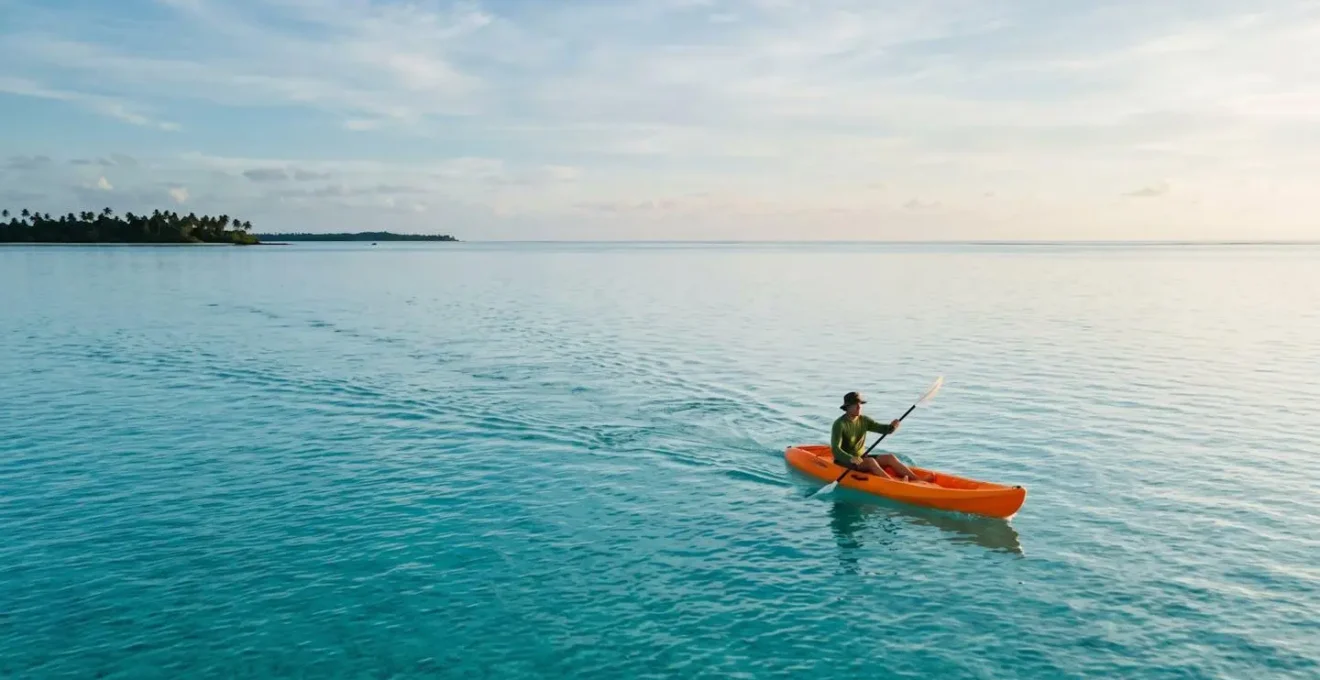
Your decompression day is a powerful training opportunity, not just a waiting game.
- Stand-up paddleboarding (SUP) directly engages the same core muscles you use for perfect trim and buoyancy control underwater.
- Kayaking provides steady, low-impact cardio that promotes stable nitrogen off-gassing, making it superior to the sporadic bursts of snorkeling.
Recommendation: Instead of just killing time, choose a surface sport that actively cross-trains your diving skills and makes you a better, stronger diver on your next descent.
As a scuba diver, you know the rule: that mandatory 18-to-24-hour surface interval before flying is non-negotiable. For many, this « no-fly day » feels like a frustrating pause—a day of missed adventure stuck on land while the ocean still calls. The common advice is to take it easy, maybe go for a walk or relax by the pool. But what if that downtime could be repurposed? What if, instead of passively waiting for nitrogen to leave your system, you could use that day to actively sharpen the very skills that make you a better diver?
The typical approach to a decompression day focuses solely on what to avoid: high altitudes, strenuous exercise, and dehydration. While crucial, this defensive mindset overlooks a massive opportunity. The real key isn’t just about avoiding harm; it’s about actively pursuing beneficial movement. Forget the lazy beach day. We’re going to reframe this day as a strategic cross-training session. This guide isn’t another generic list of tourist activities. It’s a high-performance plan for active divers who want to turn their surface interval into a competitive advantage.
We’ll break down why some activities are smarter choices than others, how they directly translate to better in-water performance, and how to do it all safely. We will explore the specific biomechanics that link paddleboarding to buoyancy control and explain why the steady rhythm of kayaking is the ideal partner for your body’s off-gassing process. Get ready to transform your next no-fly day from a mandatory stop into a powerful step up in your diving journey.
This article provides a complete game plan for your active recovery day. You’ll find a breakdown of the safest and most beneficial activities, practical tips for preparation, and the science behind why these choices will elevate your diving skills. Let’s dive in.
Summary: Your Decompression Day Dive Training Plan
- Why Driving Up Teide Is a Risk but Kayaking Is Safe Before Flying?
- How to Book Rentals in Advance to Secure Equipment?
- Kayaking vs Snorkeling: Which Is Better for Active Recovery?
- The Risk of Severe Sunburn on the Surface After Days Underwater
- Which Activities Are Suitable for Non-Diving Family Members?
- The Risk of Being Grounded from Flying for 72 Hours After Treatment
- Why SUP Engages the Same Core Muscles Used for Trim in Diving?
- Can Stand-up Paddleboarding Improve Your Scuba Buoyancy and Core Strength?
Why Driving Up Teide Is a Risk but Kayaking Is Safe Before Flying?
Alright team, let’s get the biggest safety rule locked down first. After a series of dives, your body is saturated with dissolved nitrogen. The whole point of a surface interval is to allow this nitrogen to « off-gas » safely and slowly. The biggest enemy to this process is a sudden drop in ambient pressure, which is exactly what happens when you gain altitude. Think of it like opening a soda bottle too quickly—the dissolved gas comes out of solution in the form of bubbles. In your body, these bubbles can cause Decompression Sickness (DCS), a serious and potentially fatal condition.
This isn’t just a theoretical risk. While commercial aircraft cabins are pressurized, they are typically held at an equivalent altitude of 1,800 to 2,400 meters (6,000 to 8,000 feet). This pressure change is enough to trigger DCS in a recently-dived individual. The risk is even greater with ground-based travel to high altitudes, like a scenic drive up a mountain. For instance, research on altitude decompression sickness indicates that symptoms can appear above 3,353 m (11,000 ft) even without prior diving, highlighting the profound effect of altitude. After diving, that threshold is significantly lower.
This is precisely why sea-level activities are your go-to. Kayaking, paddleboarding, or swimming keep you at a stable, consistent pressure, allowing your body to do its job without interference. You get to stay active and in the water, but in a way that works *with* your physiology, not against it. You’re eliminating the single biggest environmental risk factor and setting yourself up for a safe flight home. The mountain will be there on your next trip; your priority now is a safe and effective off-gassing period.
Staying at sea level is the non-negotiable foundation of a smart decompression day. It’s the first and most important decision you’ll make.
How to Book Rentals in Advance to Secure Equipment?
Once you’ve committed to a brilliant, sea-level activity, the last thing you want is to show up and find all the gear is gone. Popular dive destinations are busy, and equipment for activities like kayaking and stand-up paddleboarding is in high demand. Your game plan should include securing your rentals at least 24-48 hours in advance, especially during peak season. Don’t leave it to chance.
Start with a simple online search for « kayak rental [your location] » or « SUP rental [your location] ». Look for operators with solid reviews and an easy-to-use online booking system. This not only guarantees your equipment but also lets you compare prices and packages. When you book, confirm the duration, what’s included (paddles, life vests, dry bags), and the cancellation policy. A quick phone call can often clarify details and give you a feel for the operator’s professionalism. Ask them about the best local spots for paddling—they’re the local experts and can point you to sheltered coves or scenic routes perfect for a relaxed day.
This foresight pays off. It removes stress from your decompression day, letting you focus on recovery and enjoyment. Arriving with a confirmed reservation means you get straight to the good part: getting out on the water. Proper planning is the hallmark of a smart athlete and an experienced diver.
Before you even step on the paddleboard or sit in the kayak, a quick gear check is essential. This isn’t just about safety; it’s about ensuring a smooth, hassle-free experience on the water. A few minutes of inspection on shore can save you an hour of frustration later.
Your Pre-Rental Equipment Checklist
- Inspect the Hull/Board: Look for any significant dings, cracks, or deep gouges on the kayak or SUP. Ensure fins are secure and rudders (if any) are functioning.
- Check Your Paddle: Adjust the paddle to the correct height (for SUP) or check that it’s the right length for your kayak. Ensure the locking mechanism is tight and there’s no wobble.
- Test the Life Vest (PFD): Make sure it’s the correct size, all buckles and zippers work, and there are no rips or tears in the fabric or straps.
- Confirm Leash and Safety Gear: For SUP, ensure the ankle leash is in good condition. For kayaking, confirm you have a bailer or pump and any other required safety gear.
- Secure a Dry Bag: If you’re taking a phone, keys, or wallet, get a dry bag from the rental shop and test its seal before putting your valuables inside.
This proactive approach ensures that your only focus is the water, the sun, and the steady rhythm of your paddle.
Kayaking vs Snorkeling: Which Is Better for Active Recovery?
This is a common question, and from a coaching perspective, the answer is clear: for active recovery after diving, kayaking has a distinct edge. While snorkeling seems like a natural, low-key choice, it doesn’t align as well with the primary goal of your no-fly day: stable and efficient nitrogen off-gassing. Your body needs consistency, and that’s where kayaking shines.
Remember, the process of eliminating dissolved nitrogen from your tissues is a marathon, not a sprint. According to diving physiology experts, it takes up to 24 hours for recreational divers to fully off-gas after their last dive. The ideal activity to support this process involves light, steady-state cardiovascular exercise. This type of activity promotes stable circulation, which acts like a consistent delivery service, transporting nitrogen from your tissues to your lungs to be exhaled. Kayaking, with its rhythmic, continuous paddling motion, is a perfect example of this. You maintain a consistent heart rate and a steady metabolic rate, creating the perfect environment for efficient off-gassing.
Snorkeling, on the other hand, is often an activity of « stop and go. » You might float peacefully for a few minutes, then see a turtle and kick furiously to keep up. These sudden bursts of high-intensity effort can alter your circulation and respiration rates unpredictably, which is less ideal for the stable off-gassing process. While it’s still a safe, sea-level activity, it’s not as *physiologically optimal* as the steady effort of kayaking.
Case Study: Off-Gas Experiences by Original Diving
To illustrate this point, consider the experiences documented by dive travel experts at Original Diving. They highlighted kayaking along coastal cliffs as a successful surface interval activity. The report noted that the gentle, rhythmic paddling motion allows divers to remain active while avoiding pressure changes. Crucially, it promotes stable circulation for efficient nitrogen off-gassing, without the exertion spikes associated with snorkeling when one might chase after marine life. This real-world observation confirms that for predictable, controlled active recovery, the steady pace of a kayak is superior.
By choosing kayaking, you’re not just passing the time; you’re making a deliberate, scientifically-backed choice to aid your body’s recovery process.
The Risk of Severe Sunburn on the Surface After Days Underwater
After spending several days underwater, your body is in a unique state that makes you surprisingly vulnerable to the sun. It’s not just that you’ve been out of the sun; it’s that diving itself creates a perfect storm for dehydration, which in turn dramatically increases your risk of a nasty sunburn. This is a critical safety point that many divers overlook on their decompression day.
The primary culprit is the air you breathe. The compressed air in your tank is extremely dry. Every breath you take underwater sucks moisture from your body. In fact, dive safety research shows that you can lose nearly a cup of water on a single 30-minute dive through respiration alone. Add to that the osmotic effect of being immersed in salt water, which can draw more fluid from your skin, and you’re likely starting your surface interval in a state of mild to moderate dehydration, even if you don’t feel thirsty.
Dehydrated skin is less resilient and burns far more easily. It has lost some of its natural protective barrier, and its ability to repair itself from UV damage is compromised. This is where you need to be extra vigilant. On your kayaking or paddleboarding day, you’ll be exposed to direct sun as well as reflected UV rays from the water’s surface, a double dose of radiation. As the experts at DAN Europe warn, this combination can be potent.
Breathing compressed air and immersion in salt water can leave a diver’s skin more vulnerable to sun damage.
– DAN Europe, Hydration Guidelines for Divers
Your action plan is simple but non-negotiable: aggressively rehydrate with water and electrolytes throughout the day, and be meticulous with sun protection. This means applying a high-SPF, water-resistant sunscreen, wearing a wide-brimmed hat, sunglasses, and a long-sleeved rash guard. Treating sun protection as seriously as you treat your dive tables is the mark of a pro.
Which Activities Are Suitable for Non-Diving Family Members?
One of the best things about choosing kayaking or stand-up paddleboarding for your active recovery day is that they are incredibly inclusive. While your motivation might be tied to dive-specific cross-training, these activities are fantastic fun for everyone, regardless of their diving experience. This turns your « no-fly day » into a shared adventure for the entire family or group.
Kayaking, for instance, can be easily adapted to different fitness and confidence levels. You can opt for single kayaks for the more adventurous members of your group, while double kayaks are perfect for a parent and child or for partners who want to paddle together. The pace can be as leisurely or as brisk as you like. It’s an opportunity to explore coastlines, discover hidden coves, and enjoy the marine environment from a new perspective, together. It’s an activity that fosters teamwork and communication, especially in a double kayak!
Similarly, stand-up paddleboarding is more accessible than it looks. Most rental shops are located in calm, sheltered bays, which are ideal for beginners to find their balance. It’s common to start by paddling on your knees and only progressing to standing when you feel comfortable. Kids often take to it instantly, and it becomes a playful platform for jumping into the water. For the non-divers in your group, it’s a full-body workout and a fantastic way to connect with the water, offering a sense of freedom and a great view of the underwater world from above.
By choosing one of these sports, you’re not isolating yourself for a solo « diver recovery » session. You’re creating a shared, memorable experience that bridges the gap between the divers and non-divers in your party, ensuring everyone finishes the trip on a high note.
The Risk of Being Grounded from Flying for 72 Hours After Treatment
This is the part of the briefing no one wants to need, but every serious diver must understand. Let’s be crystal clear: if you experience symptoms of Decompression Sickness (DCS) and require treatment in a hyperbaric chamber, your travel plans change dramatically. The standard 24-hour no-fly rule is out the window. You are entering a new, much more conservative safety protocol.
Hyperbaric oxygen therapy works by recompressing you to a greater pressure and having you breathe pure oxygen, which helps shrink any nitrogen bubbles and allows the dissolved gas to be eliminated safely. While highly effective, the process isn’t an instant reset. Your body remains in a highly sensitive state post-treatment, and the risk of a relapse is very real. Exposing your body to the reduced pressure of a flight cabin too soon can cause the symptoms to return, sometimes with greater severity.
Because of this heightened risk, the guidelines are strict and absolute. After a successful hyperbaric treatment for DCS, dive physicians strongly recommend a no-fly period of 72 hours. This is considered the absolute minimum to ensure your body has stabilized. Flying before this window has passed is a dangerous gamble, as medical literature confirms a significant number of patients experience relapses. It’s a risk that is never worth taking. This isn’t a suggestion; it’s a critical safety mandate to protect your health.
This underscores the importance of conservative diving practices and listening to your body. The goal is to never need this information, but knowing it is part of being a responsible and prepared diver.
Key Takeaways
- Altitude is the primary risk post-dive; stick to sea-level activities to ensure safe nitrogen off-gassing.
- The steady, rhythmic motion of kayaking or SUP is physiologically superior for active recovery compared to the sporadic exertion of snorkeling.
- Diving causes dehydration, which significantly increases sunburn risk. Aggressive hydration and sun protection on your surface day are critical.
- Stand-up paddleboarding directly trains the core muscles and balance reflexes essential for mastering neutral buoyancy and trim underwater.
Why SUP Engages the Same Core Muscles Used for Trim in Diving?
Now we get to the core of our cross-training strategy. Why is stand-up paddleboarding (SUP) such a game-changer for divers? Because the act of balancing on that unstable surface forces you to engage the exact same network of muscles responsible for maintaining perfect horizontal trim underwater. Think of the SUP board as your personal trim-training simulator.
When you’re diving, achieving flat, stable trim isn’t about your arms and legs; it’s about your core. It’s the small, powerful muscles in your abdomen, obliques, and lower back that hold your body in that effortless-looking horizontal position. These muscles make the micro-adjustments that keep you from see-sawing with every breath. They are the foundation of efficient propulsion and good buoyancy control.
On a paddleboard, you are constantly fighting to maintain your center of gravity over an unstable platform. Every ripple on the water, every gust of wind, and every paddle stroke requires an immediate, subconscious reaction from your core to keep you upright. Your transverse abdominis, glutes, and spinal erectors are firing constantly. This is a form of proprioceptive training—you are teaching your body to feel its position in space and react instantly. It’s the same feedback loop you use underwater to sense whether you’re slightly head-up or feet-down and correct it without conscious thought.
By spending an hour on a paddleboard, you are performing hundreds of core-stabilizing repetitions without even thinking about it. You’re building muscle memory that will translate directly into a more stable, controlled, and efficient presence in the water on your next dive.
Can Stand-up Paddleboarding Improve Your Scuba Buoyancy and Core Strength?
Absolutely. If you want to take your buoyancy control from good to great, spending your decompression day on a stand-up paddleboard is one of the smartest training moves you can make. The connection is direct and powerful. Mastering buoyancy is about making tiny, precise adjustments to your body position and lung volume. SUP hones the very physical intelligence required for this mastery.
As we’ve established, the constant instability of the board ignites your core muscles. This translates into a stronger, more stable « chassis » when you’re in the water. A strong core is the anchor for neutral buoyancy. It prevents the unnecessary sculling with your hands or kicking with your fins that burns through air and disturbs the environment. When your core is locked in, you become a more stable platform, and every breath you take becomes a more precise tool for ascending or descending.
The payoff is huge. Divers who regularly practice activities that challenge their balance, like SUP or yoga, often find they have a more intuitive feel for their position in the water. They react to changes in buoyancy faster and with more subtlety. They use less energy, consume less air, and ultimately have longer, more controlled, and more enjoyable dives. It’s the difference between actively *fighting* to stay neutral and simply *being* neutral.
The next time you plan a dive trip, don’t just think about your dives; plan your active recovery. Choose the water sport that won’t just pass the time, but will actively build you into a more competent, confident, and efficient diver. Your logbook—and your air consumption—will thank you for it.