In summary:
- Mastering responsible riding is the real thrill, not just speed. It turns you from a tourist into a skilled, eco-conscious explorer.
- The 60-metre distance from dolphins isn’t just a rule; it’s a vital buffer to protect their sensitive hearing (biosonar) from your engine’s acoustic footprint.
- Your choice of jet ski matters. Modern 4-stroke engines are up to 97% cleaner and significantly quieter than older 2-stroke models, minimizing water and noise pollution.
- Following a certified guide isn’t a limitation—it’s your best tool for safe, legal, and truly breathtaking encounters with Tenerife’s incredible marine life.
The feeling is electric. The throttle is in your hand, the warm Tenerife sun is on your back, and the vast blue Atlantic opens up before you. A jet ski safari promises pure adrenaline, a high-speed dance with the waves. Then, you see it—a flash of grey, a dorsal fin breaking the surface. A pod of pilot whales or dolphins. The immediate instinct is to get closer, to capture that perfect photo, to be part of that magical moment. But this is where the thrill of speed meets a profound responsibility.
Many will tell you the key to a good safari is simply to « follow your guide » and « don’t get too close. » While true, this advice is passive. It treats you like a passenger. It misses the bigger picture: that the ultimate skill, the truest form of mastery on the water, isn’t about pushing your machine to its limits. It’s about understanding the environment you’re in so you can ride *with* it, not against it. What if the real adventure was learning how to be a silent, respectful guest in the home of these magnificent creatures?
This guide goes beyond the basic rules. We’ll explore the ‘why’ behind the regulations, from the science of a dolphin’s hearing to the mechanics of a clean engine. You’ll learn the techniques to handle your jet ski like a pro, ensuring the safety of yourself, your wallet, and most importantly, the incredible marine life that makes Tenerife a world-class wildlife destination. It’s time to level up your riding game from tourist to true eco-adventurer.
To help you navigate this thrilling yet sensitive environment, this article breaks down everything you need to know. From understanding the crucial distances to respect and the technical aspects of your jet ski, to the legal boundaries you must never cross, here is your complete guide to responsible riding.
Summary: Your Guide to a Responsible Jet Ski Safari in Tenerife
- Why You Must Maintain 60 Metres Distance from Dolphin Pods?
- How to Handle Choppy Waves Without Flipping the Jet Ski?
- 2-Stroke vs 4-Stroke: Which Engine Is Quieter for the Environment?
- The Risk of Losing Your £200 Deposit for Minor Collisions
- Where Can You Legally Free-Ride Outside of Guided Safaris?
- Why Are Certain Coastal Zones Off-Limits to Recreational Divers?
- Why Crossing the Yellow Buoys Can Result in a £500 Fine?
- How to Ensure Your Marine Encounters Don’t Harm the Animals?
Why You Must Maintain 60 Metres Distance from Dolphin Pods?
That 60-metre rule isn’t an arbitrary number; it’s a critical lifeline for Tenerife’s cetaceans. Think of it as a protective ‘acoustic bubble’. Dolphins and whales are highly auditory creatures. They navigate, hunt, and communicate using a sophisticated form of natural sonar called echolocation. Your jet ski’s engine, even at a distance, creates a significant acoustic footprint underwater, which can disrupt this vital sense. Getting too close can cause confusion, stress, and may even lead them to abandon important feeding or resting areas.
The law is clear and based on scientific understanding of animal welfare. In fact, official regulations in Tenerife mandate a 60-metre minimum distance for all vessels observing cetaceans. As research highlights, this interference is a serious threat. A study on the effects of man-made noise explained that a cetacean’s « biosonar is compromised by increasing anthropogenic noise in marine environments, » directly impacting their ability to survive.
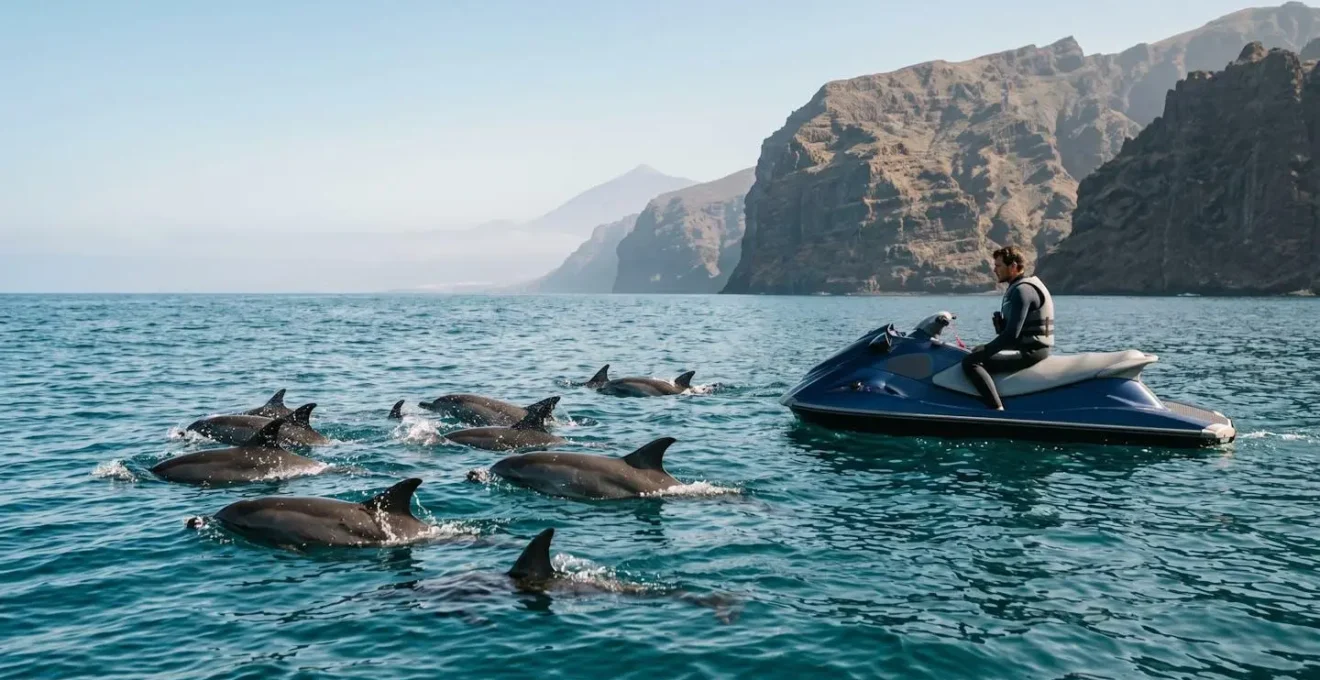
As you can see in the image above, 60 metres provides a substantial buffer that allows the animals to behave naturally without feeling threatened by your presence. It turns your encounter from an intrusion into a respectful observation. Violating this distance is not only harmful to the animals but also illegal, carrying steep penalties. A responsible rider understands that the best view is one where the animals are calm and undisturbed in their natural habitat.
How to Handle Choppy Waves Without Flipping the Jet Ski?
Rider mastery isn’t just about respecting wildlife; it’s also about commanding your machine with confidence and skill, especially when the calm sea turns choppy. Hitting waves at the wrong angle or speed is a rookie mistake that can easily lead to an uncomfortable ride or, worse, flipping your jet ski. The key isn’t to fight the ocean but to learn how to dance with it. This involves a technique of throttling and gliding that uses the jet ski’s momentum and your body weight to your advantage.
Instead of bracing for impact, you learn to use your knees and core as a natural suspension system. The goal is to get the jet ski to « plane » over the water’s surface, skimming across the tops of the waves rather than plowing through them. This requires you to anticipate the wave patterns and apply power at the right moment to lift the hull, then ease off as you crest the wave to maintain stability. It’s a proactive, not reactive, approach to riding.
Mastering this technique not only makes your safari safer and more enjoyable but also reduces stress on the machine and minimizes your acoustic footprint by avoiding constant, jarring engine revving. Here are the core steps to becoming a more skilled rider in rougher conditions:
- Read the Water: Always look ahead, identifying the pattern and size of oncoming waves from at least 50 metres out.
- Angle of Attack: Never hit a wave head-on (perpendicular). Approach waves at a 30 to 45-degree angle. This allows the hull to slice through the water more effectively, reducing impact and the risk of becoming airborne.
- Throttle Control: Apply a burst of throttle just before you reach the wave’s base to gain planing speed (around 20-25 km/h). As you start to climb the wave face, ease off the throttle slightly.
- Weight Distribution: Shift your weight slightly towards the back as you ascend the wave. This helps lift the nose of the jet ski. As you go over the crest, keep your body centered.
- Active Stance: Stay standing or in a semi-crouch with your knees bent and flexible. Let your legs absorb the shock, not your spine. Keep a firm but relaxed grip on the handlebars.
2-Stroke vs 4-Stroke: Which Engine Is Quieter for the Environment?
The jet ski you ride has a massive impact on the pristine waters of Tenerife. The engine type is the single biggest factor determining your environmental « engine hygiene. » For years, older jet skis ran on 2-stroke engines, a design that is notoriously inefficient and dirty. These engines work by mixing oil directly with fuel, and a significant portion of this unburned, oily mixture is expelled directly into the water and air with the exhaust.
Just how inefficient are they? It’s shocking. According to California’s Division of Boating and Waterways, up to 25-30 percent of the fuel in a conventional 2-stroke engine goes unburned and is discharged directly into the environment. This releases harmful hydrocarbons that are toxic to marine life, damage sensitive ecosystems like seagrass beds, and create a visible sheen on the water’s surface. In contrast, modern 4-stroke engines are a world apart. They are designed like car engines, with a separate, closed-loop oil system. They are vastly more fuel-efficient, quieter, and produce dramatically fewer emissions.
A reputable safari operator in Tenerife will exclusively use a modern fleet of 4-stroke jet skis. Choosing one is a powerful vote for a healthier marine ecosystem. The difference in environmental impact is not small; it’s a night-and-day comparison.
| Characteristic | 2-Stroke Engine | 4-Stroke Engine |
|---|---|---|
| Fuel Discharge Rate | 25-30% unburned into water | <3% emissions |
| Pollution Reduction | Baseline (high emissions) | 97% less pollution |
| Oil-Fuel Mixing | Yes (direct petrochemical discharge) | No (separate systems) |
| Combustion Efficiency | Incomplete (since 1940s design) | Complete combustion design |
| Underwater Noise | Higher frequency, irregular | Lower, more consistent |
| Catalytic Converter | Rarely equipped | Standard in modern models |
The Risk of Losing Your £200 Deposit for Minor Collisions
Beyond the environmental responsibilities, there’s a very practical reason to practice rider mastery: your wallet. Every jet ski safari requires a security deposit, typically around £200, to cover potential damages. Losing this deposit over a minor, avoidable collision is a frustrating end to an otherwise amazing day. Most incidents don’t happen because of high-speed stunts, but from a simple lack of awareness during low-speed manoeuvres or when riding in a group.
The most common cause of collisions is following the jet ski in front too closely. On water, there are no brake lights, and your stopping distance is much greater than on a road. A jet ski moving at 60 km/h can take 30 to 40 metres to come to a complete stop. Following in another rider’s wake not only reduces your visibility but also puts you in their « danger zone » if they suddenly slow down or turn. It is crucial to maintain a safe following distance and to stay offset from the rider in front of you, not directly behind them.
Another frequent mistake is abrupt stopping. When you want to stop to observe wildlife or wait for the group, always signal your intention with a raised hand and decrease your speed gradually. A sudden stop can catch the rider behind you off guard. True rider mastery means being predictable and spatially aware at all times. It’s about protecting your deposit not through timid riding, but through smart, defensive techniques that keep everyone safe.
Where Can You Legally Free-Ride Outside of Guided Safaris?
The temptation to break away from the group and explore on your own is understandable. The idea of « free-riding »—renting a jet ski without a guide—seems like the ultimate freedom. However, in a highly sensitive and regulated marine environment like Tenerife, this is an incredibly risky proposition, both legally and environmentally. The waters are a complex patchwork of open zones, restricted areas, and strictly protected marine reserves that are not always clearly marked to the untrained eye.
Without an expert guide, you have no real-time knowledge of where a pod of resident pilot whales might be resting or where a sensitive breeding ground is located. This significantly increases the risk of unintentional harassment and violations. The Teno-Rasca Marine Reserve, for example, is a massive conservation zone where unauthorized approaches to wildlife are strictly forbidden. As one case demonstrated, tourists who jumped from their vessel to interact with whales faced substantial fines, showing that authorities take these rules very seriously. Free-riding puts you at high risk of making a similar, costly mistake.
Case Study: The High Cost of Unauthorised Encounters in Teno-Rasca
The Teno-Rasca Marine Conservation Zone, covering nearly 70,000 hectares, has strict rules prohibiting unauthorised watercraft from approaching resident whale populations. In a notable incident, several tourists were heavily fined for violating these rules after jumping from their boat to swim with pilot whales. This case highlights a critical point for free-riders: even if you are in a legally designated riding zone, a spontaneous wildlife encounter can lead to severe legal liability. Without a professional guide providing real-time information on protected pod locations and restricted approach zones, the risk of accidental violations is extremely high.
Furthermore, the harm is not just from a single encounter. As highlighted by researchers, « recreational watercraft may also have cumulative impacts on marine mammals, with an individual animal potentially encountering a multitude of vessels each day. » A guided safari is structured to minimize this cumulative stress. A guide isn’t a restriction; they are your key to freedom, safely navigating the regulations so you can focus on the thrill of the ride and the beauty of the ocean.
Why Are Certain Coastal Zones Off-Limits to Recreational Divers?
The restrictions on where you can ride a jet ski, dive, or even anchor a boat are not designed to spoil your fun. They are essential measures to protect one of the most unique and vulnerable marine ecosystems in the world. The waters off the southwest coast of Tenerife, particularly the Tenerife-La Gomera Marine Area, are not just a random patch of ocean; they are a designated sanctuary of global importance. In January 2021, this area became Europe’s first Whale Heritage Site, a prestigious designation awarded by the World Cetacean Alliance.
This recognition is due to the area’s incredible biodiversity. The seafloor near the coast drops dramatically, reaching depths of over 1,000 metres just a few miles from shore. This creates a perfect, nutrient-rich habitat that supports an astonishing variety of life. Up to 28 different species of cetaceans have been spotted here. Most importantly, the area is home to one of the largest populations of resident short-finned pilot whales in the world. In fact, marine biologists have documented a resident group of about 400 individuals, one of the highest densities found anywhere on the planet.
These zones are off-limits because they are critical feeding grounds, nurseries for young calves, and resting areas for these resident populations. The constant traffic of unregulated vessels, the noise from their engines, and the physical risk from propellers can cause chronic stress, displace the animals from their core habitat, and even lead to injury. Protecting these zones is about ensuring the long-term survival of the very wildlife that makes Tenerife so special.
Why Crossing the Yellow Buoys Can Result in a £500 Fine?
Along the coast of Tenerife, you will see lines of large, yellow buoys bobbing in the water. These are not suggestions; they are the maritime equivalent of a solid wall. These buoys mark the boundary of designated swimming areas, typically extending 200 metres from the shoreline. For all motorised watercraft, including jet skis, crossing this line into the swimmers’ zone is strictly illegal and extremely dangerous.
The reason for the hefty fine—which can be £500 or more—is simple: public safety. The area inside the buoys is reserved for people, who are often difficult to see from a fast-moving vessel. A collision between a jet ski and a swimmer would be catastrophic. The authorities enforce this rule with zero tolerance to prevent such accidents. Your guide will be acutely aware of these boundaries and will ensure the safari route stays well clear of them.
This rule is part of a wider framework of Spanish maritime law designed to protect both people and wildlife. As stated by the Spanish Ministry for Ecological Transition (MITECO), these regulations are in place for safety and to minimize environmental disturbance. For example, regarding wildlife, official guidance specifies clear rules on vessel conduct to avoid harassment.
Royal Decree 1727/2007 and MITECO guidance prohibit unauthorized approaches within 500 meters and emphasize slow, predictable movements to avoid disturbance.
– Spanish Ministry for Ecological Transition (MITECO), Marine Protection Regulations and Coastal Safety Framework
Respecting the yellow buoys is non-negotiable. It’s a clear, bright line that separates the thrill of high-speed riding from the calm, safe space of the beach. It’s the most basic rule of responsible seamanship.
Key Takeaways
- The 60-Metre Bubble is Sacred: Your primary responsibility is to maintain a minimum 60-metre distance from all marine life to protect them from acoustic stress.
- Your Engine Matters: Always choose safaris that use modern, clean-burning 4-stroke engines. They are significantly quieter and up to 97% less polluting than older 2-stroke models.
- Guides Are Your Allies: A certified guide is not a restriction. They are your key to navigating complex regulations, finding the best (and safest) spots, and ensuring your adventure is both thrilling and responsible.
How to Ensure Your Marine Encounters Don’t Harm the Animals?
So, you’ve respected the distance, chosen a clean engine, and you’re with a great guide. Now, the magic happens: a pod of dolphins appears. How you conduct yourself in this moment is the ultimate test of rider mastery. The goal is proactive observation, not disruptive pursuit. It’s about letting the animals control the encounter and reading their behaviour to ensure they are comfortable with your presence.
The worst thing you can do is speed directly towards them from the front or behind; these are perceived as threat angles. The professional technique is a « parallel drive. » You position your jet ski parallel to the pod’s direction of travel, maintaining the 60-metre bubble, and match their speed. If they are swimming calmly at 5-10 km/h, you do the same. This non-threatening approach allows them to accept you into their environment. Once you are in a good observation position, the best move is to cut your engine entirely. The silence dramatically reduces your acoustic footprint and often makes the animals more curious and relaxed.
This moment of quiet observation is often the most rewarding part of the safari. You’re no longer just a noisy spectator; you’re a silent guest. It’s crucial to watch for any signs of stress, such as tail slapping or sudden changes in direction. If you see this, it’s a clear signal to slowly back away and give them more space. Remember, this is their home. We are just visitors, and the most memorable encounters are the ones built on mutual respect.
Your Action Plan for a Respectful Encounter
- Assess Your Approach Angle: Never motor directly towards dolphins from the front or rear. Always plan a slow, parallel approach course that runs alongside their direction of travel.
- Maintain the Safety Bubble: Actively maintain the 60-metre minimum distance. Match their speed, which is often a slow crawl, rather than maintaining your cruising speed.
- Monitor for Stress Signals: Watch the animals’ body language. Rapid surfacing, loud tail slaps, or abrupt changes in direction are all signs of stress. If you see any, increase your distance to over 100 metres immediately.
- Go Silent for the Best View: Once you are in a stable, parallel position, cut your engine. This eliminates your acoustic footprint and provides the most natural, least intrusive observation experience.
- Let Them Lead the Dance: Never pursue a pod that is swimming away. Respect their choice to end the encounter. Even if they seem relaxed, limit your direct observation time to a maximum of 15 minutes to prevent cumulative stress.
Your jet ski safari in Tenerife can and should be one of the most exciting experiences of your life. By embracing the principles of rider mastery—understanding the rules, respecting the wildlife, and honing your skills—you elevate the adventure. Now, go out there and have an incredible, responsible ride. Choose a certified « Barco Azul » operator and be part of the solution for protecting Tenerife’s marine paradise.