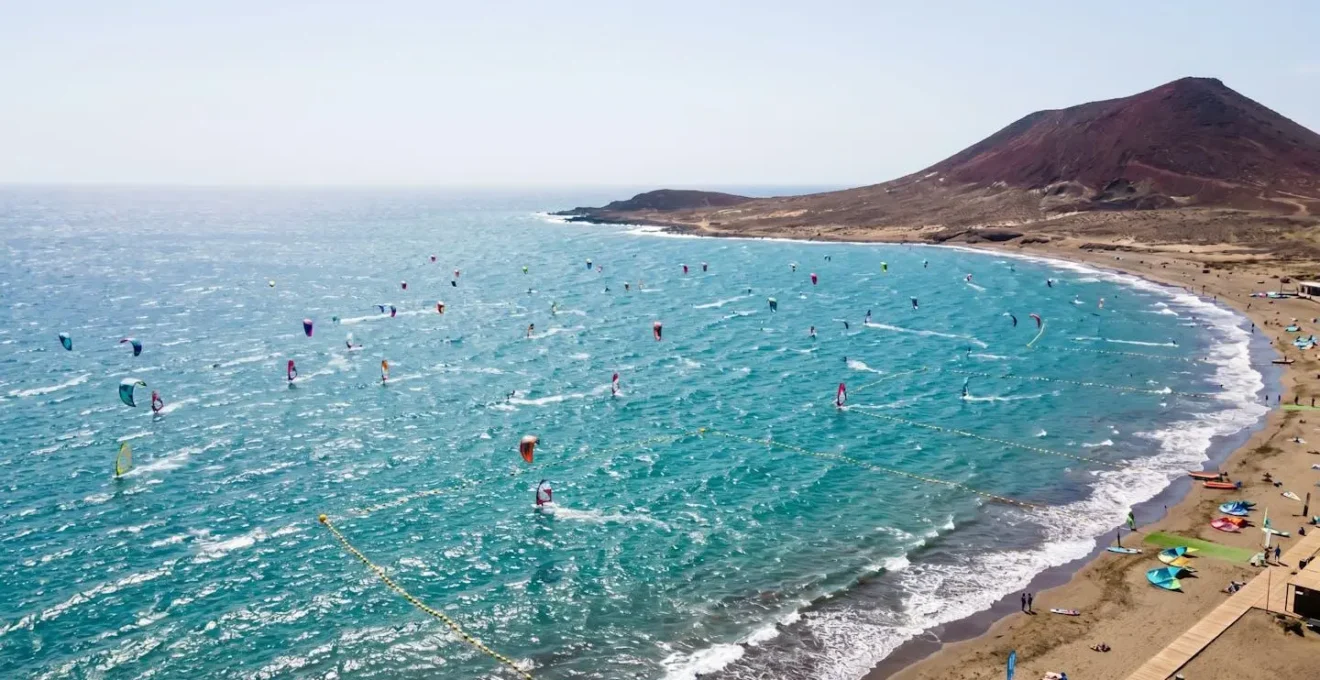
The rules of El Médano are not optional courtesies; they are mandatory protocols to prevent chaos and ensure everyone’s survival on the water.
- Starboard tack ALWAYS has right-of-way over port tack, no exceptions.
- Mandatory distances from swimmers (yellow buoys) and wildlife (60m) are strictly enforced.
Recommendation: If you are in any doubt about your ability to follow these rules, choose an alternative, less crowded spot like La Tejita.
You see it every day out here. The flash of a colorful kite, the glint of sun on a wet board, and then the heart-stopping moment two riders on a collision course swerve at the last second. Sometimes, they don’t. I’ve pulled people out of the water who thought they knew what they were doing. They saw El Médano as a playground, not the complex, high-traffic system it is. They knew the basic, generic advice: « be aware, » « check the wind. » But they didn’t know the bay’s real code.
This is not another friendly guide. I’m not here to tell you about the best bars for a post-session beer. As a local lifeguard, my job is to prevent you from needing me. The rules we enforce aren’t suggestions; they are the hard-learned lessons from countless incidents. The core problem here isn’t a lack of skill; it’s a lack of situational awareness and an ignorance of the specific, non-negotiable protocols that keep this bay from descending into chaos. The true key to riding safely in El Médano isn’t just knowing how to handle your gear; it’s understanding and respecting the invisible traffic system that governs every interaction on the water.
This briefing will walk you through the critical rules, from the legally enforced boundaries to the life-saving right-of-way hierarchy. We will cover launching procedures, the hidden dangers of the wind, and what to do when your skills don’t match the conditions. Pay attention. It might just save your life, or someone else’s.
Summary: The Lifeguard’s Briefing on El Médano’s Water Safety Protocols
- Why Crossing the Yellow Buoys Can Result in a £500 Fine?
- Starboard Tack vs Leeward: Who Gives Way in Crowded Chop?
- How to Launch Safely Through the Shorebreak Without Breaking a Fin?
- The Risk of Offshore Gusts Pushing You Away from the Bay
- Where to Go When El Médano Is Too Crowded for Your Skill Level?
- The Risk of Collisions in Crowded Bays and How to Avoid Them
- Why You Must Maintain 60 Metres Distance from Dolphin Pods?
- Is El Médano Suitable for Beginner Kitesurfers or Only Pros?
Why Crossing the Yellow Buoys Can Result in a £500 Fine?
Let’s make this simple: the line of yellow buoys is not a suggestion. It is a wall. On one side, you have the sailing area. On the other, you have a designated swimming zone. This isn’t just a local custom; the bay is officially zoned, with the swimming area marked by a chain of buoys. Crossing this line with a kite or windsurf board is a serious infraction, demonstrating a dangerous lack of control and respect for public safety. We see it far too often—a kiter losing an edge, a windsurfer misjudging a jibe, and suddenly they are in a space filled with families and children.
The fine is not the primary deterrent; it’s the consequence. The real reason to stay out is to prevent a catastrophic accident. A fin, a board, or a person traveling at speed can cause life-threatening injuries to a swimmer. The authorities take this extremely seriously, and so do we. If you are seen inside the buoys, expect to be intercepted, reported, and fined heavily. There are no excuses. « I lost control » is an admission that you were riding beyond your ability in the given conditions, which is a violation in itself.
Your responsibility is to maintain a buffer zone at all times. If the wind is pushing you towards the buoys, you head back to the beach or sail far upwind long before you become a hazard. Treat the yellow buoy line as a solid, uncrossable barrier. Your session, and your bank account, depends on it. Situational ignorance is not a valid defense when you put swimmers at risk.
Starboard Tack vs Leeward: Who Gives Way in Crowded Chop?
On the water, confusion is a killer. In the chaotic chop of El Médano’s main bay, you cannot afford a moment of hesitation about who has right of way. The rules are clear, absolute, and designed to create predictable movements in a crowded environment. The most fundamental rule is the one of opposing tacks: the rider on a starboard tack (right hand and foot forward, traveling to the left) ALWAYS has the right of way. The rider on the port tack (left hand and foot forward, traveling to the right) MUST give way. This means altering your course early, clearly, and safely, usually by passing downwind of the starboard rider. No exceptions.
This principle is the cornerstone of on-water safety. When two riders approach each other, the starboard tack rider has the right to maintain their course and speed. The port tack rider has the duty to stay clear. Any other action creates a dangerous « collision corridor » where both riders are second-guessing each other’s intentions. When passing another rider on the same tack, the downwind (leeward) rider has right of way, and the upwind (windward) rider must keep clear. If you are the upwind rider, keep your kite high to avoid tangling lines.
This isn’t maritime etiquette; it’s a traffic law. Understanding the subtle differences between how this applies to kiters and windsurfers is also critical, as their maneuverability and blind spots differ.
The table below breaks down the specific right-of-way scenarios. Study it. Memorize it. Apply it without fail. Your ability to follow this code is what separates a safe rider from a liability to everyone on the water. According to an analysis of established water sports rules, these principles are universal, but in a crowded spot like El Médano, their application is constant and critical.
| Scenario | Who Has Right of Way | Who Must Yield | Key Consideration |
|---|---|---|---|
| Kiter vs Kiter (opposite tacks) | Starboard tack (right hand forward) | Port tack (left hand forward) | Port tack passes downwind keeping kite low |
| Kiter vs Kiter (same tack) | Downwind (leeward) rider | Upwind (windward) rider | Upwind rider keeps kite high when passing |
| Windsurfer vs Windsurfer (opposite tacks) | Starboard tack (sail on left from rider’s view) | Port tack | Right hand closer to mast = starboard = right of way |
| Windsurfer vs Windsurfer (same tack) | Leeward (downwind) | Windward (upwind) | Upwind sailor can keep track |
| Kiter vs Windsurfer | Slower vessel (usually windsurfer) | Faster vessel (usually kiter) | Kiters have greater maneuverability and speed, must yield to slower craft |
How to Launch Safely Through the Shorebreak Without Breaking a Fin?
The launch zone is the most dangerous place on the beach. It’s a chaotic mix of tangled lines, powerful shorebreak, and people. A botched launch doesn’t just mean a broken fin or a damaged kite; it can lead to serious injury for you or an innocent bystander. Launching and landing require a strict, repeatable protocol. This is not the time for improvisation. You need a clear, unobstructed area and, ideally, the help of an experienced rider. Before you even think about getting your kite in the air, you must assess the area and your gear meticulously.
The key to navigating the shorebreak is timing and technique. Watch the wave sets. There is always a lull, a calmer period between the larger sets. That is your window. For windsurfers, this means walking your board out past the breaking waves before you even attempt to uphaul. For kiters, it means getting in the water quickly and body dragging out with your board held upside down to protect the fins, getting well past the impact zone before you attempt a water start. Rushing this process is the most common and costly mistake we see. Patience is not a virtue here; it is a required safety procedure.
Your goal is to spend the minimum amount of time in the high-risk shorebreak zone. Following a clear, step-by-step procedure removes guesswork and minimizes danger. The following protocol is not just a suggestion; it’s the standard operating procedure for a safe launch in crowded conditions.
Action Plan: Safe Launching Protocol
- Ask another experienced kiteboarder for launch assistance and ensure the area is clear of obstacles and people.
- Check the tension of your lines thoroughly, making sure there are no tangles or twists in the setup.
- When ready, give a clear thumbs-up signal to your helper and slowly move the kite to the edge of the wind window.
- Time your entry by reading incoming wave sets to identify the ‘lull’ (calmer period between larger sets).
- For kiters, body drag out with your board held upside down until you are well past the break zone before attempting a water start.
The Risk of Offshore Gusts Pushing You Away from the Bay
The wind in El Médano can be deceptive. What feels like a perfect, steady side-shore breeze can be punctuated by powerful, unpredictable offshore gusts. An offshore wind is the most dangerous condition you can ride in. It acts like a giant hand, pushing you further and further out to sea. If your equipment fails or you can’t stay upwind, there is no ‘friendly’ beach downwind to wash up on. There is only the open Atlantic.
We’ve had to launch rescue operations for riders who ignored the forecast and found themselves being dragged towards the horizon, their kite acting as an unstoppable sail. This is not a theoretical risk; it is a recurring and potentially fatal reality. You must be proficient in self-rescue techniques *before* you ever need them. You must know how to flag your kite, wrap your lines, and use your board and kite as a floatation and visibility aid while you await rescue. Waiting until you are in a panic, a kilometer from shore, is too late to learn.
Checking the forecast is not enough. You must monitor real-time conditions, watch the cloud formations, and be aware of any sudden changes in wind direction or intensity. If you see dark clouds or squalls approaching, get off the water immediately. No ride is worth your life.
Case Study: The Lethal Power of Offshore Wind
To understand the gravity of this risk, consider a tragic incident from Chicxulub Puerto, Mexico. A 21-year-old kiter attempting to launch in strong offshore winds was lofted over 20 meters into the air and crashed into a house. He died from his injuries. This is not a freak accident; it is a direct and brutal demonstration of what happens when the force of an offshore wind is underestimated. As confirmed in the official incident report, this highlights the critical danger of offshore conditions and the absolute necessity of never launching in unsuitable wind directions.
Where to Go When El Médano Is Too Crowded for Your Skill Level?
There is no shame in admitting that the conditions are beyond your ability. In fact, it is the hallmark of a smart, safe rider. El Médano’s main bay can be an intimidating frenzy of experts, chop, and strong winds. Trying to learn or practice new maneuvers in the middle of this chaos is not only frustrating but also incredibly dangerous for you and everyone around you. If you feel overwhelmed, anxious, or are constantly in other people’s way, you are a hazard. The responsible choice is to move to a more suitable location.
Fortunately, the area offers alternatives that are far better suited for progressing your skills in a less stressful environment. La Tejita, just to the south, is the prime example. It generally has lighter winds, a sandy bottom, and far fewer people. It provides the space to make mistakes, to practice water starts without a gallery of experts flying past you, and to build confidence safely. Ignoring these safer options and insisting on riding in the main bay when you are not ready is a sign of ego, not skill. Your goal should be to have a safe, productive session, not to prove you can survive the main bay.
Choosing the right spot for your skill level is a fundamental aspect of risk management. Don’t let your ambition override your common sense. A short drive or walk can be the difference between a great day on the water and a disaster.
This decision is a strategic one. Before you launch, take a moment to honestly assess the crowd and your own confidence. The following breakdown, based on a detailed analysis of local spots, should guide your choice. Choosing the right venue is as important as choosing the right size kite.
| Spot Name | Distance from El Médano | Best For (Skill Level) | Wind Conditions | Key Features |
|---|---|---|---|---|
| La Tejita | 2 km south | Beginners to Intermediate | Lighter winds, less gusty | Sandy bottom, less crowded, gradual entry, safer learning environment |
| El Cabezo Bay | North past Harbour Wall | Experts and Professionals only | Windiest part of bay, cross-onshore NE trades | Wave spot, suitable for advanced wave riding, can accommodate kites when not busy with windsurfers |
| South Bay (Main) | Central El Médano | Intermediate to Advanced | Chop and rolling swell | Main launch area, 7-minute walk from town, access to multiple riding zones |
| Harbour Wall | North from South Bay | Advanced | Windiest section, NE trade wind cross-onshore | Short sail from South Bay, maximum wind acceleration |
The Risk of Collisions in Crowded Bays and How to Avoid Them
In a bay as busy as El Médano, you are never riding alone. Every move you make has a potential consequence for dozens of other riders. The single biggest cause of collisions is not a lack of skill, but a lack of space and foresight. With an estimated 1.5 million kitesurfers worldwide and growing, crowded spots are becoming the norm, and so are the accidents that come with them. Collisions with other riders, obstacles, and even wildlife are a significant and increasing risk.
The solution is to actively manage your space. This means maintaining a safe buffer zone around you at all times. A good rule of thumb is to keep a distance of at least twice the length of your kite lines (about 50 meters) downwind and one line-length upwind. This gives you and the other rider time to react to sudden changes. When you are about to perform a maneuver like a jibe, a tack, or a jump, you must look first. A 360-degree check for clearance is not optional; it’s mandatory. Initiating a trick without confirming your landing zone is clear is a reckless act that endangers everyone around you.
Furthermore, you must ride predictably. Sudden, erratic changes in direction are a recipe for disaster. Your movements should be telegraphed so that other riders can anticipate your path. This is the essence of « The Bay’s Code »: a shared understanding that we are all responsible for the collective safety. A rider focused only on their own trajectory, oblivious to the flow of traffic around them, is the most dangerous person on the water. Do not be that person.
Why You Must Maintain 60 Metres Distance from Dolphin Pods?
Sharing the water with marine life, like the pods of dolphins frequently seen off this coast, is a privilege, not a right. This privilege comes with a strict set of non-negotiable rules designed to protect these animals. Your excitement at seeing them does not give you permission to harass them. The law is explicit and enforced with zero tolerance. You are legally required to maintain a minimum distance of 60 meters from any cetacean (dolphins, whales, etc.).
This is not a guideline. It is a legal mandate under Spanish national law, specifically Royal Decree 1727/2007, which establishes measures for the protection of cetaceans. Approaching closer than 60 meters can disrupt their natural behaviors, cause them stress, separate mothers from their calves, and in the worst-case scenario, lead to injury from a board or fin. The Spanish Ministry for Ecological Transition is very clear on this point, as stated in their enforcement guidelines.
As the Ministry states unequivocally:
It is forbidden to approach with the boat less than 60 m from the cetaceans.
– Spanish Ministry for Ecological Transition (MITECO), Royal Decree 1727/2007 enforcement guidelines
If a pod of dolphins appears near you, your duty is to immediately and calmly give them space. This may mean changing your course or even ending your session and returning to shore. Chasing them for a photo or a closer look is illegal and irresponsible. We are visitors in their home. Act like a respectful guest, or face the legal consequences and the shame of having put these magnificent creatures at risk for a moment of selfish curiosity.
Key Takeaways
- Starboard has absolute right of way: The rider with their right hand forward maintains course. No exceptions.
- Respect the zones: The yellow buoys mark a no-go swimming area. Crossing them is illegal and dangerous.
- Skill-appropriate spots: If the main bay is too crowded or challenging, move to a safer alternative like La Tejita. Ego has no place in safety.
Is El Médano Suitable for Beginner Kitesurfers or Only Pros?
This is the critical question every new arrival asks. The answer is nuanced: yes, El Médano *can* be suitable for beginners, but only under very specific conditions and with a significant degree of self-awareness and caution. The beach does offer a specially designated zone to set up kites and different areas suitable for various experience levels. However, simply being a « beginner » is not the defining factor. The real question is: are you an *independent* and *responsible* rider?
A true beginner, someone still learning to control the kite or struggling with water starts, has no business in the main bay during peak hours. The conditions are too demanding, the traffic too intense. For them, the answer is a clear « no. » They should be at La Tejita or taking lessons from a certified school in a controlled environment. However, for a rider who has progressed past the initial learning stages, El Médano can be a place to improve, provided they meet a strict set of criteria. Being able to ride consistently upwind is not a « goal, » it is the absolute minimum entry requirement. Without this skill, you are a passive object being blown downwind, a hazard to everyone in your path.
Before you even consider riding independently here, you must be able to answer « yes » to all of the following. This is not a quiz; it is your personal safety audit. Being honest here is the most important decision you will make.
- Can you consistently ride upwind in choppy water without losing ground?
- Have you mastered a deep-water self-rescue and can you activate your quick-release systems instinctively?
- Can you confidently handle an overpowered kite and do you know how to depower in sudden gusts?
- Have you familiarized yourself with local hazards, including rocks, reefs, and the locations of the buoy lines?
- Are you prepared to avoid the water entirely if conditions (wind, crowds) are beyond your skill level?
Your safety, and the safety of everyone you share the water with, is your personal responsibility. These rules are the tools to manage that responsibility. Study them, respect them, and enforce them with your own actions. The next step is not to buy new gear; it’s to honestly assess your skills against this code. The bay is here for everyone to enjoy, but only if we all commit to a culture of safety and mutual respect. Don’t be the reason I have to get my rescue board wet.