In summary:
- The challenging return trip is not about brute strength but about smart energy management and efficient technique.
- Your core, not your arms, should power your paddle stroke to prevent shoulder pain and exhaustion.
- Using the volcanic cliffs as strategic waypoints turns the daunting journey into manageable segments.
- Proper hydration, the right safety gear (a buoyancy aid, not a life jacket), and maintaining a safe distance from the cliffs are non-negotiable.
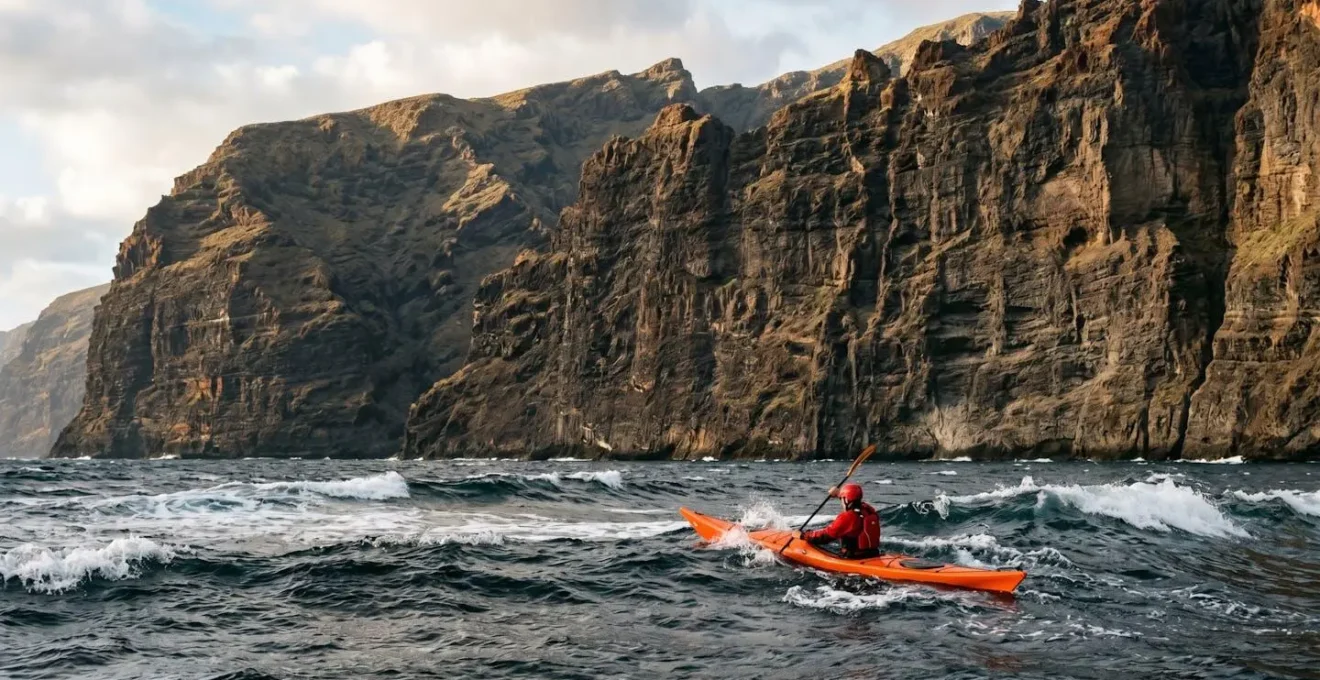
The paddle out along the base of the Los Gigantes cliffs is breathtaking. The sheer volcanic walls rise from the sea, the water is a deep blue, and the sense of adventure is palpable. But every experienced guide in Tenerife knows the real test isn’t the journey out; it’s the journey back. After an hour or so, the trade winds pick up, creating a relentless headwind. For the novice kayaker, this is where the dream trip can turn into a grueling battle against the elements, leading to shoulder pain, exhaustion, and even seasickness.
Many will tell you to simply « paddle harder » or to « be prepared for the wind. » This advice, while well-intentioned, is useless when your shoulders are burning and your energy is gone. The truth is, conquering the return trip has little to do with brute force. It’s a game of strategy, efficiency, and understanding your environment. It’s about transforming your body from a flailing engine into a finely-tuned machine and learning to read the story the ancient cliffs are telling you.
This guide will give you the strategy we use as guides. We won’t just tell you what to do; we’ll explain why. We’ll break down the biomechanics of a powerful, sustainable paddle stroke, explain the critical difference in safety gear, and show you how to use the geology of the cliffs as your map and your ally against the wind. You’ll learn to manage your energy, avoid common mental traps, and turn the challenging return into a confident, controlled, and still magnificent conclusion to your adventure.
To help you navigate this comprehensive guide, we’ve structured it to address every key aspect of your trip, from fixing your technique to understanding the very rocks you’re paddling past. Explore the sections below to build your strategy step-by-step.
Summary: Kayaking Los Gigantes: A Guide to Conquering the Windy Return Trip
- Why Your Shoulders Hurt After 20 Minutes and How to Fix Your Stroke?
- Life Vest vs Buoyancy Aid: Which Is Mandatory for Cliffs Excursions?
- The Mistake of Looking Down at the Paddle That Triggers Sea Sickness
- Vertical Walls: Where to Stop for the Best Perspective of the Layers?
- What to Pack for a 3-Hour Paddle Under the Direct Sun?
- The Risk of Paddling Too Close to the Base of Unstable Cliffs
- Why Driving Up Teide Is a Risk but Kayaking Is Safe Before Flying?
- Reading the Volcanic Walls: Identifying Lava Flows form Your Kayak Seat
Why Your Shoulders Hurt After 20 Minutes and How to Fix Your Stroke?
If your shoulders start burning early into the paddle back, you’re experiencing the single most common novice mistake: « arming it out. » This happens when you rely solely on your small shoulder and arm muscles to pull the paddle through the water. It’s inefficient, exhausting, and a primary reason why, according to sports medicine research, up to 55% of paddlers experience shoulder pain. When you add a headwind, this flawed technique becomes unsustainable. You’re not just fighting the wind; you’re fighting your own body.
The solution is to stop thinking of paddling as an arm exercise and start thinking of it as a core exercise. Your torso—your powerful abdominal and back muscles—should be the engine. Your arms are just the transmission, connecting the engine’s power to the paddle. This is called torso rotation. As you plant your paddle in the water, twist your torso to pull the blade back. You’ll know you’re doing it right when you feel your stomach muscles engage. Your arms should remain relatively straight, forming a « paddler’s box » with your chest and the paddle shaft.
To master this, keep a relaxed grip on the paddle; a death grip leads to cramps and tendonitis. Your elbows should be at a roughly 90-degree angle. Into a strong headwind, you should also « feather » your paddle. This involves adjusting the ferrule (the connector in the middle of the shaft) to offset the blades. This allows the blade that is out of the water to slice through the wind with minimal resistance, saving you a tremendous amount of energy on every single stroke. It’s a small adjustment with a massive impact on your endurance.
Life Vest vs Buoyancy Aid: Which Is Mandatory for Cliffs Excursions?
Safety is paramount, but using the wrong equipment can be as dangerous as using none at all. A common point of confusion is the difference between a life vest (or life jacket) and a buoyancy aid. While they sound similar, their functions are vastly different, and for an active sport like kayaking, a buoyancy aid is the correct and mandatory choice. A life jacket is designed to turn an unconscious person face-up in the water. It’s bulky, especially when inflated, and severely restricts the arm and torso movement essential for effective paddling.
A buoyancy aid, on the other hand, is designed to assist a conscious swimmer. It’s made of closed-cell foam, provides immediate flotation, and is cut to allow maximum freedom of movement around the shoulders and arms. This is not just a comfort feature; it’s a critical safety feature. It allows you to paddle efficiently, brace against waves, and, most importantly, perform a self-rescue if you capsize. Trying to climb back into a kayak while wearing a fully inflated life jacket is incredibly difficult, if not impossible.
The following table, based on guidance from marine equipment safety experts, breaks down the key differences:
| Feature | Buoyancy Aid (50N) | Life Jacket (150N+) |
|---|---|---|
| Primary Function | Assists conscious swimmer in horizontal position | Turns unconscious casualty face-up, keeps airway clear |
| Freedom of Movement | Far less restrictive, allows efficient paddling stroke | Bulky when inflated, restricts arm movement |
| Self-Rescue Capability | Easier to re-enter kayak from water | Inflated bladder can hinder kayak re-entry |
| Activation | Instant (closed cell foam), no re-arming needed | Requires inflation, needs re-arming kit after each use |
| Best For | Active kayakers in sheltered/coastal waters, conscious and able to swim | Unconscious casualties, non-swimmers, extreme offshore conditions |
| Kayaking Suitability | Recommended for most paddling scenarios | Only for extreme cases or non-swimmers |
As the experts at Pirates Cave Marine note in their UK Kayaking Safety Guide, the choice is clear for this environment:
A buoyancy aid is far more suitable than a life jacket for kayaking, except in extreme cases.
– Pirates Cave Marine Equipment Experts, Pirates Cave UK Kayaking Safety Guide
The Mistake of Looking Down at the Paddle That Triggers Sea Sickness
When fatigue sets in and the wind pushes against you, there’s a natural tendency to focus inward. Your world shrinks to the 10 feet in front of your kayak. You stare down at your paddle, watching the blades enter and exit the water, trying to force your tired body to comply. This is a critical cognitive trap. Staring at a fixed, close object (your paddle) while your body is being rocked by the waves creates a sensory mismatch in your brain, the primary trigger for motion sickness.
The moment you feel that first wave of nausea, your trip is effectively compromised. Your mental focus shatters, your energy plummets, and your ability to paddle effectively disappears. The fix is simple, yet requires conscious effort: lift your gaze and fix it on the horizon. The stable, distant horizon line gives your brain the constant reference point it needs to reconcile the motion your inner ear is feeling. It stops the sensory conflict before it starts.
As you can see, keeping your eyes up does more than just prevent seasickness. It forces you into a better paddling posture—head up, chest open, which facilitates the torso rotation we discussed earlier. It also keeps you situationally aware, able to see wind gusts on the water, other boat traffic, and—most importantly—the geological waypoints we’ll discuss next. When you feel tired, fight the urge to look down. Look up, look out, and connect with the immense landscape around you.
Vertical Walls: Where to Stop for the Best Perspective of the Layers?
The sheer, 600-meter-high walls of Los Gigantes are not just a stunning backdrop; they are a strategic map. Paddling head-on into the wind for an hour straight is a recipe for burnout. The secret to managing the return trip is to break it down into a series of smaller, achievable goals. This is exactly what professional guides do. They don’t just paddle randomly; they have a route that incorporates strategic rest stops in sheltered coves.
Case Study: Strategic Rest Coves
As documented in guided tour itineraries, operators at Los Gigantes use a network of specific coves as planned rest stops. These locations are chosen for a dual purpose. Firstly, they offer a temporary refuge from the headwind, allowing paddlers to take an « active rest »—catching their breath and rehydrating without losing ground. Secondly, these coves provide the best, most intimate vantage points to observe the dramatic volcanic stratification and layering in the cliffs. This transforms a necessary rest break into a fascinating geological lesson, providing a powerful psychological boost. The fact that professional kayak tour routes are deliberately weather-dependent underscores how central wind management is to the entire experience.
Instead of seeing the distant marina as one impossibly far-off destination, learn to see the journey as a series of sprints between these safe harbors. Paddle with purpose toward a distinctively shaped cave or a uniquely colored section of rock. Once there, your reward is a few minutes of calm. You can drink some water, eat a high-energy snack, and appreciate the immense geological history towering above you. This mental trick of setting and achieving small goals makes the overall challenge feel far less daunting. It reframes the return from a single, exhausting marathon into a manageable series of short, purposeful efforts.
What to Pack for a 3-Hour Paddle Under the Direct Sun?
Your body is an engine, and paddling against the wind for over an hour is like driving up a steep mountain. You need fuel, and you need a lot of it. Underestimating your caloric and hydration needs is a critical error. A three-hour kayaking session, especially with a headwind, can burn anywhere from 900 to over 2,500 calories. Running out of fuel halfway back isn’t just unpleasant; it’s dangerous. Your muscles will cramp, your decision-making will falter, and your ability to control the kayak will diminish.
Packing for this trip isn’t about bringing a picnic; it’s about tactical fueling for performance and endurance. Here’s what is essential:
- Water, and More Water: At least 1.5 to 2 liters per person. A hydration pack (like a CamelBak) is ideal as it allows you to drink small amounts frequently without stopping or fumbling with a bottle.
- Electrolytes: When you sweat under the intense Canarian sun, you lose not just water but critical salts like sodium and potassium. Adding an electrolyte tablet or powder to one of your water bottles is non-negotiable. It helps prevent cramps and maintain mental clarity.
- Quick-Release Energy: You need simple carbohydrates that your body can convert to energy fast. Energy gels, chews, or even a handful of gummy bears are perfect. Have them in an easily accessible pocket for a quick boost during a rest stop.
- Sun Protection System: This is more than just sunscreen. It includes a wide-brimmed hat or cap, UV-protective long-sleeved rash guard, and high-quality polarized sunglasses. Polarized lenses are crucial as they cut the blinding glare from the water’s surface, reducing eye strain and headaches, which contribute significantly to overall fatigue.
Think of your gear not as optional extras, but as your personal support system. Having these items within arm’s reach means you can refuel and rehydrate efficiently in those short rest stops, ensuring your engine has the power it needs to get you home safely.
The Risk of Paddling Too Close to the Base of Unstable Cliffs
When battling a strong headwind, instinct tells you to seek shelter. The massive cliff face seems to offer a lee from the wind, and the temptation to paddle as close as possible to the rock wall is immense. This is another cognitive trap, and arguably the most dangerous one. The Los Gigantes cliffs are a dynamic, living geological feature. They are beautiful, but they are also inherently unstable. Rockfalls are a real and documented hazard.
The scale of the cliffs is deceptive from the water. They rise 500 to 800 meters above you, but crucially, they also extend up to 30 meters underwater. This creates a massive, steep underwater debris field known as a talus slope at their base. The combination of wind, wave action, and the natural erosion of volcanic rock means that small and large rocks can and do dislodge from the face. Paddling directly underneath them puts you in a high-risk zone.
Hazard Zone: Mandatory Safe Distance Protocols
Due to the documented geological hazards, professional kayak operators enforce a strict safe distance protocol. As noted by local experts, the combination of katabatic winds (dense, cold air that can suddenly rush down the cliff face) and the instability of the volcanic formations requires a mandatory clearance. Guides will instruct their groups to maintain a 20-30 meter distance from the cliff base at all times. This is especially critical during the return journey when fatigue can compromise judgment and the desire for shelter from the wind is strongest. The perceived « shelter » is not worth the objective risk of rockfall.
Resist the instinct to hug the cliffs. The safest path is to maintain your distance, even if it means taking the wind more directly. Your safety is more important than a few moments of perceived calm. Use the strategies of efficient paddling and strategic rest stops in designated coves to manage the wind, not by hiding from it in a dangerous location.
Why Driving Up Teide Is a Risk but Kayaking Is Safe Before Flying?
A common question from active tourists in Tenerife revolves around post-activity safety before a flight. You may have heard warnings about not going up Mount Teide on the same day you fly due to the risk of decompression sickness (DCS), caused by the rapid change in atmospheric pressure. This logically leads to the question: is an intense physical activity like kayaking at sea level also a risk before flying? The good news is, no. Kayaking, even a strenuous 3-hour paddle, does not pose a DCS risk as you remain at sea level.
However, the physical exertion does create other, more subtle risks for air travel that you must manage. The primary concerns are dehydration and deep vein thrombosis (DVT). The paddle is a significant workout under the sun, and the dry, recycled air in an airplane cabin will exacerbate any existing fluid loss. This dehydration, combined with sitting immobile for hours, increases the risk of blood clots. Therefore, a post-kayak, pre-flight recovery protocol is essential not just for comfort, but for health.
Proper recovery focuses on rehydration, refueling, and reducing muscle stiffness. By actively managing these factors, you ensure you board your flight feeling recovered and safe, not exhausted and at risk. The following plan outlines the simple steps to take in the hours between docking your kayak and boarding your plane.
Your Fit-to-Fly Recovery Checklist: From Kayak to Cabin
- Immediate Rehydration (0-30 mins post-paddle): Your first priority. Drink 2-3 large glasses of water or an electrolyte-rich sports drink to begin replacing the significant fluid lost during the 3-hour exertion in the sun.
- Recovery Nutrition (30-90 mins post-paddle): Have a balanced meal. Focus on lean protein to help repair muscle fibers and complex carbohydrates to replenish the glycogen stores you depleted while fighting the headwind.
- Pre-Flight Mobility (2-4 hours before flight): Perform light, dynamic stretches. Target your shoulders, lower back, and legs (calves, hamstrings). This improves circulation and reduces the muscle stiffness that can contribute to DVT risk during a long flight.
- In-Airport Hydration: Don’t stop drinking water. Continue to sip water right up until you board and, if possible, during the flight to counteract the extremely dry cabin air.
Key takeaways
- Your biggest enemy is inefficient technique; power your stroke with your core, not your arms.
- Choose the right gear for the job: a buoyancy aid for movement, not a restrictive life jacket.
- Manage your energy and psychology by using sheltered coves and geological features as waypoints, breaking the return trip into smaller goals.
Reading the Volcanic Walls: Identifying Lava Flows form Your Kayak Seat
Now that you have the tools to manage your body and your safety, it’s time for the final and most elegant piece of the strategy: turning the cliff face from a monolithic obstacle into your personal navigation chart. The return journey against the wind feels infinitely long when your only marker is a distant marina. But when you learn to read the walls, the journey becomes a fascinating series of short, distinct stages.
The cliffs of Los Gigantes are a cross-section of geological time. They are composed of countless layers from different volcanic eruptions. As a guide, I don’t just see rock; I see a story that doubles as a map. Professional guides actively use these features as waypoints. They point out the darker, vertical stripes of volcanic diques—ancient magma feeding channels that cut through the older layers. They highlight the color changes between different lava flows, from reddish, oxidized rock to dark, dense basalt. These are not just interesting facts; they are your milestones.
This approach completely changes the psychology of the return trip. Instead of a single, grueling paddle, your goal becomes « paddle to the big red layer, » then « reach the cave with the basalt columns. » Each waypoint achieved provides a hit of psychological reinforcement. It’s the perfect time to take a 30-second active rest, sip some water from your hydration pack, and pick your next target. As local eco-tour operators highlight, this technique transforms the paddle into a series of achievable segments, making the challenge manageable and educational.
Now you possess the complete strategy: an efficient stroke powered by your core, the right safety equipment, a fuel and hydration plan, and the mental framework to use the epic landscape as your guide. The return trip is no longer an unknown beast to be feared, but a challenge to be met with skill, confidence, and a deep appreciation for the incredible environment you are in. The next step is to put this knowledge into practice and experience the majesty of Los Gigantes with the assurance of a seasoned paddler.