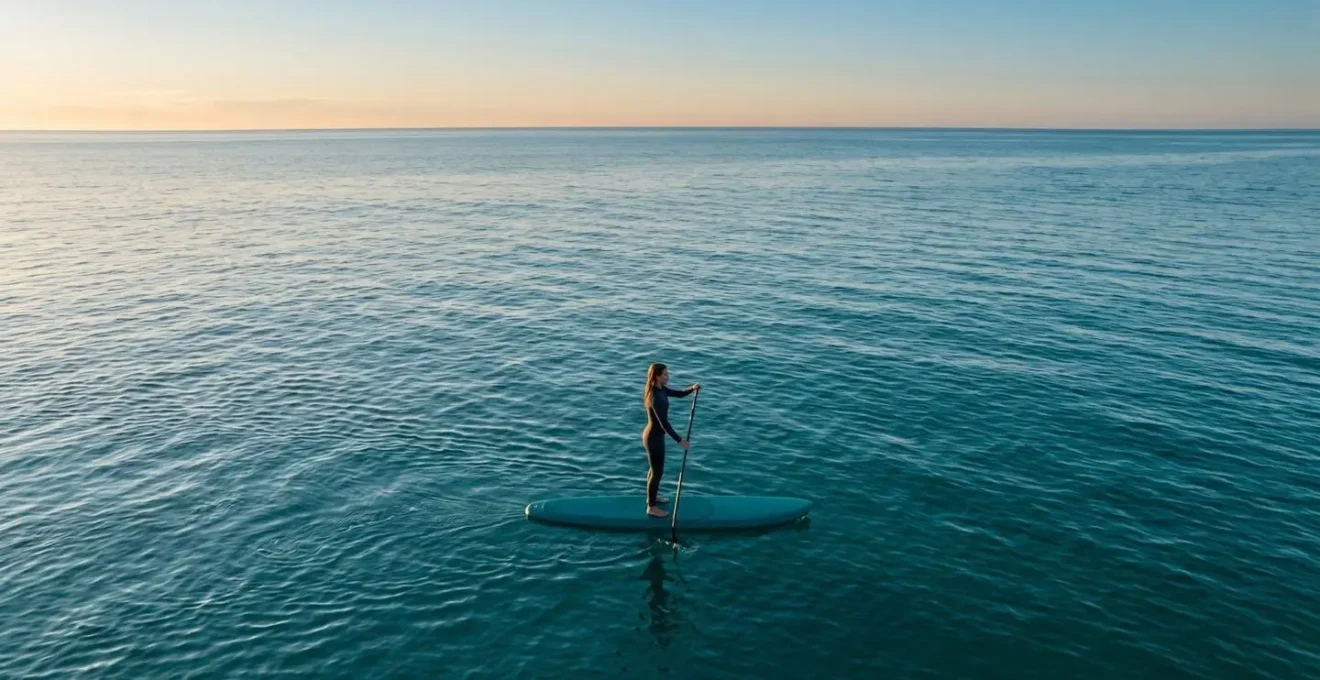
Stand-up paddleboarding is more than a hobby; it’s a precision training tool that directly rewires your brain and body for elite scuba diving control.
- SUP on unstable water forces constant micro-adjustments, engaging the exact same deep core muscles used for maintaining perfect underwater trim.
- This neuromuscular training translates into superior buoyancy control, enhanced finning efficiency, and unshakable static stability for photography or observation.
Recommendation: Integrate structured 45-minute SUP sessions, focusing on isometric holds and balance drills, to see tangible improvements in your diving within weeks.
Every diver knows the feeling. That constant, subtle battle for perfect trim; the moment you think you’re perfectly still, only to find yourself slowly sinking or ascending. You’ve likely heard the standard advice: « practice your breathing, » « get your weighting perfect, » « spend more time in the pool. » While all true and essential, these tips often address the symptoms, not the root cause: an underdeveloped neuromuscular connection to your core stabilization system.
But what if the most significant leap forward in your buoyancy control wasn’t found underwater at all, but on its surface? What if the key to unlocking rock-solid stability lies in retraining your body’s entire stabilization system through an activity that seems, at first glance, unrelated? This is the power of stand-up paddleboarding (SUP) as a cross-training tool for divers. It’s not just about « balance »; it’s about forging a deeper, more intuitive connection between your brain, your core, and your ability to remain motionless in the water column.
This guide moves beyond generic advice. We will deconstruct the specific biomechanical and neurological reasons why SUP is such a potent tool for divers. We will explore how balancing on a board directly trains your brain for underwater chaos, compare board types for optimal results, and provide a concrete workout plan designed to translate surface stability into underwater mastery. Prepare to look at that paddleboard not as a toy, but as your new secret weapon for becoming the diver you want to be.
Summary: The Definitive Link Between SUP and Enhanced Diving Skills
- Why SUP Engages the Same Core Muscles Used for Trim in Diving?
- How Balancing on Chop Trains Your Brain for Underwater Stability?
- Inflatable vs Hard Board: Which Is Better for Core Workouts?
- The Danger of Being Blown Offshore While Focusing on Exercise
- How to Structure a 45-Minute SUP Session for Maximum Leg Strength?
- How to Perfect Your Finning Technique to Protect Fragile Volcanic Moss?
- How to Control Buoyancy for Static Observation Without Crashing?
- Which Water Sport Should You Try on Your Non-Diving Decompression Day?
Why SUP Engages the Same Core Muscles Used for Trim in Diving?
The connection between SUP and diving trim isn’t coincidental; it’s biomechanical. When you maintain trim underwater, you are engaging a complex network of muscles—the transverse abdominis, obliques, multifidus, and pelvic floor—to create a rigid, stable platform from your shoulders to your knees. This is your body’s kinetic chain in action. Now, consider what happens on a paddleboard. The unstable surface of the water forces your body to make thousands of unconscious micro-adjustments per minute to prevent you from falling. These adjustments are driven by the exact same deep core muscles you use for trim.
You aren’t just « balancing »; you are actively performing a high-repetition, low-intensity isometric workout for your entire core. As a systematic review on core training from Frontiers in Physiology highlights, these muscles are the hub of the body’s motor system. A leading research team notes:
Strong core muscles function as hubs in the biological motor chain, which create a fulcrum for the four limbs’ strength and establish a channel for the cohesion, transmission, and integration of the upper and lower limbs.
– Research team, Frontiers in Physiology systematic review on core training
This « fulcrum » is precisely what you need for perfect trim. A strong, responsive core allows you to make fine adjustments with your lungs and fins without your entire body reacting. The impact of this is significant; a 2025 study found that 57% of variance in athletic performance can be explained by combined core strength and stability. For a diver, that athletic performance is measured in air consumption, control, and the ability to hover effortlessly. SUP builds this foundation directly and effectively.
How Balancing on Chop Trains Your Brain for Underwater Stability?
The true magic of SUP training for divers goes beyond muscle development; it happens in your brain. Balancing on an unstable surface, especially in choppy water, is a powerful form of neuromuscular training. It actively rewires the neural pathways responsible for proprioception—your body’s innate sense of its position in space. Every time the board shifts, your nervous system receives a massive influx of data from receptors in your feet, ankles, and core, and it must instantly command muscles to react. This is training for chaos.
This process of constant feedback and correction is identical to what experienced divers do to maintain stability in a surge or current. They aren’t consciously thinking about it; their bodies have learned to anticipate and react. A 12-week trial on kayakers provides compelling evidence for this neurological adaptation.
Case Study: The Transfer of Instability Training
A 12-week randomized controlled trial with 63 young male Chinese kayakers compared core training on unstable surfaces (like BOSU balls) to traditional training on stable ground. The results were clear: the instability group showed significantly greater improvements in both static and dynamic balance. This demonstrates that the brain’s ability to manage instability is a trainable skill that transfers to complex, real-world environments—precisely like the dynamic underwater world a diver inhabits.
This image of a paddleboarder’s feet illustrates the very core of this training. Notice the active engagement of the toes and the visible tension in the muscles of the lower leg. These are the micro-adjustments in real-time, the physical manifestation of the brain processing proprioceptive feedback to maintain balance.
Each time you step on a board, you are giving your nervous system a masterclass in stability. You are teaching it to filter out irrelevant movements and respond only with the necessary, precise muscle contractions. This is the skill that allows a diver to hold a camera steady in a current or hover motionless just inches from a fragile reef.
Inflatable vs Hard Board: Which Is Better for Core Workouts?
When choosing a paddleboard specifically for core conditioning, the debate between inflatable (iSUP) and hard boards comes down to your training goals. While hard boards offer maximum stiffness and speed for racing or surfing, for a diver focused on building stability, the answer might be counter-intuitive. The inflatable board is often the superior training tool for developing core strength and neuromuscular control.
An iSUP, even when fully inflated, has a subtle micro-flex that a rigid board lacks. This slight give in the platform acts as an additional layer of instability, forcing your stabilizing muscles—from your feet to your core—to work even harder. It demands constant, active engagement to maintain balance, accelerating the development of the proprioceptive feedback loop that is so crucial for diving. Furthermore, the portability of iSUPs makes them an ideal travel companion for dive trips, allowing you to warm up and condition on-site.
The following table breaks down the key differences between the two board types from a diver’s training perspective, drawing on a comparative analysis of their features.
| Feature | Inflatable SUP (iSUP) | Hard Board |
|---|---|---|
| Neurological Training | Superior due to higher instability and micro-flex requiring constant micro-adjustments | More predictable platform, less neurological challenge |
| Portability for Dive Trips | Rolls into backpack, fits in car trunk or luggage | Requires roof rack or large vehicle, difficult to travel with |
| Stability Progression | Can adjust inflation pressure (15-20 PSI) to increase/decrease difficulty | Fixed stability characteristics |
| Core Muscle Engagement | Higher engagement due to flexible platform demanding constant stabilization | Moderate engagement with more efficient energy transfer |
| Performance Ceiling | 90-95% as stiff as comparable hard board when fully inflated | Maximum stiffness and speed for racing/surfing |
| Best Use for Divers | Pre-dive conditioning, travel companion, balance training | Power paddling, speed work once balance baseline established |
For the diver, the choice is clear. While a hard board has its place for performance paddling, the iSUP is a dedicated gym for your stabilizing system. Its inherent (and adjustable) instability provides a more intense and effective workout for building the specific skills that translate directly to better buoyancy and trim.
The Danger of Being Blown Offshore While Focusing on Exercise
While SUP is an incredible training tool, its effectiveness hinges on your ability to focus intently on balance and form. This very focus can create a dangerous tunnel vision, making you oblivious to your surroundings. The most significant non-diving risk for paddleboarders is being caught by an offshore wind or current. While you’re concentrating on a set of squats or a balance drill, you could drift hundreds of meters without realizing it, turning a simple workout into a serious rescue situation.
Treating your SUP workout with the same discipline as a dive plan is not an overstatement; it’s a necessity. Before you even get on the water, you must assess the conditions—especially wind direction and speed—and have a clear plan for your session and potential contingencies. This mindset of preparation is the hallmark of a safe water enthusiast. The equipment shown below is not optional; it is your personal rescue system.
Your PFD, whistle, and communication device are your lifeline if your workout focus causes you to lose situational awareness. To prevent this from ever becoming necessary, you must integrate a rigorous safety protocol into every single training session. The following checklist is not just a suggestion; it’s a mandatory procedure for any diver using SUP as a serious training method.
Your Pre-Session Safety Protocol: The SUP Dive Plan
- Assess Conditions: Check wind direction, speed, and forecast changes. Always start by paddling against the wind so your return trip is easier.
- Identify Safe Exits: Mentally mark multiple « bailout » points along the shore in case you drift further than planned.
- Set Awareness Alarms: Use a waterproof watch to set a timer for every 5-10 minutes, forcing you to stop, look up, and check your position relative to the shore.
- Carry Redundancy Gear: Always have a PFD (ideally worn), a whistle, and a waterproofed phone. Know how to self-rescue by kneeling or lying prone to paddle in high wind.
- Never Train Alone: The buddy system is as crucial on the surface as it is below. Always train with a partner or have someone on shore who knows your plan.
By adopting this « paddling dive plan, » you ensure that your training remains both effective and, most importantly, safe. Your focus can then be entirely on the workout, knowing your safety procedures are already in place.
How to Structure a 45-Minute SUP Session for Maximum Leg Strength?
A productive SUP workout is about quality, not just time on the water. A structured 45-minute session can deliver significant gains in leg strength, core stability, and balance—all of which directly translate to more powerful and efficient finning, as well as better endurance on long dives. This workout is specifically designed for divers, incorporating elements of breath control and movements that mimic underwater actions.
The goal is to move beyond simple paddling and use the board as a dynamic training platform. Each phase of the workout has a specific purpose, from activating your breath control to building explosive power and finishing with a functional cool-down. Follow this structure to turn your SUP session into a targeted, high-impact training routine for diving.
- Minutes 0-5 (Warm-up & Breath Control): Begin by kneeling, then standing. Focus on a Box Breathing drill: 4-second inhale, 4-second hold, 4-second exhale, 4-second hold. This calms the nervous system and directly links breath control to balance, a core diving skill.
- Minutes 5-10 (Dynamic Mobility): While standing, perform slow, controlled ankle circles and hip flexor stretches. This prepares the kinetic chain for finning movements and improves your range of motion.
- Minutes 10-20 (Core & Leg Circuit): Perform 10 « Buoyancy Squats. » Squat as low as possible without losing balance, keeping your chest up. Hold the bottom position for two full breaths (simulating a hover) before slowly returning to standing.
- Minutes 20-30 (Power & Trim): Perform 8-10 « Trim Lunges » on each leg. Step into a forward lunge, keeping your torso horizontal and stable, mimicking an ideal trim position. Return to center and repeat with a reverse lunge. This builds unilateral leg strength and rotational stability.
- Minutes 30-40 (Rotational Control): Practice « Helicopter Turns. » Use your paddle and core to pivot the board 360 degrees, first clockwise, then counter-clockwise. Perform 5 turns in each direction. This engages the obliques, crucial for controlling your body’s rotation underwater when handling gear.
- Minutes 40-45 (Cool-down & Skill Simulation): Sit on the board and perform gentle paddling, focusing on driving the movement from your hips. Practice a simulated frog kick with your legs in the water. Finish with seated stretches for the hips and ankles.
Integrating this workout 2-3 times per week will build a powerful and resilient lower body and core. The evidence is clear that such targeted training pays off, as research demonstrates that core training programs improve skill performance across a wide variety of sports, including water sports. For divers, this means better control, less effort, and more enjoyment underwater.
How to Perfect Your Finning Technique to Protect Fragile Volcanic Moss?
Perfecting your finning technique is about more than just propulsion; it’s about control and precision. Whether you’re navigating a delicate coral garden or hovering over fragile volcanic moss, the ability to maneuver with minimal impact is the sign of an advanced diver. This precision doesn’t come from your legs alone; it originates from a stable core. Stand-up paddleboarding is one of the most effective ways to build this specific type of stability.
The Divers Alert Network (DAN) explicitly connects the dots between SUP training and diving performance. As they state in their guide on the topic:
Training on a paddleboard requires you to stabilize your body to maintain balance. Working your stabilizing muscles is beneficial for diving because they are helpful in dynamic ocean environments.
– Divers Alert Network, Stand-Up Paddleboard Exercises guide
When your core is solid, your brain can decouple the movements of your lower body. You can make small, precise adjustments with your fins (like a frog kick or a helicopter turn) without your entire body lurching. On a paddleboard, you learn this skill instinctively. Every paddle stroke you take while maintaining balance is an exercise in core stabilization and upper/lower body dissociation. This principle is backed by sports science, which shows that building foundational strength directly enhances balance and fine motor control. The National Academy of Sports Medicine’s research on SUP training protocols confirms that progressive instability workouts build the exact ankle and hip stabilizer muscles essential for the delicate maneuvering needed to protect fragile underwater ecosystems.
To protect fragile environments, your fin kicks must be intentional and controlled, not clumsy and accidental. By strengthening the entire stabilizing chain from your feet to your shoulders on a paddleboard, you are programming your body for the kind of effortless precision that keeps the underwater world safe and beautiful.
How to Control Buoyancy for Static Observation Without Crashing?
The ultimate test of buoyancy control isn’t moving, it’s being perfectly still. Whether you’re an underwater photographer lining up a shot or a naturalist observing creature behavior, the ability to hover motionless, without sculling with your hands or kicking up silt, is a coveted skill. This level of control is an act of isometric engagement—the static tensing of your core and gluteal muscles to create an unwavering platform. And the best place to practice this is on a paddleboard.
As the experts at Glide SUP note, it’s about a chain of stability: « Training your core (front, sides, and back) and glutes makes it easier to stay stable when the water moves under you. » This is the essence of hovering. On a paddleboard in light chop, you can’t relax. You must constantly engage your core to remain upright and still. You are, in effect, practicing the exact muscle control needed for a perfect underwater hover. This is active, not passive, balance.
You can structure your SUP sessions to specifically target this skill. These drills, performed on the unstable surface of the board, build the muscle memory and endurance for static control:
- Single-Leg Stance: Simply standing on one leg on the board for 30-60 seconds is an intense workout for the stabilizing muscles in your standing leg and hip, crucial for micro-fin adjustments.
- Static Hold Drill: The ultimate hover practice. Stand perfectly still on the board in light chop for 2-3 minutes, focusing on keeping your body motionless from the ankles up. This is pure isometric core work.
- Breath-Controlled Balance: While holding a static stance, practice the shallow, controlled breathing you use underwater. This teaches your body to separate the act of breathing from your overall stability, preventing the up-and-down movement many divers experience with each breath.
- Plank Variations: Holding a front or side plank on the board is one of the most direct ways to build the transverse abdominis and oblique strength required for maintaining static trim for extended periods.
By mastering stillness on the surface, you are programming your body for stillness below. Each minute spent in an isometric hold on your SUP is a direct deposit into your buoyancy control bank account, ready to be withdrawn when you need to be perfectly, beautifully motionless underwater.
Key Takeaways
- SUP training directly targets the exact deep core muscles and neuromuscular pathways required for perfect trim and buoyancy control in scuba diving.
- For core conditioning, inflatable paddleboards (iSUPs) are often superior to hard boards due to their inherent micro-flex, which increases instability and muscle engagement.
- Safety is paramount. Every SUP workout must begin with a « paddling dive plan » that includes assessing wind and weather, identifying exit points, and carrying safety gear.
Which Water Sport Should You Try on Your Non-Diving Decompression Day?
Your non-diving or decompression days are critical for recovery, but that doesn’t mean you have to be completely sedentary. The right activity can actually enhance your diving skills, maintain your fitness, and keep you connected to the water. When choosing a surface water sport for a diver’s rest day, the primary criteria should be skill crossover and appropriate physiological strain. You want an activity that reinforces good habits without being overly strenuous.
While kayaking and swimming are excellent for general fitness, stand-up paddleboarding stands out as the optimal choice for a diver. It offers the highest degree of skill crossover with the lowest relative strain. The core stability, balance, breath control, and proprioceptive awareness you develop on a paddleboard are all directly applicable to improving your performance underwater. It’s not just exercise; it’s specific, targeted training that makes you a better diver.
This comparative table illustrates why SUP is the most logical choice for a diver’s day off.
| Activity | Skill Crossover Benefit | Physiological Strain Level | Diving Skill Enhancement |
|---|---|---|---|
| Stand-Up Paddleboarding | High – Core stability, balance, breath control, proprioception | Low to Moderate (scalable intensity) | Buoyancy control, trim, rotational stability, endurance |
| Kayaking | Moderate – Upper body endurance, core rotation | Moderate (sustained paddling effort) | Upper body strength, cardiovascular base |
| Surface Snorkeling | Moderate – Finning technique, breath awareness | Low (minimal exertion) | Fin efficiency, breathing patterns |
| Swimming | Low – General fitness | Moderate to High (can elevate heart rate significantly) | General cardiovascular fitness |
Ultimately, as the team at Glide SUP explains, « Paddle board stability and balance isn’t a mystery—it’s a blend of smart board design, proper technique, physics, and body awareness. » This perfectly describes diving as well. By choosing SUP on your off-days, you are choosing to actively invest in your body awareness, making every moment on the water a step towards underwater mastery.
By consistently integrating stand-up paddleboarding into your fitness routine, you are doing more than just getting a workout. You are fundamentally re-engineering your body’s relationship with instability, transforming it from a challenge to be overcome into a medium for precise control. Start today by incorporating these principles and workouts, and watch as your stability, confidence, and enjoyment on every dive reach a new level.