Tired of hearing about the shark everyone else saw? The problem isn’t your eyesight; it’s that you’re only looking at the reef. The secret to spotting big pelagics like barracuda and tuna is to stop just looking into the blue and start reading the invisible highways of current and structure that predators use as hunting grounds. This guide will teach you how to predict where the action will be, turning you from a passive spectator into the diver who sees it all.
Listen up. You’ve been there. You surface from a beautiful dive, buzzing about a tiny nudibranch you found, only to hear your buddies yelling about the massive eagle ray that cruised by. You were ten feet away, completely oblivious, your nose buried in the reef. You tell yourself it’s bad luck, but the truth is harsher: you were looking in the wrong place. Most divers treat the reef as the entire show, but the real blockbuster action—the sharks, the tuna, the vast shoals of barracuda—happens off-stage, in the deep, intimidating blue.
The common advice is frustratingly simple: « Just look away from the reef more often. » But this is lazy guidance. It’s like telling a hunter to « just look for deer. » A real hunter reads the tracks, understands the wind, and knows where the animal will be before it even arrives. What if you could apply that same predatory instinct to your diving? What if the key wasn’t about looking more, but about looking smarter?
This is where we shift your entire perspective. The secret is to stop seeing the blue as an empty void and start seeing it for what it is: a complex environment full of invisible highways and intersections that apex predators use to their advantage. The reef isn’t just scenery; it’s a map that tells you where those highways are. This guide will give you the eyes to read that map. We’ll break down how predators use currents, how to make yourself invisible, how to identify distant shapes, and how to do it all safely, without becoming another cautionary tale.
In this guide, we’ll cover the essential tactics and knowledge to transform your dives. You will learn to anticipate, identify, and safely encounter the majestic pelagics that patrol the open water, ensuring you’re always looking in the right direction when the moment arrives.
Summary: Spotting Pelagic Predators in the Blue
- Why Pelagics Hunt Where Currents Hit the Reef?
- How to Drift in the Blue Without Bubbles Scaring the Fish?
- Amberjacks vs Tunas: Identifying Shapes in the Distance
- The Risk of Getting Separated from the Reef While Chasing Big Fish
- How to Set Your Camera for Wide Angle Shots in Low Contrast Blue Water?
- The Danger of Drifting Into the Blue Without Visual Reference Points
- Stingray vs Eagle Ray Behavior: Which Is More Likely to Approach?
- Why Feeding Stingrays at Los Cristianos Is a Risky Practice for Divers?
Why Pelagics Hunt Where Currents Hit the Reef?
First rule: stop thinking of the reef edge as a wall and start seeing it as a dining table. Pelagic predators are smart and ruthlessly efficient. They don’t waste energy searching the vast emptiness of the ocean. Instead, they patrol the edges where their food is concentrated, and the number one factor that concentrates food is current. When a strong current collides with a reef wall or a point, it creates a dynamic buffet that is irresistible to hunters.
This collision creates several phenomena. You get upwellings that bring nutrient-rich colder water to the surface, which attracts plankton. The plankton attracts clouds of baitfish, and the baitfish attract the big guys. The structure also creates eddies and turbulent zones that disorient smaller prey, making them easy targets. Experienced predators position themselves in these zones, using the reef structure as a natural ambush point. They are waiting for the current to deliver their meal on a silver platter.
The biomass in these areas is staggering. On healthy reefs, predators are not a rare sight; they are a cornerstone of the ecosystem. In fact, research on pristine coral reefs shows that predators can account for over 50% of all fish biomass. They are there. The question is whether you know where to look. By identifying these high-current points—the corners of the reef, the channels between pinnacles—you stop hoping for a lucky encounter and start strategically placing yourself at the predator’s intersection.
How to Drift in the Blue Without Bubbles Scaring the Fish?
Once you’ve positioned yourself at a promising vantage point, your next job is to become invisible. The single biggest giveaway that you’re an alien intruder in the marine world is your breathing. A frantic, loud, and chaotic stream of bubbles signals panic and clumsiness—two things that make any self-respecting predator wary. To get close, you must master the art of the silent drift.
This isn’t about holding your breath. It’s about achieving a state of meditative calm. Your breathing should be slow, deep, and rhythmic. Inhale for a count of four, hold for two, and exhale for a count of six. This technique not only conserves air and calms your heart rate but also produces a steady, predictable, and less alarming stream of bubbles. You stop being a thrashing, noisy monster and become just another part of the blue, a strange column of rising particles that is not perceived as a threat.
As you can see, a controlled exhalation creates a clean, linear column rather than a chaotic explosion. This minimal disturbance profile is key. Combine this breathing with perfect buoyancy, keeping your movements slow and deliberate. No sudden fin kicks, no flailing arms. You are a silent observer, a ghost in the machine, drifting along the current just as the predators do. This is how you earn their trust and get close enough for that life-changing encounter.
Amberjacks vs Tunas: Identifying Shapes in the Distance
It’s the moment of truth. A school of large shapes materializes in the hazy distance. Your heart hammers against your ribs. Are they tuna? Jacks? Barracuda? Identifying shapes in low-contrast blue water is a critical skill. As the experts at NOAA Ocean Service note, oceanic pelagic fish have specific body types for a reason: « Oceanic pelagic fish, such as the tuna pictured above, have agile bodies made for long distance migration. » This form dictates their function and their silhouette.
Here’s your field guide to distant shapes:
- Tuna: Look for a torpedo or bullet shape. Tunas are built for pure speed and power. Their movement is stiff, and their tail beats are short, rapid, and powerful. They often travel in disciplined, fast-moving schools.
- Amberjacks / Jacks: These fish are more elongated and slightly more « serpentine » in their movement. They are powerful, but their swimming motion is more fluid than a tuna’s. Look for the characteristic dark « bandit » stripe through the eye if you’re close enough.
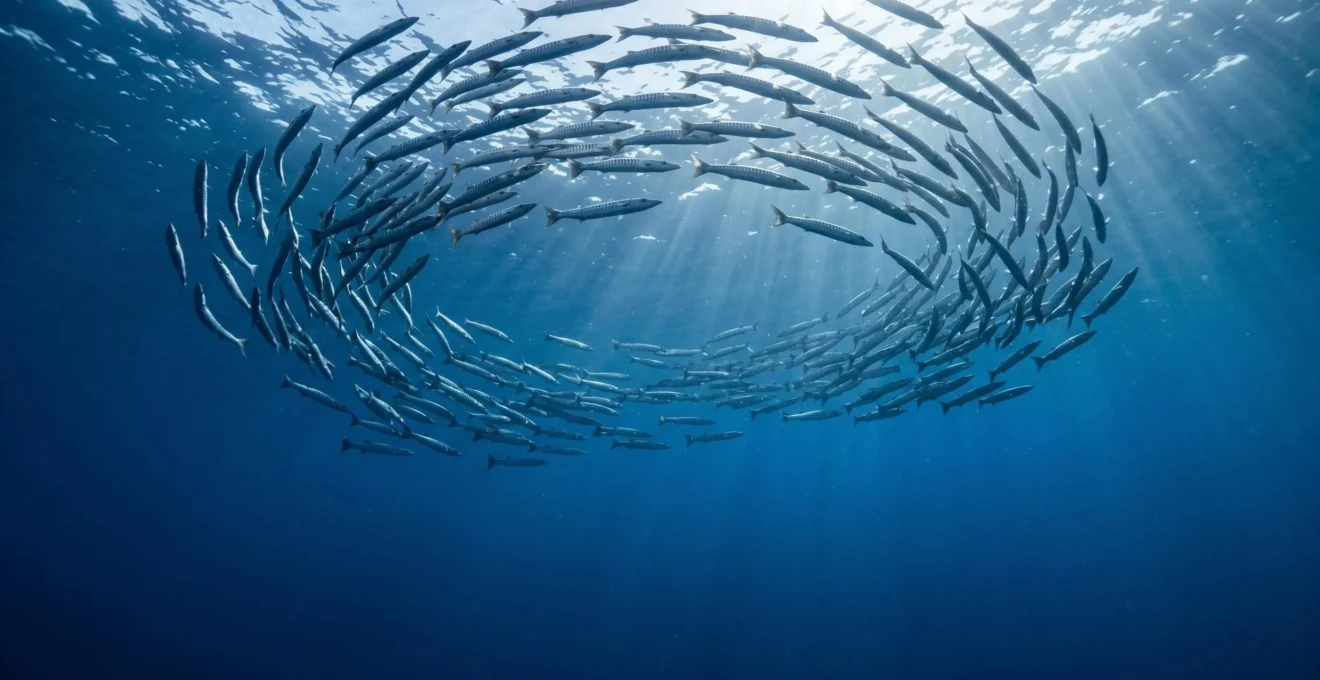
- Barracuda: The easiest to identify. They are long, thin, and silver, like a javelin. They can hang almost motionless in the water column, often in large, spiraling shoals, or hunt with terrifying bursts of speed.
Remember that light levels are a major trigger for activity. Many predatory fish emerge to hunt at dawn and dusk, when the changing light gives them an advantage over their prey. By timing your dives for these « golden hours, » you significantly increase your chances of witnessing these hunters in action and getting a clear look at their distinct shapes and behaviors.
The Risk of Getting Separated from the Reef While Chasing Big Fish
The temptation can be overwhelming. A magnificent shark glides past, just at the edge of your visibility. The instinct to follow, to get a closer look, to get that one perfect photo, is immense. This is the most dangerous moment of your dive. Giving in to that impulse, abandoning your buddy and the reef reference, is how dives go horribly wrong.
Let’s be brutally clear: never chase a fish into the blue. The fish is in its element; you are not. It is faster, more aware, and doesn’t rely on a tank of air. In the time it takes you to swim 30 feet, you can become completely disoriented, lose sight of the reef, and, most critically, lose your buddy. Buddy separation is not a minor inconvenience; it is a primary factor in diving accidents.
The statistics are a sobering reminder of this reality. While data varies, incident reports often highlight this critical failure. For example, an analysis of diving incidents in the UK found that in situations with a clear cause, nearly 50% of 12 recorded fatalities involved buddy separation or divers being alone. The reward of a slightly closer look is never worth becoming a statistic. Your plan is your lifeline. Your buddy is your lifeline. The reef is your visual lifeline. Do not sever any of them for a fleeting glimpse of a fish.
How to Set Your Camera for Wide Angle Shots in Low Contrast Blue Water?
As the Underwater Photography Guide states, « Shooting photographs in open blue water can be one of the most challenging and yet rewarding forms of underwater photography. » Capturing that massive barracuda shoal or that passing whale shark requires a different approach. Your biggest enemy is the water column itself, which sucks away light, contrast, and color. The first rule, therefore, is to get as close as possible, which reinforces the principle of not chasing, but letting the subject approach you.
Once you are in position, your camera settings are paramount. You need to take control away from the camera’s automatic brain and dial in the settings manually to balance the ambient light of the blue with the artificial light of your strobes. Your goal is to illuminate your subject while rendering a beautiful, rich blue background, not a washed-out grey or a stark black one (unless that’s your creative intent).
Action Plan: Dialing In Your Blue Water Settings
- Shoot in Manual (M): This is non-negotiable. You need full control over aperture, shutter speed, and ISO to balance ambient light with your strobes.
- Boost Your ISO: Don’t be afraid to use a higher ISO (e.g., 400-500). This makes your sensor more sensitive to ambient light, helping you capture a more saturated and vibrant blue in the water column.
- Control Your Aperture: A wider aperture (smaller f-number) lets in more light, but it creates a shallow depth of field, which can be tricky for fast-moving pelagics. Start around f/8 and adjust from there.
- Adjust Shutter Speed for Background: This is your primary tool for the blue. A slower shutter speed (e.g., 1/60s) will let in more ambient light for a brighter blue. A faster shutter speed (e.g., 1/200s) will reduce ambient light for a darker, more dramatic blue.
- Aim for Black Backgrounds (Creative): For a dramatic portrait, use a very high shutter speed (1/250s or higher), a small aperture (f/16+), and a low ISO (100). This eliminates the ambient light, and only your strobes will light the subject against a black void.
Remember to shoot in RAW format to give yourself the maximum flexibility in post-processing to bring back colors and adjust contrast. Mastering these settings will allow you to bring home images that do justice to the awe-inspiring encounters you’ve worked so hard to witness.
The Danger of Drifting Into the Blue Without Visual Reference Points
There is a unique and insidious danger that awaits the diver who strays too far from the reef: the Ganzfeld effect. This phenomenon of perceptual deprivation, as described by science, is « caused by exposure to an unstructured, uniform stimulation field. » In diving terms, this is the infinite, featureless blue. When you are suspended in a void with no reef, no surface, and no seabed in sight, your brain is starved of visual cues. It doesn’t know which way is up, down, or sideways.
This isn’t just a feeling of unease; it’s a physiological response that can lead to vertigo, disorientation, and panic. Your depth gauge may tell you you’re ascending when you feel like you’re sinking. Research shows that the effects can be surprisingly rapid; studies on the Ganzfeld effect indicate that it can cause intermittent loss of vision with as little as 10-20 minutes of exposure to this uniform field. Falling into this sensory trap is terrifying and can lead to a dangerously rapid, uncontrolled ascent or descent.
This underscores the critical importance of the reef as more than just a navigational landmark. It is your spatial anchor. Maintaining visual contact with the reef structure is what keeps your brain oriented in three-dimensional space. The moment you lose that reference, you are not just lost; you are at risk of losing your fundamental sense of direction, which can have fatal consequences.
Stingray vs Eagle Ray Behavior: Which Is More Likely to Approach?
Not all rays are created equal, and where you are looking determines what you are likely to see. The fundamental difference between a stingray and an eagle ray lies in their habitat and feeding style. Stingrays are primarily benthic, meaning they live and feed on the seabed, using their powerful jaws to crush mollusks and crustaceans they uncover in the sand. Eagle rays, on the other hand, are pelagic. They are swimmers, elegantly flying through the water column and hunting in open water.
This difference explains where you’ll find them. You will encounter stingrays over sandy patches, often near the reef base or in lagoons. An eagle ray is more likely to be seen cruising along the reef edge or out in the blue, where the action is. This is tied to food availability. Scientific research into reef fish communities and oceanic production reveals a clear pattern: plankton-eating fish communities are far more abundant on the outer edges of reefs, where they intercept plankton drifting in from the open ocean. This creates what scientists call the « wall of mouths. »
This « wall of mouths » is a major food source for pelagic predators, including eagle rays. They patrol these outer reef edges to hunt. Therefore, if you are looking for an encounter, your chances of an eagle ray passing by are highest when you are positioned at a high-current point, watching the blue. A stingray is unlikely to be there. However, in terms of a close approach, habituated stingrays in sandy bays (often due to feeding, unfortunately) may be more likely to interact directly with divers, whereas an eagle ray is more likely to observe you from a distance as it glides past on its patrol.
Key Takeaways
- Read the Currents: Stop looking randomly. Identify high-current points where the reef meets the open ocean; this is where predators hunt.
- Become a Ghost: Master slow, rhythmic breathing and perfect buoyancy to reduce your bubble noise and appear non-threatening to wildlife.
- Safety First, Always: The reef is your lifeline. Never chase a fish into the blue, and always maintain visual contact with your buddy and your reference point.
Why Feeding Stingrays at Los Cristianos Is a Risky Practice for Divers?
The infamous stingray encounters at sites like Los Cristianos in Tenerife are a perfect example of a wildlife interaction gone wrong. The practice of feeding these animals has turned them into aggressive, dependent creatures, creating a situation that is dangerous for both the rays and the divers. While it may seem like a thrilling experience, artificially altering the behavior of wild animals is a fundamentally risky and unethical practice.
When stingrays associate humans with food, they lose their natural caution. They can become demanding and aggressive, bumping and even biting divers in their search for a handout. This not only puts divers at risk of injury but also harms the animals. A diet of unnatural food can cause health problems, and large concentrations of animals in one spot can facilitate the spread of disease. They also become easy targets for poachers and lose their ability to hunt for themselves.
Responsible diving means observing nature, not directing it. The most rewarding encounters are the ones that happen on the animal’s terms. You can encourage this by following simple ethical guidelines. Maintain a respectful distance and let the animal control the encounter. Never touch, corner, or harass a marine creature. Be mindful of your equipment; shiny objects can sometimes resemble the glint of fish scales and attract unwanted predatory attention. By moving calmly and confidently, you project a non-threatening presence, and most animals will accept you as a temporary part of their world.
The next time you descend, the choice is yours. You can be the diver with their nose buried in the coral, or you can be the diver who reads the blue, anticipates the action, and witnesses the breathtaking spectacle of the open ocean. Apply these principles, stay aware, and become the diver who always sees what others miss.