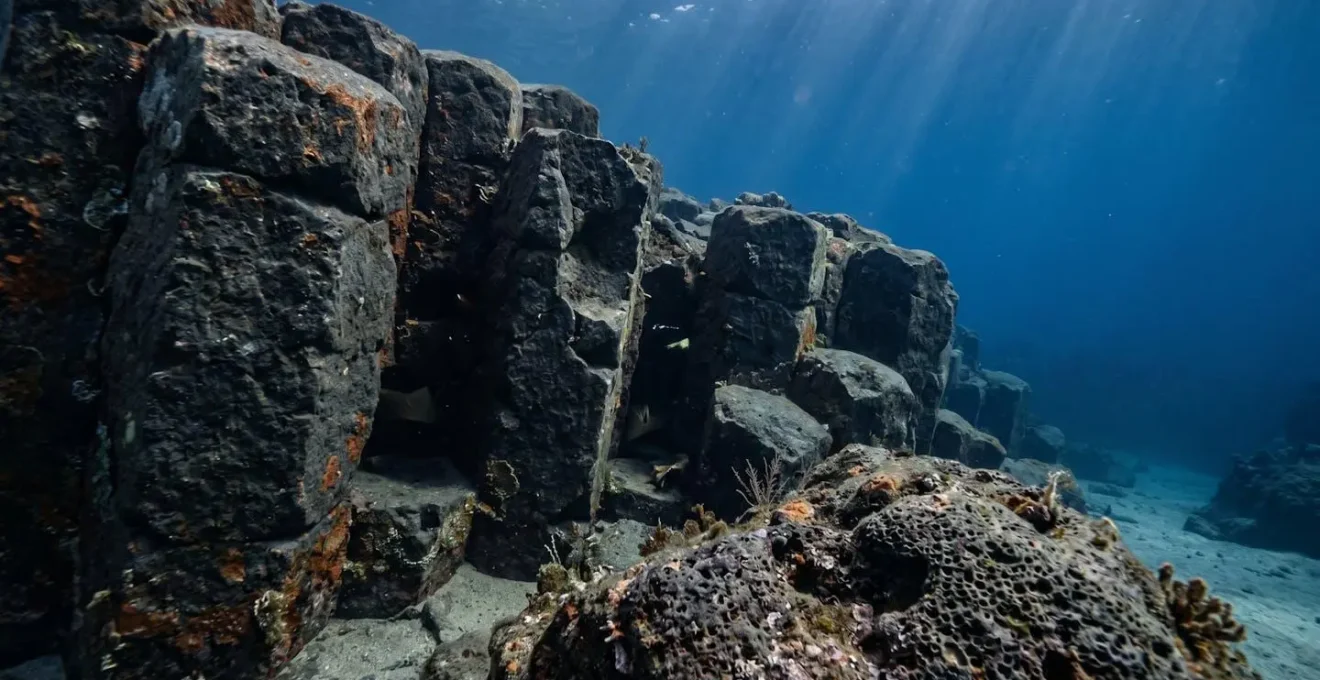
You stare at a wall of volcanic rock and see nothing but stone. But the reef isn’t empty; you’re just looking with the wrong eyes. The secret isn’t to look harder, but to understand the ‘why’ behind each hiding spot. This guide will transform your perception, teaching you to read the subtle language of the reef—from an octopus’s choice of den to a moray’s hunting ground—turning barren-looking basalt into a vibrant theater of hidden life.
For the curious diver, there’s a unique frustration that comes with exploring basalt rock formations. You’ve heard tales of volcanic reefs teeming with life, yet as you drift past the dark, geometric columns, they often seem barren. You peer into cracks and crevices, finding only shadows. It can feel like you’re missing the secret, that the vibrant ecosystem everyone talks about is hiding in plain sight, just out of your view. You’re told to « look in the holes, » but that advice feels hollow when the holes appear empty.
What if the problem isn’t your eyesight, but your mindset? What if the key to unlocking this hidden world isn’t about searching for animals, but about understanding their choices? The truth is, these creatures are masters of camouflage and concealment, and their survival depends on it. They don’t just pick a random hole. Every den, every patch of sand, every shadowed ledge is a deliberate choice based on safety, food, and opportunity. To find them, you must stop looking and start seeing. You must learn to read the rock itself.
This guide moves beyond the generic advice. We won’t just tell you where to look; we’ll explain *why* creatures are there. By understanding the motivations and behaviors of the reef’s most elusive residents, you will learn to anticipate their locations. We will explore the precise criteria an octopus uses to select its home, the proper way to wield your torch without causing alarm, the subtle signs of an ambush predator buried in the sand, and the dynamic forces that turn a simple current into a hunting ground. Prepare to adjust your focus from the big picture to the macro details, where the real magic happens.
In the sections that follow, we’ll peel back the layers of the basalt reef’s ecosystem. Each part is a piece of the puzzle, designed to equip you with the knowledge to transform your dives from passive sightseeing into active, successful investigations.
Summary: The Secrets in the Stone
- Why Octopuses Choose Specific Basalt Dens Over Others?
- How to Use a Torch to Inspect Crevices Without Blinding Fish?
- Moray Eels vs Conger Eels: Who Rules the Rocky Reefs?
- The Risk of Putting Your Hands in Holes Occupied by Morays
- How to Spot Tiny Nudibranchs on Vertical Rock Walls?
- How to Scan the Sand for the Distinctive Outline of an Angel Shark?
- Why Pelagics Hunt Where Currents Hit the Reef?
- How to Spot Angel Sharks Buried in the Sandy Seabed Without Spooking Them?
Why Octopuses Choose Specific Basalt Dens Over Others?
An octopus’s home is not an accident; it’s a carefully calculated decision. When you see a collection of shells—the discarded remains of a meal—piled outside a crevice, you’ve found an octopus’s front door, or what divers call a « garden. » This is the first clue, but the real question is why *this* hole and not the one next to it? The answer lies in a sophisticated process of real estate evaluation. An octopus is a soft-bodied, vulnerable creature, and its den is its fortress. It is looking for a perfect blend of security and strategic advantage.
Research confirms that octopuses are incredibly discerning tenants. As noted by marine biology researchers Katsanevakis and Verriopoulos, « Octopuses choose homes preferentially; assessing the dimensions and transparency of potential shelters and selecting the one that provides the best protection. » They will physically inspect potential dens, testing the size of the entrance to ensure it’s small enough to keep predators out but large enough for them to squeeze in. They also prefer opaque materials, which is why the dark, solid nature of basalt is so appealing. In fact, research on octopus den selection reveals that the preference for den quality is even stronger than the preference to be solitary.
This den is not just a passive shelter but the center of a complex micro-ecosystem, as revealed by one fascinating study.
A Window into Octopus Life: The Den-Cam Study
A motion-activated camera trap study provided an unprecedented look into the daily life around an Octopus rubescens den. It revealed the octopus was primarily active during the day and had frequent interactions with others of its own kind. More interestingly, the study found that the presence or absence of the octopus changed the behavior of other species. Rockfish and red rock crabs were more likely to visit when the octopus was away, while kelp greenling actually visited more often when the octopus was home, demonstrating the intricate web of relationships centered on these prime real estate locations.
So, when you’re scanning a basalt wall, don’t just look for an octopus. Look for the perfect octopus home: a small, defensible entrance, evidence of past meals, and a location that offers a commanding view of its territory. You’re not just looking for a creature; you’re looking for its castle.
How to Use a Torch to Inspect Crevices Without Blinding Fish?
One of the first instincts for a diver wanting to see into the dark recesses of a basalt reef is to fire up their torch and blast the interior with light. This is also one of the biggest mistakes. What you see as illumination, a fish or crustacean sees as a sudden, blinding assault. Many nocturnal and crevice-dwelling species have eyes specifically adapted for low-light conditions. Their retinas often contain a reflective layer called the tapetum lucidum—the same structure that makes a cat’s eyes glow in the dark.
This structure acts like a biological mirror, bouncing light back through the retina for a second pass. It dramatically improves night vision but also makes the eye incredibly sensitive to bright, direct light. Scientific studies on fish vision show that the tapetum lucidum increases photosensitivity by a factor of approximately 1.5. Pointing your high-lumen torch directly at them is not just startling; it’s physically painful and can temporarily blind them, leaving them vulnerable. The result is predictable: the creature either bolts deeper into the hole or freezes in a panic, and your chance for a peaceful observation is ruined.
The solution is to adopt a technique of subtlety and respect, what I call the « light’s caress. » Instead of aiming your beam directly into the crevice, aim it at the palm of your hand a few inches in front of the opening. The reflected, diffused glow will be more than enough to gently illuminate the interior without causing distress. Alternatively, aim the main « hot spot » of your beam onto the rock face next to the hole, letting the softer, peripheral « spill » of light provide the visibility. Your movements should be slow and deliberate. Think of it less like a search-and-rescue operation and more like a gentle invitation for the reef’s secrets to reveal themselves.
Moray Eels vs Conger Eels: Who Rules the Rocky Reefs?
Peer into a shadowed crevice in a basalt wall, and you may be met with the unnerving sight of a head, mouth agape, silently observing you. But is it a moray or a conger? While both are elongated, eel-like inhabitants of rocky reefs, they are distinct rulers of their respective domains. Telling them apart is the first step to understanding their roles. Conger eels typically have smoother, greyish skin, larger pectoral fins just behind the head, and a more « curious » face. Morays, on the other hand, often boast patterned or mottled skin, lack pectoral fins, and possess a more serpentine, « prehistoric » look that commands a primal respect.
While congers are formidable predators, it is the moray eel that has truly perfected the art of ambush hunting within the complex architecture of a basalt reef. They are the undisputed masters of the hole-in-the-wall attack.
Moray eels are nocturnal hunters, slithering through the reef at night to corner their prey in reef holes. As opportunistic predators, they primarily feed on smaller fish, crabs, and octopuses.
– Marine biology diving safety experts, Abyss Scuba Diving marine life documentation
What truly sets the moray apart is its specialized anatomy. That constant opening and closing of the mouth isn’t a sign of aggression; it’s simply how they breathe, pumping water over their gills. But that mouth hides a terrifyingly efficient predatory tool. Their teeth are not just sharp; they are often backward-curving needles designed for one purpose: to grip and not let go. Once prey is caught, there is little chance of escape.
This dental architecture is the key to their dominance in the tight confines of the reef. A conger might need space to maneuver, but a moray can strike, grip, and hold its ground with lethal efficiency. So, while both may share the reef, the moray eel, with its specialized adaptations for ambush from a fixed position, truly rules the rocky crevices.
The Risk of Putting Your Hands in Holes Occupied by Morays
Every new diver learns the cardinal rule: don’t put your hands where you can’t see them. This advice is never more critical than on a rocky reef, the prime territory of the moray eel. The danger, however, is widely misunderstood. It’s not about a malicious, aggressive creature actively looking for a fight. A moray bite is almost always a defensive reaction from a startled animal whose territory has been invaded. With more than 185 moray eel species distributed across tropical and temperate waters, the chance of encountering one is high, making this a risk to be taken seriously.
The common question is, « Are they venomous? » The answer clarifies the true nature of the danger. As diving medicine researchers explain, a moray bite is not venomous in the traditional sense of injecting a toxin. The real threat is twofold: severe physical trauma and a devastating bacterial infection.
A moray eel bite is not venomous, but it is dangerous due to the high risk of severe bacterial infection from their bacteria-rich saliva and the deep puncture wounds caused by their unique pharyngeal jaws.
– Marine biology and diving medicine researchers, Scientific analysis of moray eel bite dangers
A moray’s mouth is a breeding ground for bacteria. When their sharp, backward-curved teeth create deep puncture wounds, this bacteria is driven deep into the tissue, leading to aggressive infections that can be difficult to treat. Furthermore, some morays have a second set of jaws in their throat—pharyngeal jaws—that can protract to pull prey (or a finger) deeper into their gullet, causing even more severe tearing and damage. The consequences can be severe, as medical documentation clearly shows.
Medical documentation shows that moray eel bites can cause serious bleeding, swelling, and infection which can lead to paralysis in some cases. Many moray eel varieties have toxins in their mouth mucous including hemagglutinin that causes red blood cells to clump, and may generate crinotoxins which can destroy red blood cells. Secondary infections and septicemia are significant risks requiring immediate antibiotic treatment.
– Clinical documentation of moray bite infection complications, Healthline
The lesson is unequivocal. Your curiosity about what lies within a hole should never outweigh your respect for its potential occupant. Keep your hands to yourself and use your torch—gently—to explore.
How to Spot Tiny Nudibranchs on Vertical Rock Walls?
Moving from the threat of a moray to the delicate beauty of a nudibranch is a perfect example of adjusting your mindset. To find these « jewels of the sea, » you must slow down, shrink your focus, and start thinking like a macro photographer. Basalt rock walls, which seem monolithic and plain from a distance, are actually bustling cities for tiny invertebrates. Indeed, biodiversity surveys at volcanic rock sites show that sites like Basalt Island are home to over 100 reef fish species and a huge diversity of invertebrates, including these colorful sea slugs.
But they won’t jump out at you. Spotting a nudibranch, which can be just a few millimeters long, on a vast wall of rock requires a specific strategy. It’s about training your eyes to look for the unusual: a splash of electric blue or vibrant orange that simply doesn’t belong to the muted tones of the rock, sponge, and algae. They are often found on their specific food sources, so learning to identify certain types of hydroids, sponges, or bryozoans is like learning to find a lion by first spotting the gazelles.
More than anything, it requires patience and technique. You can’t find nudibranchs while swimming at a normal pace. You must achieve neutral buoyancy, get your face close to the wall (without touching it!), and scan a small area, maybe the size of a dinner plate, for a full minute before moving on. This is where the real secrets of the reef are revealed. To help you master this, here is an expert’s checklist for developing your macro vision.
Action Plan: Nudibranch Spotting Techniques
- Illuminate the Shadows: Use a torch even during day dives to light up dark crevices and overhangs, making the vibrant colors of hidden invertebrates pop.
- Master Buoyancy: Control your buoyancy with precision. Avoid any kicking that stirs up sediment, which reduces visibility for you and can smother delicate organisms.
- Get Close and Personal: Approach the wall closely without touching it. Scan small, manageable sections for several minutes at a time; your eyes need time to adjust and detect patterns.
- Find Their Food: Look for the specific organisms nudibranchs feed on. Search for patches of certain hydroids, sponges, or bryozoans, as the nudibranchs will likely be nearby.
- Mind Your Gauges: When you’re engrossed in the macro world, it’s easy to lose track of time and air. Check your pressure gauge and depth frequently, especially when exploring deeper rocky bottoms beyond 10-20 meters.
Adopting this slow, methodical approach will not only help you find nudibranchs but will open up an entirely new, miniature world that most divers swim right past.
How to Scan the Sand for the Distinctive Outline of an Angel Shark?
Not all of the basalt reef’s secrets are in the rock itself. Where the volcanic formations meet the sandy seabed, a different kind of master of concealment holds court: the angel shark. Finding one is a true « holy grail » for many divers, not just for its rarity, but for the skill it takes to spot one. This is not an animal you find by chance; you find it by knowing exactly what to look for. An angel shark is a master of ambush, and its entire strategy relies on becoming one with the sand.
As the MarineBio Conservation Society explains, « Angel sharks lie partially buried in the sand, with only its eyes and spiracles visible. This positioning enables the shark to ambush unsuspecting prey that swim by. » Therefore, you are not looking for a « shark. » You are looking for a subtle disturbance in the texture of the sand. You are looking for the « shark-shaped patch of sand »—a slightly raised, flattened outline that just doesn’t look quite as natural as the surrounding ripples. More specifically, you are looking for two small bumps, positioned close together, that are its eyes. Sometimes, you might see the gentle puff of sand as it exhales through its spiracles.
The best way to scan is to swim slowly, a meter or two above the sandy bottom, letting your eyes relax and look for patterns. Don’t focus too hard. Instead, look for anomalies in the texture. Is there an outline that looks suspiciously symmetrical? A shape that seems to absorb light differently? Finding one is a moment of pure underwater magic, where the sand itself seems to resolve into the form of a living creature. This skill is all the more important given their conservation status; according to conservation assessments, angel sharks are Critically Endangered, making every respectful sighting a valuable and poignant experience.
Why Pelagics Hunt Where Currents Hit the Reef?
While much of our focus has been on the small, hidden creatures, the basalt reef’s influence extends far out into the blue. Where strong ocean currents collide with these immovable volcanic structures, an incredible phenomenon occurs: the creation of a pelagic hunting ground. This is where you’ll find the big players—jacks, tuna, barracuda—congregating for a feast. But why here?
The answer lies in a combination of physics and biology. The current, rich with microscopic plankton and nutrients from the deep, is forced upwards when it hits the reef wall. This upwelling concentrates the food source in a specific area. Small planktivorous fish, like fusiliers and damselfish, swarm to this all-you-can-eat buffet, forming dense, shimmering schools. They, in turn, become the main course for larger predatory fish. This creates a predictable, reliable behavioral hotspot.
This process is often supercharged in volcanic regions, creating true oases of life in the open ocean.
Nutrient-rich waters emanating from volcanic formations create oases for fish, corals, and other marine creatures, attracting massive aggregations where basalt formations interact with currents.
– Dressel Divers volcano diving research, Volcano Diving Explorations marine ecosystem analysis
As a diver, this means you can « read » the water to find the action. Position yourself on a point of the reef that juts out into the current. Look for the « wall of mouths »—the line of small fish all facing into the flow, feeding on the invisible conveyor belt of plankton. If you find the bait ball, it’s only a matter of time before the predators arrive. You’ve used your understanding of the environment to place yourself in the front row of one of the ocean’s most dramatic spectacles.
Key Takeaways
- For an octopus, the quality and security of a den are more important than being alone, driving them to be highly selective tenants.
- The greatest danger from a moray eel bite is not venom, but the severe bacterial infection and deep tissue damage from their unique jaws.
- To find large pelagic fish, look for where currents hit the reef; this concentrates baitfish and creates predictable hunting grounds.
How to Spot Angel Sharks Buried in the Sandy Seabed Without Spooking Them?
You’ve done it. After hours of patient scanning, you’ve spotted the subtle outline, the two small bumps in the sand. You’ve found an angel shark. Now comes the most critical part: the approach. The thrill of discovery can quickly lead to a cloud of sand as a panicked, powerful animal flees the scene. How you behave in these next few seconds determines the nature of the encounter, turning a fleeting glimpse into a prolonged, magical observation. Spooking them is not just bad form; it’s a missed opportunity and stressful for an animal already under immense pressure.
The conservation status of these sharks makes a respectful approach paramount. As comprehensive conservation assessments confirm, all three angel shark species in the Eastern Atlantic and Mediterranean are classified as Critically Endangered on the IUCN Red List. We are privileged observers in their last remaining strongholds. The goal is to be a ghost, a silent passerby that poses no threat. This requires impeccable buoyancy and an understanding of how the shark perceives its world.
To ensure a safe and ethical encounter, you must follow a strict protocol. These are not just guidelines; they are the rules of engagement for interacting with a critically endangered species. Your every movement should communicate « I am not a threat. »
- Approach slowly from the side with minimal water displacement to avoid triggering their pressure-sensing lateral line.
- Maintain perfect buoyancy control, staying low to the seabed to prevent kicking up sand or casting a large, predatory shadow from above.
- Never touch, block, or chase the shark. Physical contact can damage their protective mucous layer and cause immense stress.
- Watch for pre-flight signals, such as the body tensing, slight lifting from the sand, or an increased breathing rate. If you see these, stop your approach and slowly back away.
When done correctly, these encounters are incredibly rewarding. The shark, sensing no danger, will remain placid, allowing you to observe its beautiful camouflage and patient hunting posture. As the Save Our Seas Foundation notes, « Angel sharks are generally placid and reliably observed. In a few remaining refuges such as the Canary Islands, there is a burgeoning ecotourism trade around diving and snorkelling with them. » By being a responsible, educated diver, you become part of the solution, proving that humans and these magnificent sharks can coexist.
Now that you know how to read the reef and approach its inhabitants with respect, your dives will never be the same. It’s time to put your new eyes to the test. Plan your next dive not as a tourist, but as an explorer, and start discovering the vibrant, hidden world that was there all along.