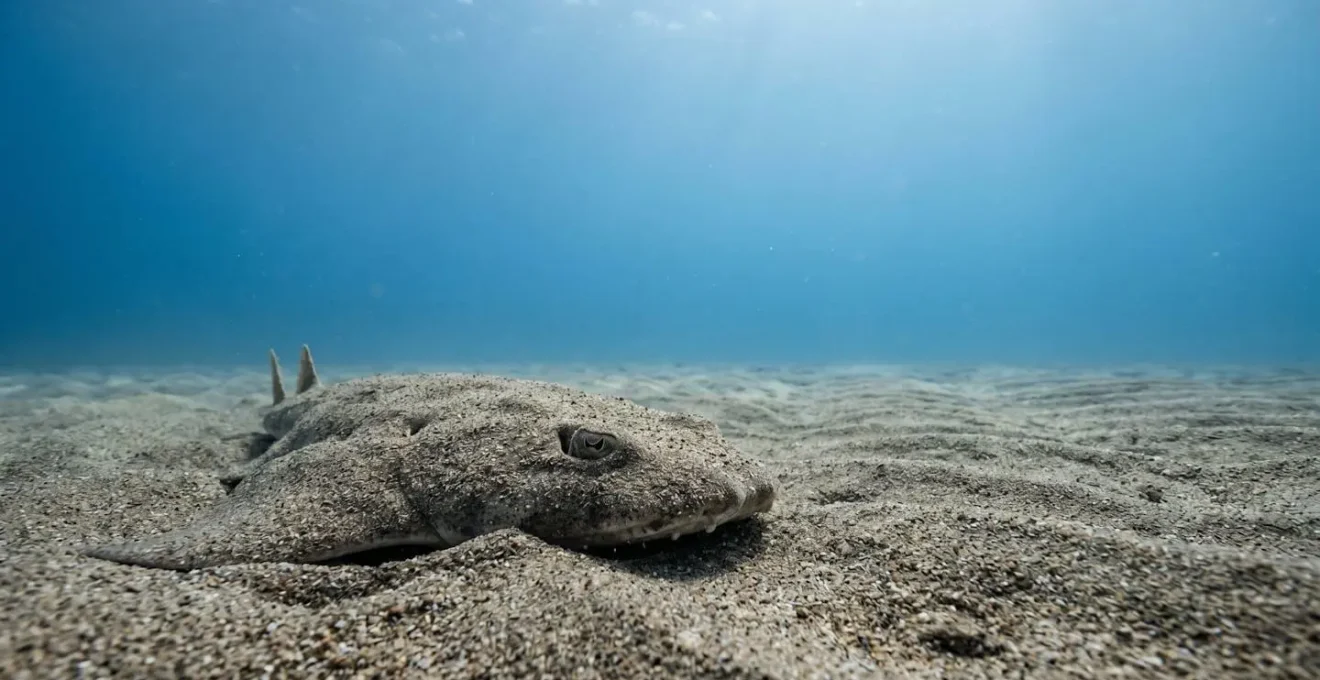
The frustration of missing a perfectly camouflaged angel shark is familiar to many divers. The solution isn’t better eyesight, but a shift in mindset. This guide moves beyond simple ‘look for an outline’ advice and teaches you to become an ecosystem detective, reading the subtle environmental clues, understanding shark behaviour, and mastering your own movements to transform your chances of a magical, respectful encounter.
There is a unique kind of quiet anticipation that comes with gliding over a vast, sandy plain underwater. You know that life is here, hidden in plain sight, and none is more masterful at the art of disappearance than the angel shark. For the naturalist diver, the thought of swimming right over one of these magnificent creatures without ever knowing it was there is a source of constant wonder and a little frustration. Common advice often falls short, telling you to simply “look for the outline” or “go slow,” but failing to explain the deeper strategy involved.
The truth is, spotting a buried angel shark is less a test of vision and more a test of perception. It’s an intellectual puzzle. What if the secret wasn’t just in your eyes, but in your ability to read the story of the seabed? What if spotting them is less about a lucky glance and more about methodical deduction—the work of an underwater detective? This requires understanding not just what to look for, but why the shark is there in the first place.
This guide is designed to shift your perspective. We will deconstruct the angel shark’s camouflage by understanding its motivations, its preferred habitats, and the subtle signs it leaves behind. You will learn to read the environment for clues, refine your own movements to become a silent observer, and even train your brain to recognize patterns that most divers miss. It’s time to stop searching and start seeing.
Summary: How to Find Camouflaged Angel Sharks
- Why Do Angel Sharks Bury Themselves During Daylight Hours?
- How to Scan the Sand for the Distinctive Outline of an Angel Shark?
- Angel Shark vs Stingray Prints: How to Tell What Lies Beneath?
- The Mistake of Kicking Up Sand That Ruins Visibility and Scares Sharks
- How to Approach a Buried Shark for the Perfect Low-Angle Shot?
- Sand Ripples vs Rock Ridges: Reading the Bottom for Direction
- How to Spot Tiny Nudibranchs on Vertical Rock Walls?
- Which Creatures Hide in the Basalt Rock Formations During the Day?
Why Do Angel Sharks Bury Themselves During Daylight Hours?
Understanding the ‘why’ is the first step for any ecosystem detective. An angel shark doesn’t bury itself at random; it’s a calculated, deeply ingrained survival strategy. This behaviour is primarily driven by its nature as an ambush predator. By concealing itself under a fine layer of sand, it becomes nearly invisible to the fish and crustaceans that make up its diet. This method is incredibly energy-efficient, allowing the shark to wait patiently for a meal to swim within striking distance rather than expending energy on active pursuit.
Research shows this strategy is remarkably effective, with some sharks remaining in a chosen ambush spot for extended periods. This isn’t just about laziness; it’s about optimization. They are masters of energy conservation.
Case Study: The Strategic Hunter of Santa Catalina
A fascinating study of Pacific angel sharks off Santa Catalina Island revealed just how deliberate this behaviour is. Individual sharks didn’t just pick any sandy spot; they meticulously chose ideal ambush sites and would remain there for up to ten days. These prime locations were typically at the junction of sandy bottoms and rocky reefs. The sharks would orient themselves facing upslope, a clever tactic that uses falling sediment to help with burial and silhouettes unsuspecting prey against the brighter surface water, making them easier targets.
This tells us something crucial: the shark is looking for specific real estate. By learning to recognize these prime ambush locations, you are no longer searching an entire ocean of sand, but focusing your attention on high-probability zones. The shark has done the work of finding the best spot; your job is to find the shark in that spot.
How to Scan the Sand for the Distinctive Outline of an Angel Shark?
Once you’ve identified a high-probability area, the search itself requires a specific technique. A frantic, wide-ranging gaze is the least effective method. The key is a slow, systematic scan that allows your brain to process subtle inconsistencies in the texture of the sand. The goal is to detect the « tell »—the tiny clue that breaks the camouflage. Instead of looking for a « shark, » look for a shark-shaped space.
Swim slowly, about two meters above the sand, along the edge of the reef or kelp line. This is where sand meets structure, creating a highway for prey. Your eyes should not be darting around. Instead, establish a cognitive grid. Scan a small patch of sand methodically, then move to the next. You are looking for the faint outline, which is often still visible. More importantly, you are looking for the two things the shark cannot hide: its eyes and spiracles, which are always kept exposed to see and breathe. They often appear as two small, dark, and unnaturally symmetrical dots on the seafloor.
Perceiving random movement, such as the flick of a fin or antenna, is the most successful way to break a creature’s camouflage code. And as any hunter can tell you, roving eyes don’t tend to see movement well—diving slow is the trick.
– Ned DeLoach, Scuba Diving Magazine – Pro Tips for Finding Marine Life
Before your dive, study photographs of buried angel sharks. Actively training your « search image » builds a mental library of what these subtle shapes look like. This practice primes your brain to recognize the pattern when you see it in the wild, transforming a confusing patch of sand into a readable clue.
Angel Shark vs Stingray Prints: How to Tell What Lies Beneath?
The sandy bottom near a reef is a busy place, and not every buried shape is an angel shark. The most common case of mistaken identity involves stingrays, which also have a habit of burying themselves. Distinguishing between the two before they are disturbed is a mark of a skilled observer. The secret lies in reading the impression left in the sand, a skill that relies on knowing their fundamental anatomical differences.
An angel shark, being a shark, has pectoral fins that are distinct from its body, creating a more angular, almost kite-like or triangular shape. A stingray’s pectoral fins are fused to its head, forming a more rounded, disc-like body. This structural difference creates a different « print » in the sand.
As the image above illustrates, you are looking for angles. A buried stingray often creates a softer, more circular mound. An angel shark’s impression will have more defined edges, particularly at the « corners » where its pectoral fins end. Other key differences to keep in mind include gill slit position (on the sides for sharks, underneath for rays), mouth position (at the front for sharks, under the body for rays), and the presence of whisker-like barbels near the angel shark’s nostrils, which rays lack.
By learning to recognize these subtle differences in the sand’s texture and outline, you can make a more educated guess about what lies beneath, saving you the effort of investigating a common ray and increasing your chances of focusing on a true angel shark.
The Mistake of Kicking Up Sand That Ruins Visibility and Scares Sharks
You can have the best eyes in the world, but if you arrive at the scene in a cloud of sand, the show is over before it begins. The single biggest mistake divers make when searching for bottom-dwellers is poor finning technique. A careless flutter kick can stir up sediment, reducing visibility to zero and sending a pressure wave that will spook any nearby shark long before you see it. Mastering your movement is non-negotiable.
The goal is to eliminate any downward thrust from your fins. According to dive training organizations, the frog kick technique provides minimized sand disturbance, making it the gold standard for this type of diving. Unlike the flutter kick, its propulsion is directed backward, not down. If you must use a flutter kick, it should be a modified version, with small, controlled movements originating from the hips, keeping the fins high.
Perfecting this requires exceptional buoyancy control. You must be able to maintain a completely horizontal trim, with your fins at or above the level of your body. This prevents your fin tips from accidentally dipping and stirring the sand. This level of control isn’t achieved overnight; it’s a skill to be practiced on every single dive, turning you into a stealthy, silent observer rather than a clumsy visitor.
Your Action Plan: Stealthy Finning and Buoyancy Control
- Establish Buoyancy Early: Achieve perfect neutral buoyancy at least 10 meters away from the sandy search area, not while you are over it.
- Choose the Right Kick: Prioritize the frog kick or a modified, small-range flutter kick to direct water backward, not downward.
- Keep Fins High and Slow: Maintain a horizontal trim with your fins held slightly above your body line. All movements should be small, slow, and deliberate.
- Hands Off: Do not use your hands for propulsion or balance. This destabilizes your trim and affects breathing, which in turn affects buoyancy.
- Maintain Horizontal Trim: Your entire body, from head to fin tips, should be parallel to the seabed. This is the foundation of a low-impact approach.
How to Approach a Buried Shark for the Perfect Low-Angle Shot?
Spotting the shark is only half the battle. The approach is where many encounters go wrong, leading to a stressed animal and a missed opportunity. The goal is a respectful, non-threatening advance that allows for observation and, for photographers, the perfect low-angle shot. A successful approach is slow, low, and indirect.
Never approach from directly above. This is a classic predator attack angle and will almost certainly trigger a flight response. Instead, approach from the side, staying as low to the seabed as your buoyancy skills allow. Plan your path relative to the sun; you want to avoid casting your large, moving shadow directly over the shark. Settle down on the sand next to the shark, not on top of it, using slow, deliberate movements. A single fin tip can be used as a stable pivot point to get your camera to sand level without using your hands.
Pay close attention to the shark’s body language. It will tell you if you are too close. Watch for subtle cues like rapid eye movement or a slight tensing of the pectoral fins. These are signals that you are approaching its comfort boundary. Respect these signals and hold your position or back away slightly. A calm shark may allow you to observe it for several minutes. When the encounter is over, execute an ethical exit by backing away slowly along the same path you approached, ensuring the animal remains calm for the next diver.
This patient, respectful technique not only results in better photographs and longer encounters but is our fundamental responsibility as visitors to their world.
Sand Ripples vs Rock Ridges: Reading the Bottom for Direction
An expert spotter learns to read the entire landscape, not just the space immediately in front of them. The very composition of the seabed—the transition from sand to rock, the direction of sand ripples—provides crucial directional clues. You are not just looking for a shark; you are looking for the ‘X’ on the treasure map, and the map is the seafloor itself.
As the Santa Catalina study showed, angel sharks are not randomly distributed across the sand. They have a strong preference for ecotones, the junctions where sandy and rocky substrates meet. These zones are highways for their prey. Fish use the reef for shelter and forage out over the sand. By positioning themselves at this border, the sharks place themselves in a high-traffic area, increasing their chances of a successful ambush.
Therefore, your search should be concentrated along these lines. Swim parallel to the reef edge, scanning the sand that borders it. Don’t waste time in the middle of vast, featureless sand flats far from any structure. The shark is a strategic hunter, and it has already identified the most productive hunting grounds. Follow its logic. Look for where the rock ridges give way to sand ripples. This transition zone is the primary search area, the most important place to apply your patient, systematic scanning.
By learning to read the bottom composition, you are adopting the shark’s own point of view, using the landscape to predict where the highest probability of an encounter lies. This is the essence of predictive spotting.
Key Takeaways
- Spotting angel sharks is a skill of perception, not just sight; it requires reading the entire ecosystem.
- Focus your search on high-probability zones, especially the junctions between sandy bottoms and rocky reefs.
- Mastering buoyancy and finning to ensure a silent, non-disruptive presence is more important than any other factor.
How to Spot Tiny Nudibranchs on Vertical Rock Walls?
This may seem like a strange detour, but to become a master of spotting camouflaged animals, you must train your brain. One of the best ways to hone your skills for finding a creature that blends in is to practice finding creatures that stand out. Spotting tiny, brightly colored nudibranchs on a complex rock wall is an excellent cognitive exercise that directly improves your ability to find angel sharks.
The process engages the same neural pathways. You are training your brain to detect anomalies and recognize patterns. With nudibranchs, you are looking for « out-of-place » color. With angel sharks, you are looking for « out-of-place » texture and shape. The underlying skill is the same: the ability to pick out a specific signal from a noisy background.
Once you locate a cryptic animal, it will be easier to detect in the future because of a phenomenon known as a ‘search image,’ where key characteristics are imprinted subconsciously from previous encounters.
– Ned DeLoach, Scuba Diving Magazine – Marine Life Spotting Techniques
Try this exercise on your next dive: find a one-meter square section of a vertical rock wall and commit to examining it for a full five minutes. Hover motionlessly, control your breathing, and let your eyes slowly trace every surface. Challenge yourself to find every tiny creature within that square. This « one-meter-square challenge » is an exercise in patience and focus that builds the mental muscle memory for visual identification. By actively building your « search image » for all types of marine life, you are sharpening the very tool you need to break the angel shark’s camouflage code.
Which Creatures Hide in the Basalt Rock Formations During the Day?
The final piece of the detective’s puzzle is to understand the entire neighborhood. The rocky reef adjacent to the sandy bottom is not just a landmark; it is the angel shark’s pantry. By observing the life within the rocks, you can gather crucial intelligence about the likelihood of a predator lurking nearby. A vibrant, bustling reef is a strong indicator of a healthy ecosystem, one that can support a large ambush predator.
Angel sharks are most active at night, when they may leave their buried position to cruise the bottom. This coincides with the activity patterns of many rock-dwelling creatures. However, during the day, the presence of their food source is a vital clue. Studies confirm that angel sharks feed primarily on bottom-dwelling fish, crustaceans, and mollusks—exactly the kinds of animals that seek shelter in the nooks and crannies of basalt rock formations.
The Day-Shift / Night-Shift Dynamic
The ecosystem operates on a two-shift system. During the day, the rocks are a refuge for moray eels, octopuses, crabs, and various fish. The adjacent sand is the domain of the camouflaged, waiting angel shark. At night, the roles can shift, with the shark becoming more active and its prey venturing out. The presence of a healthy « day shift » population in the rocks is a strong sign that the adjacent sandy area is a viable hunting ground. A barren reef likely means a barren sand flat next to it.
So, as you swim along the reef edge, pay attention. Is it teeming with life? Are there crabs scuttling between rocks? Do you see small fish darting in and out of crevices? If the answer is yes, you are in the right place. You are not just looking at potential prey; you are looking at a living, breathing signpost that points directly to the hunting grounds of the master you seek.
By combining this ecosystem-level understanding with personal skill and a patient mindset, you transform a search from a game of chance into a science. Your next dive over a sandy bottom won’t be a hopeful scan, but a methodical investigation. Apply this detective’s mindset, and you won’t just see more angel sharks—you’ll see the entire underwater world in a new, more interconnected way.