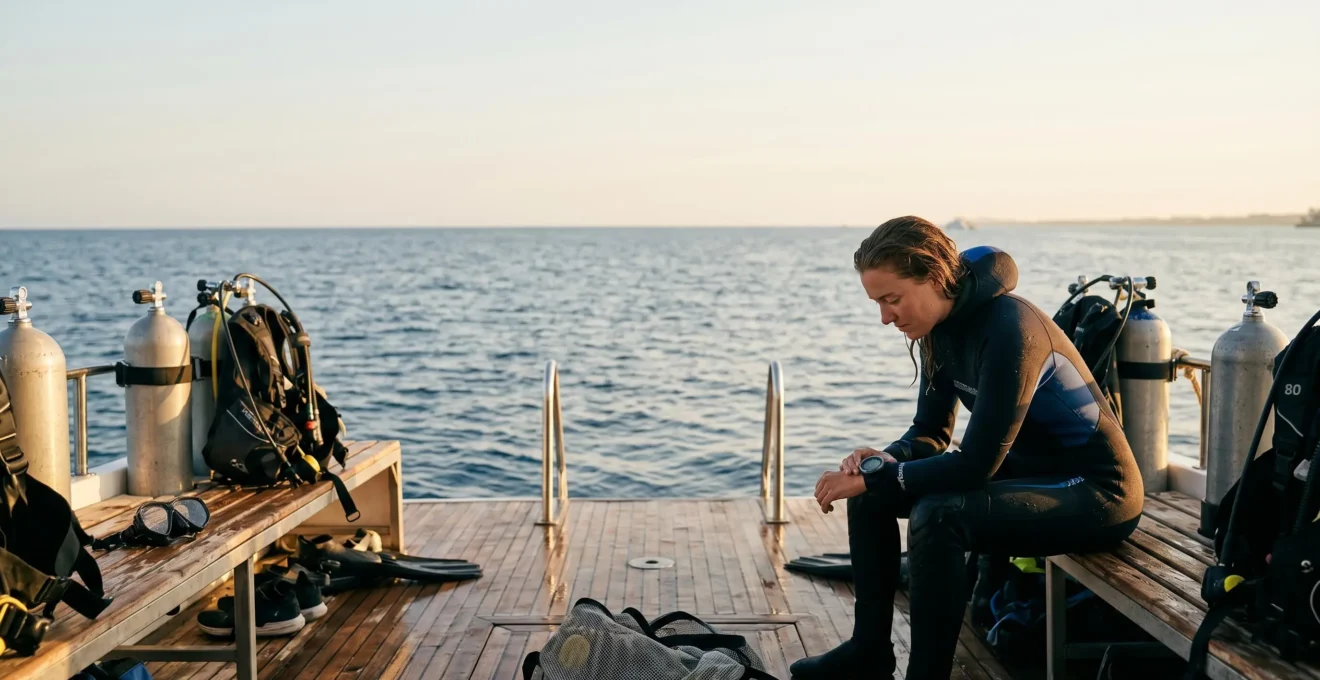
The key to safely managing a 3-dive day isn’t just watching your computer, but actively managing your body’s cumulative « physiological debt. »
- Fatigue and dehydration accelerate nitrogen loading and can dangerously mask the subtle, early symptoms of decompression sickness (DCS).
- Using conservative computer settings and Enriched Air Nitrox are powerful tools, but they require a deep understanding of their true physiological impact, not blind faith.
Recommendation: Adopt a post-dive self-assessment protocol to systematically check for neurological, skin, and joint symptoms that differ from normal, expected tiredness.
The allure of a liveaboard trip or a week at a dive resort is the promise of immersion—not just in the water, but in the rhythm of diving. Wake, dive, eat, dive, nap, dive, sleep, repeat. It’s a diver’s paradise. Yet, with each successive plunge, a silent tab is run up within your body: a cumulative nitrogen load. For the intensive diver, managing this « physiological debt » is the most critical skill, far surpassing buoyancy control or air consumption. The common advice— »stay hydrated, » « watch your computer »—is not wrong, but it is dangerously incomplete. It treats the diver as a passive observer of their own safety, a passenger along for the ride with their dive computer as the pilot.
This approach is insufficient for a three-dive-a-day schedule. The real danger isn’t a sudden, catastrophic failure, but a slow, creeping accumulation of risk where profound fatigue begins to mask the subtle onset of decompression sickness. The question is no longer « Am I within my NDL? » but rather, « Is this joint ache from finning or from microbubbles? Is this weariness from the early wake-up call or a neurological symptom? » This guide reframes the challenge. The goal is not simply to follow rules, but to understand the physiological principles behind them. We will move beyond platitudes to build a robust, proactive system for self-monitoring, enabling you to distinguish true fatigue from the first whispers of DCS and ensuring your last dive of the week is as safe as your first.
This article provides a physiologist’s framework for managing the intense demands of repetitive, multi-day diving. We will explore the critical role of hydration, the science of surface intervals, the truth about computer settings, and the crucial skill of distinguishing fatigue from decompression illness.
Summary: The Physiologist’s Guide to Nitrogen Management on Intensive Dive Schedules
- Why Drinking Water Is Critical in Salty Atlantic Air?
- How to Plan Surface Intervals Effectively for Repetitive Dives?
- Standard vs Conservative: Which Computer Setting for a Heavy Dive Week?
- The Danger of Fatigue Masking Subtle DCS Symptoms
- How Enriched Air Reduces Post-Dive Tiredness on Multi-Dive Days?
- The Risk of Exceeding NDL When Exploring the Cave Floor
- How Doctors Distinguish Between Tiredness and DCS Symptoms?
- The Cost of Decompression Illness: Why You Never Want to Pay for a Chamber Ride Out of Pocket?
Why Drinking Water Is Critical in Salty Atlantic Air?
The advice to « stay hydrated » is ubiquitous in diving, but its physiological importance is often understated, especially in marine environments. Dehydration is not merely a matter of comfort; it is a primary catalyst for increasing decompression sickness (DCS) risk. The mechanism is simple: decreased blood plasma volume from dehydration thickens the blood, reducing its efficiency in transporting and off-gassing dissolved nitrogen from tissues. This creates a bottleneck in your body’s ability to manage its physiological debt, effectively making you more susceptible to bubble formation. For divers on an intensive schedule, maintaining optimal hydration is a non-negotiable safety protocol. In fact, specific research demonstrates that consuming around 30% of your daily water intake in the hours before diving significantly contributes to risk mitigation.
The environment itself conspires against your hydration status. A diver’s fluid balance is under constant assault from multiple factors:
- Breathing Compressed Air: The air from your scuba tank is extremely dry. Your lungs must humidify every breath, leading to significant respiratory water loss, which is amplified in colder water.
- Immersion Diuresis: The combined effect of cold and pressure constricts peripheral blood vessels, shunting blood to your body’s core. Your kidneys interpret this as fluid overload, triggering increased urine production and the loss of both water and essential salts.
- Pre-Dive Sweating: The simple act of waiting on a sunny dive deck while wearing a thick wetsuit can cause substantial fluid loss through sweat before you even enter the water.
- Salty Air and Skin Residue: In a marine environment, microscopic salt crystals left on your skin after the water evaporates actively draw moisture out of the epidermis, compounding surface-level dehydration.
Ignoring these combined effects is a critical error. Proactive, aggressive hydration is not just about quenching thirst; it’s about maintaining the efficiency of your body’s nitrogen transport system. On a three-dive day, you are not just drinking for today, but pre-loading for the dives to come.
How to Plan Surface Intervals Effectively for Repetitive Dives?
Surface intervals are not passive waiting periods; they are active recovery and off-gassing sessions. For a diver on a heavy schedule, the effectiveness of these intervals dictates the safety and viability of subsequent dives. The primary goal is to allow dissolved nitrogen to exit your tissues, but this process can be either hindered or helped by your actions on the surface. Simply sitting on the dive deck is the bare minimum. A more physiological approach involves creating an optimal environment for de-gassing. This includes rehydrating, seeking shade to avoid further heat stress, and consuming a light, easily digestible snack to replenish energy without diverting significant blood flow to digestion, which could otherwise be used for nitrogen transport.
Furthermore, consider incorporating gentle activity and deliberate breathing. Light walking can promote circulation in the extremities, helping to move nitrogen-rich blood back to the lungs. However, strenuous activity is counterproductive as it can increase metabolic rate and potentially affect bubble formation. The most impactful and often overlooked technique is controlled, diaphragmatic breathing. This practice helps to maximize gas exchange efficiency in the lungs, creating a more favorable pressure gradient for nitrogen to leave the bloodstream. It’s a simple, proactive measure that transforms a passive wait into an active part of your decompression strategy.
As this image suggests, simple, focused actions like controlled breathing can be a powerful tool. This concept of proactive de-gassing is central to managing cumulative risk. While dive computers dictate the minimum time, your body’s actual state dictates the quality of that time. A 90-minute interval spent stressed, dehydrated, and sun-baked is far less effective than a 60-minute interval focused on calm, cool, hydrated recovery. The length of the interval matters, but the quality of what you do during that time matters more.
Standard vs Conservative: Which Computer Setting for a Heavy Dive Week?
For a diver undertaking a demanding schedule of multiple dives over multiple days, the choice of a dive computer’s algorithm setting is a critical safety decision. The debate between « Standard » and « Conservative » is not about being brave or timid; it is a calculated decision about managing unquantified risk factors. A standard setting assumes an ideal diver under ideal conditions. A heavy dive week, however, is rarely ideal. Factors like fatigue, minor dehydration, thermal stress, and the sheer volume of diving create a level of physiological debt that standard algorithms cannot measure. Opting for a more conservative setting is a direct acknowledgment of these real-world variables.
A conservative setting effectively tells your computer’s algorithm that you are not a perfect physiological model. It reduces your no-decompression limits (NDLs) and may mandate longer safety or decompression stops by applying a more cautious « gradient factor. » This builds an additional safety margin into every dive, reducing the maximum allowable nitrogen tension in your tissues. This is not a sign of weakness but of professionalism. It is an admission that after three dives yesterday and two already today, your body’s off-gassing efficiency is likely compromised compared to when you were fresh on day one. A conservative gradient is the only tool within the computer that can account for this cumulative, unquantifiable stress.
Understanding what these settings control is key to making an informed choice. The following table breaks down common features in modern dive computer algorithms and how they contribute to safety during intensive dive schedules.
| Algorithm Feature | Function | Benefit for Multi-Dive Days |
|---|---|---|
| Bühlmann ZHL-16C | Divides body into 16 tissue compartments with different nitrogen absorption rates | Provides precise NDL calculations accounting for varied tissue saturation speeds |
| RGBM (Reduced Gradient Bubble Model) | Predicts bubble formation risk based on gradient factors and ascent profiles | Alerts divers when approaching decompression stops, especially critical on dive 3 |
| Real-Time Nitrogen Saturation Display | Visual indicators (green/yellow/red zones) show current tissue loading status | Enables proactive surface interval planning between repetitive dives |
| Residual Nitrogen Tracking | Monitors nitrogen remaining in tissues after surfacing to calculate next dive safety | Automatically adjusts NDL for subsequent dives based on cumulative loading |
| Conservative Factor Adjustment | User-selectable gradient factors reduce allowable nitrogen exposure thresholds | Builds safety buffer accounting for age, fitness, fatigue on heavy dive weeks |
Ultimately, the computer is a tool, not an oracle. On a heavy dive week, the most prudent choice is to set the computer to its most conservative setting from day one and leave it there. This simple action provides a consistent, reliable safety buffer that helps compensate for the physiological toll of repetitive diving.
The Danger of Fatigue Masking Subtle DCS Symptoms
One of the most insidious dangers of a high-intensity dive schedule is the phenomenon of symptom masking. The profound, bone-deep fatigue that can accompany three-dive days is real and, to some extent, expected. However, this exhaustion creates a dangerous camouflage for the early, subtle signs of decompression sickness. A diver might dismiss unusual tiredness, a mild headache, or a localized joint ache as « just part of diving hard. » This is a potentially catastrophic error in judgment. While the overall studies estimate the incidence of decompression sickness at 2.8 to 4 cases per 10,000 dives, this statistic doesn’t account for the numerous cases of subclinical DCS or mild symptoms that are self-resolved or misattributed to fatigue.
The key is to understand that normal physical fatigue from exertion typically improves with rest, hydration, and nutrition. Neurological or physiological symptoms of DCS, on the other hand, tend to persist, worsen, or change in character over time. Aching shoulders from carrying tanks feel different from a sharp, localized pain in a single joint that wasn’t there before. The weariness of an early morning feels different from a sudden onset of confusion, dizziness, or a metallic taste in the mouth. Learning to make this distinction is a critical survival skill. It requires a shift in mindset from passively accepting fatigue to actively interrogating any unusual sensation.
To combat symptom masking, a diver must implement a structured, repeatable post-dive self-assessment protocol. This is not a casual « how do you feel? » but a systematic check of your body’s systems to detect deviations from your personal baseline. It provides objective data points in a situation clouded by subjective feelings of tiredness.
Your Post-Dive Self-Assessment Protocol
- Neurological check: Perform a heel-to-toe walking test along a straight line on the deck and a Romberg balance test (stand with feet together, arms out, and eyes closed for 30 seconds). Any significant wobble or loss of balance that feels different from normal sea legs should be noted.
- Skin examination: Visually inspect and feel your skin, particularly on the torso, shoulders, and back. Check for unusual rashes, mottled or marbled patterns (cutis marmorata), or sensations of ‘sandpaper texture’ which can indicate subcutaneous bubbles.
- Joint rotation assessment: Systematically and gently rotate all major joints (shoulders, elbows, wrists, hips, knees, ankles). Note any pain that is sharp, localized, or disproportionate to the physical exertion of the dive.
- Sensory verification: Actively check for any abnormal sensations. This includes tingling, ‘pins and needles,’ numbness in fingers or toes, or unusual sensory experiences like a metallic taste.
- Cognitive evaluation: Honestly assess your mental state. Is there any difficulty concentrating, memory lapse, or confusion that feels out of place compared to your typical post-dive mental state? Critically, do these symptoms worsen rather than improve with rest?
How Enriched Air Reduces Post-Dive Tiredness on Multi-Dive Days?
The claim that diving with Enriched Air Nitrox (EANx) reduces post-dive fatigue is one of the most common and fiercely debated topics in recreational diving. Many experienced divers on liveaboards swear by it, reporting feeling significantly less tired and more alert at the end of a three-dive day when using nitrox compared to air. The underlying theory is that a lower partial pressure of nitrogen reduces the overall physiological stress on the body, both in terms of subclinical narcosis during the dive and the off-gassing load afterward. This subjective experience is powerful and has driven the widespread adoption of nitrox for repetitive diving.
However, from a strict physiological standpoint, the evidence is inconclusive. The diving science community, including leading organizations like the Divers Alert Network (DAN), has struggled to prove a direct causal link in controlled studies. The following citation summarizes the official scientific consensus:
Despite a common impression that diving on nitrox may cause less fatigue than performing the same dive using an air mixture, scientific research to date has not found solid evidence to support such an assumption.
– Divers Alert Network (DAN), Air, Nitrox and Fatigue – DAN Medical Article
This scientific skepticism doesn’t necessarily mean the thousands of divers reporting benefits are wrong. Several theories could explain the perceived reduction in fatigue, and the truth is likely a combination of factors.
The Critical Flicker Fusion Frequency Study
To investigate the nitrox-fatigue link, a 2010 double-blind study used a clever method called critical flicker fusion frequency (CFFF) to objectively measure mental alertness. Divers performed identical dives, once on air and once on EAN36, without knowing which gas they were breathing. The results were telling: after the air dive, divers’ CFFF scores (a measure of cognitive processing speed) dropped by 6%, aligning with their reported feelings of fatigue. After the nitrox dive, however, their CFFF scores actually increased by 4%. While divers felt less tired on nitrox, researchers caution that this could be due to several reasons: reduced subclinical nitrogen narcosis, decreased asymptomatic bubble formation, or a very powerful placebo effect. The consensus remains that while many divers feel a benefit, the direct physiological cause is not yet definitively proven.
For the intensive diver, the takeaway is pragmatic. While EANx is primarily a tool to extend bottom time, if you subjectively feel less tired when using it, that is a valid benefit. Any factor that reduces overall perceived stress—whether physiological or psychological—is a net positive during a heavy dive week. It is a tool for managing your overall physiological load, but not a magic bullet that negates the need for conservative planning and self-assessment.
The Risk of Exceeding NDL When Exploring the Cave Floor
On the third dive of the day, your body is saturated, and your dive computer is unforgiving. The no-decompression limit (NDL), which seemed generous on the morning’s first dive, has now shrunk dramatically. This is the moment of greatest temptation. You descend on a beautiful wall, and just a few meters below your planned depth, you spot something extraordinary—a rare turtle, a unique rock formation, or the entrance to a swim-through. The urge to dip down for « just a minute » is immense. This is perhaps the most dangerous moment of the day. Exceeding your NDL, even for a moment, on a highly saturated third or fourth dive carries a disproportionately higher risk than doing so on a single, isolated dive.
The computer’s display of a rapidly diminishing NDL is not a suggestion; it’s a stark visualization of your body’s physiological state. Each preceding dive has loaded your « slower » tissues (like joints and fats) with nitrogen, and the short surface intervals haven’t been long enough to fully off-gas. Your computer knows this and recalculates your limits accordingly. Ignoring its warning by dropping deeper is a gamble against well-established physiological models. The risk is compounded by the fact that research published in 2005 found that a larger number of consecutive days diving is associated with a higher risk of DCS, confirming the cumulative nature of this stress.
The image above is a perfect representation of the diver’s reality on a late-afternoon dive. The available bottom time is a fraction of what it was that morning. This is not a limitation to be beaten, but a physiological boundary to be respected. The discipline of a truly experienced diver is not shown by their ability to push limits, but by their unwavering commitment to respecting them, especially when fatigue is high and temptation is great. The most beautiful sight in the ocean is not worth compromising the safety that allows you to return tomorrow.
How Doctors Distinguish Between Tiredness and DCS Symptoms?
In a hyperbaric chamber facility, the diagnostic challenge for a physician is immense: is the diver’s condition a case of extreme fatigue and dehydration, or is it true decompression sickness? The diver’s ability to provide clear, objective information is crucial in this process. Subjective complaints like « I just feel really tired » are of little diagnostic value. Physicians rely on a pattern of objective signs and a precise timeline to make a diagnosis and initiate treatment. Understanding what they look for can empower a diver to become a better observer of their own body.
A prospective study of DCS incidents provides a critical diagnostic clue for divers. Researchers found that a key differentiator is the symptom’s response to rest. Normal, exertion-induced fatigue should improve after a period of rest, hydration, and a good meal. Symptoms of DCS, however, typically persist, worsen, or may even appear to get better before returning with greater intensity. The study highlighted that divers who were ultimately diagnosed with DCS often had symptoms that did not resolve with rest and exhibited objective neurological signs, such as a loss of coordination detectable with a simple heel-to-toe walking test. The failure of divers in the study to apply first aid oxygen despite their training points to the powerful effect of denial—a diver’s tendency to wish symptoms away.
If you ever have to make that call, being prepared with the right information is critical. A hyperbaric physician needs specific, factual data to assess your case. This includes:
- Complete dive profile data: Provide the exact depth, bottom time, ascent rate, and surface interval duration for every dive conducted in the 48 hours leading up to the symptoms.
- Precise symptom timeline: Document the exact time each symptom began relative to surfacing. Did it happen on the boat? Two hours later? The next morning?
- Objective symptom descriptions: Replace vague feelings with concrete observations. Instead of « I feel weird, » say « The skin on my left shoulder feels like sandpaper, » or « I have a persistent metallic taste in my mouth. »
- Fluid intake and exertion record: Report your hydration status and physical workload. Did you drink a liter of water or just one coffee? Were you fighting a current or was it a gentle drift?
- Previous DCS history and risk factors: Disclose any past incidents, known medical conditions (like a PFO), your age, and BMI. This history is crucial as it can significantly elevate the statistical risk of a recurrence.
Key Takeaways
- Dehydration is not just a comfort issue; it is a physiological multiplier for DCS risk that compromises your blood’s ability to off-gas nitrogen.
- Normal dive fatigue can dangerously mask the subtle neurological and skin symptoms of DCS. A systematic, objective self-check after every dive is non-negotiable.
- Conservative computer settings and Enriched Air Nitrox are critical risk-mitigation tools, but they are not a license to push physiological limits—they are a buffer to accommodate for cumulative stress.
The Cost of Decompression Illness: Why You Never Want to Pay for a Chamber Ride Out of Pocket?
Beyond the immediate physical danger, the financial consequences of decompression sickness can be life-altering. The phrase « a chamber ride » vastly understates the reality of treatment. It is not a single event but often a series of complex medical interventions with staggering costs. According to DAN dive accident coverage data, hyperbaric oxygen therapy can cost from $330 to over $1,000 per hour. A typical treatment plan may involve multiple sessions, and this price tag doesn’t even include the associated hospital fees, medication, or physician consultations.
However, the chamber treatment itself is often not the most expensive component. In many of the world’s premier diving destinations, hyperbaric facilities are not immediately available. This means that a suspected case of DCS can trigger a medical evacuation, which can dwarf the cost of the treatment itself. The financial reality of a dive accident is a sobering deterrent against cutting corners on safety.
The True Cost: Evacuation and Treatment
Real-world cases documented by the diving community paint a stark picture. In one incident, a diver required a helicopter transfer when the initial hospital could not treat diving accidents. The final bill included: $1,400 for the initial hospital visit, a staggering $34,000 for the helicopter transport, and then $3,700 for the chamber treatment plus another $7,500 at the receiving hospital. In another case, a diver whose insurance had lapsed by just two months faced a total bill of $45,000 for 12 chamber sessions and a medical flight. These examples demonstrate that emergency evacuation is the financial wildcard, with costs in remote locations like Palau easily reaching six figures for the specialized air transport required to get a patient to a capable facility.
These figures transform the abstract concept of « risk » into a concrete financial liability. They underscore the immense value of dedicated dive accident insurance, which is designed to cover these specific, high-cost scenarios that a standard travel or health policy may exclude. But more importantly, they provide the ultimate motivation for conservative diving practices. The most effective way to manage the cost of a dive accident is to invest every effort in preventing one from ever happening. The price of prevention—a more conservative computer setting, an extra bottle of water, a canceled third dive when you feel « off »—is infinitely lower than the cost of the cure.
Armed with this physiological understanding of cumulative risk, the next step is to integrate these principles into your immutable dive habits. Make the post-dive self-assessment protocol a non-negotiable part of your routine on every trip, turning abstract knowledge into concrete, life-saving action.