The difference between a memorable dive holiday and a dangerous one in Las Galletas lies in spotting three key operational red flags before you book.
- Equipment & Safety: Assess not just if gear exists, but its specific state of hygiene, maintenance, and the vessel’s integrity for the given sea conditions.
- Logistical Friction: Evaluate the entire process from the shop to the boat; convenience in logistics like gear transport and parking advice is a key sign of professionalism.
- Price Transparency: Scrutinize « cheap » deals for hidden fuel surcharges or unclear package terms that reveal a centre’s true customer service ethics.
Recommendation: Trust tangible evidence over online hype. A five-minute physical inspection of the equipment and premises is infinitely more valuable than a generic five-star review.
Las Galletas, a charming fishing village on Tenerife’s sun-drenched south coast, is a gateway to some of the island’s most vibrant underwater ecosystems. Divers flock here for the chance to encounter majestic rays and sea turtles. However, with popularity comes a proliferation of dive centres, and not all are created equal. The standard advice—to check PADI ratings and read online reviews—is a starting point, but it’s dangerously insufficient. These are surface-level checks that miss the critical, tangible details that define a truly safe and professional operation.
Many vacationers, eager to get in the water, overlook subtle but significant red flags. They fall for cheap packages that hide extra costs or trust centres with poorly maintained equipment. The key to avoiding a « tourist factory » isn’t just about reading what others say; it’s about knowing what to look for yourself. This guide moves beyond the generic advice and provides a quality auditor’s framework. But what if the secret wasn’t in asking if the equipment is « good, » but in knowing precisely how to conduct a 30-second hygiene inspection of your regulator? Or understanding that a centre’s location relative to the marina speaks volumes about its commitment to reducing your stress?
This article will equip you with a practical checklist to assess a dive centre’s operational integrity. We will delve into equipment safety, vessel suitability, pricing transparency, and the small logistical details that separate the premier outfits from the precarious ones. By the end, you will be able to walk into any dive shop in Las Galletas and make an informed decision based not on marketing, but on a clear-eyed audit of their professionalism.
To help you navigate this crucial decision, this guide breaks down the key areas you must audit. The following sections provide a structured approach to evaluating everything from equipment to on-boat etiquette, ensuring you choose a centre that values your safety and enjoyment above all else.
Summary: An Auditor’s Checklist for Las Galletas Dive Centres
- Why Proximity to the Marina Saves You Stress Before the Dive?
- How to Inspect Rental Regulators for Hygiene and Safety?
- RIBs vs Hard Boats: Which Vessel Suits Your Comfort Level?
- The Hidden Fuel Surcharges That Inflate Cheap Dive Packages
- Where to Park in Las Galletas Without Getting Towed While Diving?
- 6-Dive Pack vs Unlimited Diving: Which Offers Better Value for You?
- How to Check if Your Holiday Rental Has Secure Gear Storage?
- Boat Diving Etiquette: 5 Unspoken Rules to Avoid Annoying the Captain and Crew
Why Proximity to the Marina Saves You Stress Before the Dive?
The first sign of a well-run dive centre is its attention to logistics. A shop located far from the marina might seem trivial, but it introduces significant operational friction. Imagine hauling heavy tanks, weights, and BCDs several hundred metres under the hot Canarian sun in a thick wetsuit. This isn’t just an inconvenience; it’s a source of unnecessary stress and fatigue before your dive has even begun. A professional centre eliminates this by being located a short walk from the pontoon or by having a seamless system for transporting gear.
This logistical ease is a hallmark of an operator who respects your time and energy. As one diver noted about a top-tier Las Galletas centre, the experience is defined by what you *don’t* have to do. The crew handles all the heavy lifting, allowing divers to simply walk to the boat after kitting up. This is the gold standard.
Tanks and other equipment are transferred from the dive centre onto the boat and back by Alfonso and team. As a diver, you just need to get yourself to the port/boat after changing into your dive suit in the shop which is only a short walk to the pier from where we sailed out.
– Diver Review, TripAdvisor
When you visit a potential dive centre, observe the flow. Is there a clear, organized staging area for equipment? Or is it a chaotic scramble? A centre that has invested in a prime location or a slick transport system is one that invests in the overall quality of your dive experience. It shows they think about the entire process, not just the underwater part.
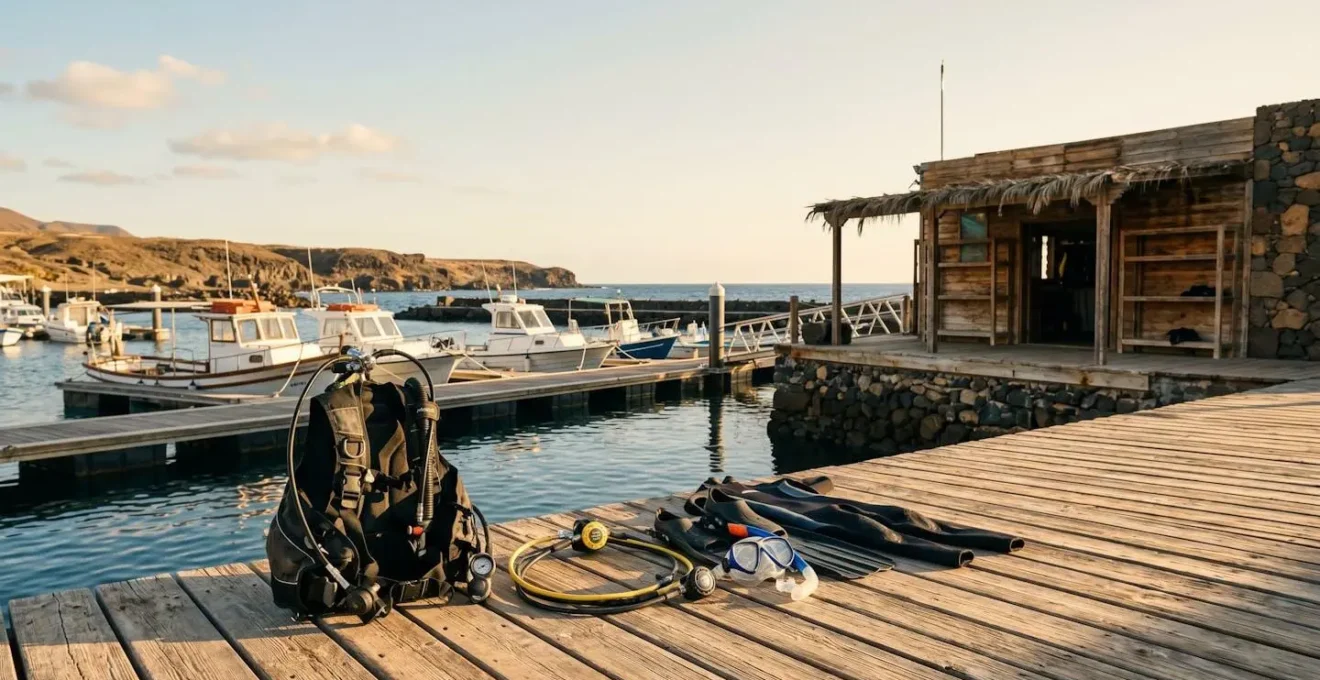
The image above illustrates what a professional setup looks like: an organized, spacious area where gear can be assembled without clutter or stress. This level of organization is a strong indicator of a centre’s commitment to safety and efficiency. A chaotic pre-dive environment is often a precursor to a chaotic and potentially unsafe dive.
How to Inspect Rental Regulators for Hygiene and Safety?
No piece of equipment is more critical to your safety than your regulator. While most divers trust that rental gear is safe, a quick personal inspection is a non-negotiable step in your audit. A professional dive centre will not only welcome this scrutiny but will also have transparent maintenance logs. The industry standard is clear: regulators must be serviced regularly. PADI guidelines, for instance, state this should happen at least every year or after every 100 dives, whichever comes first. Don’t be afraid to ask when the gear was last serviced.
However, a service log only tells part of the story. Your own senses can reveal the daily state of the equipment. A hygiene inspection takes less than a minute and can tell you everything you need to know about a centre’s day-to-day standards. A faint scent of disinfectant from the mouthpiece is a positive sign; a musty or mildew odour is a major red flag indicating poor cleaning protocols. Visually check for salt crystals, corrosion, or cracks in the hoses, especially near the fittings. This isn’t about being paranoid; it’s about taking ownership of your safety with the gear you’re about to trust with your life underwater.
This hands-on check empowers you to verify the quality of the life-support system you’re about to use. The following checklist formalizes this process into a simple, repeatable routine.
Your 30-Second Pre-Dive Regulator Inspection:
- Visual Check: Look for salt crystals, obvious corrosion, or damage on all metal components of the first stage.
- Smell Test: Sniff the mouthpiece. A clean disinfectant scent is good; a mildew or stagnant water odour is a serious red flag.
- Hose Integrity: Gently flex all hoses near their connection points to check for micro-cracks, brittleness, or excessive wear.
- Dust Cap Discipline: Verify the first stage dust cap is present and fits snugly. Its absence suggests carelessness in handling and storage.
- Breathe & Purge: Once connected to a tank, take a few breaths. Inhalation should be smooth and effortless. Press the purge button; it should be easy to depress and stop immediately upon release.
RIBs vs Hard Boats: Which Vessel Suits Your Comfort Level?
The type of boat a dive centre uses is a critical factor that directly impacts your comfort and, in some conditions, your safety. In Las Galletas, you’ll primarily find two types: Rigid Inflatable Boats (RIBs) and conventional Hard Boats. Neither is inherently « better, » but they offer vastly different experiences. Understanding this difference allows you to choose a centre whose vessel integrity and style match your personal needs. This is especially important when you consider that roughly one in three individuals is highly susceptible to motion sickness, a condition that can ruin a dive day.
RIBs are fast and efficient, getting you to dive sites quickly. However, in choppy seas, they ride over the waves, leading to a bumpy, high-impact « rodeo ride » that can be tough on your back and a nightmare for anyone prone to seasickness. Hard boats are larger, heavier, and more stable. They cut through waves rather than bouncing over them, offering a much smoother transit. They also typically feature more amenities, such as a marine toilet and better sun protection, which can make a huge difference during your surface interval.
The choice of vessel also has implications for safety and ease of use. Hard boats usually have a proper dive platform for easy giant-stride entries and a sturdy ladder for exiting. RIBs often require a back-roll entry and a more awkward exit, heaving yourself over the inflatable tubes. The following table breaks down the key differences to help you decide which vessel is right for you.
| Feature | RIB (Rigid Inflatable Boat) | Hard Boat (Conventional Hull) |
|---|---|---|
| Stability in Choppy Conditions | Rides over waves, can feel like ‘rodeo ride’ | More stable platform, cuts through waves |
| Speed to Dive Site | Faster due to lightweight design | Slower but steadier transit |
| On-Board Amenities | Minimal – typically no toilet, limited shade | Marine toilet, better shade coverage |
| Entry/Exit Method | Back-roll entry, ladder over tubes | Dive platform for giant stride, easier exit |
| Seasickness Factor | Higher impact from wave action | Lower due to greater stability and size |
When you inquire with a dive centre, ask them what type of boat they use for their daily trips. A professional operator will be transparent about their vessel and should be able to tell you if it’s suitable for the day’s expected sea conditions and your comfort level.
The Hidden Fuel Surcharges That Inflate Cheap Dive Packages
A low advertised price for a dive package can be tempting, but it’s often a red flag in disguise. One of the most common tactics used by less scrupulous dive centres is the « hidden fuel surcharge. » You book a seemingly great deal, only to discover at the end of your trip that you owe a significant extra amount for the fuel used to get to popular sites, like the famous ray feeding spots. This lack of transparency is a major indicator of a centre that prioritizes profit over a positive customer experience.
A price transparency audit is a crucial part of your selection process. Before committing, ask one simple, direct question: « Is the price you’re quoting all-inclusive, or are there any additional charges for fuel, marine park fees, or equipment? » A reputable centre will give you a straight answer. Hesitation, or a vague response like « it depends on the site, » should be treated with extreme caution. True professionals in the industry are moving towards complete transparency, recognizing that surprise fees are a source of frustration for divers.
As Alexander Bryant, CEO of Emperor Divers, stated when his company moved to an all-inclusive pricing model, the problem of hidden fees is widespread and often confusing for customers.
We often see compulsory charges presented in different ways – daily fees, marine park fees, fuel surcharges or other dubious onboard extras – sometimes clear, sometimes less so.
– Alexander Bryant, CEO, Emperor Divers Official Statement on Pricing Transparency
The best operators build all mandatory costs into their advertised prices. They understand that trust is built on honesty, not on bait-and-switch pricing tactics.
Case Study: The ‘No Hidden Extras’ Model
Industry leader Emperor Divers implemented a transparent pricing policy after recognizing that divers were frequently surprised by extra costs. Their « No Hidden Extras » guarantee incorporates all mandatory fuel surcharges, port fees, and marine park fees into the advertised price. This approach specifically combats the common practice where centres advertise a low base price but then add significant fuel supplements for trips to premier dive sites, fundamentally changing the real cost of a dive package.
Where to Park in Las Galletas Without Getting Towed While Diving?
This may seem like a minor detail, but a dive centre’s advice on parking is a powerful litmus test of their local knowledge and customer care. Las Galletas, like many Spanish coastal towns, has a complex system of street parking. Getting a ticket—or worse, having your rental car towed while you’re 45 minutes into a dive—is a guaranteed way to ruin your day. This creates exactly the kind of operational friction you want to avoid.
A professional dive centre located in the heart of the town understands this challenge intimately. When you inquire, they shouldn’t just wave a hand vaguely and say, « There’s parking on the street. » They should provide specific, actionable advice. They should be able to tell you:
- The location of the nearest free parking areas (marked with white lines).
- The rules and time limits for paid « Zona Azul » areas (marked with blue lines), and how to use the payment machines.
- The times of day when parking is most difficult, and suggest you arrive earlier.
- Any local quirks, such as market days when certain streets are closed to traffic.
Asking « Where is the best and safest place to park for a two-tank morning dive? » is an excellent audit question. The quality and detail of the answer reveal how much the centre has considered your entire experience, from the moment you arrive in town to the moment you leave. A centre that gives you clear, helpful parking instructions is one that is invested in making your day seamless and stress-free. A centre that can’t be bothered is showing you that their service ends at the shop door.
6-Dive Pack vs Unlimited Diving: Which Offers Better Value for You?
Dive centres often promote « unlimited diving » packages as the ultimate value proposition. For a diver on a mission to log as many dives as possible, this can seem incredibly attractive. However, a quality auditor knows that true value isn’t measured solely by quantity. The best dive centres understand the risks of dive fatigue and will help you structure a package that prioritizes quality and safety over sheer volume. While industry data shows that a standard week-long dive trip can average thousands of dollars, maximizing that investment means enjoying every single dive safely.
Unlimited diving often encourages divers to push their physical limits. Diving is mentally and physically demanding, and residual nitrogen loading, dehydration, and general tiredness can accumulate over several days. This fatigue can lead to poor decision-making, slow reaction times, and an increased risk of decompression sickness. A responsible divemaster will watch for signs of fatigue in their divers and may even recommend taking an afternoon off, even if it’s « paid for. »
A more sensible approach for most vacationers is a fixed-dive package, such as a 6 or 10-dive pack. This structure encourages a more balanced holiday, leaving time for rest, relaxation, and exploring the other attractions Tenerife has to offer. When discussing packages, observe the centre’s approach. Do they aggressively push the « unlimited » option? Or do they ask about your experience level, your holiday plans, and help you choose a package that makes sense? A centre that advises a more conservative plan, even if it means less revenue for them, is a centre that has your best interests at heart.
How to Check if Your Holiday Rental Has Secure Gear Storage?
If you’re bringing your own expensive dive gear, its security and maintenance become a key part of your holiday logistics. Leaving a few thousand dollars’ worth of regulators, computers, and BCDs on an unsecured balcony or in a damp, unventilated room is a recipe for disaster. This is an area where a dive centre’s local expertise can again be invaluable, but the primary responsibility falls on you during the booking process for your accommodation.
Before you book that Airbnb or holiday apartment, you must perform a « storage audit. » Don’t just rely on photos of a sunny balcony. You need to ask the host specific questions about their facilities for divers. A host who understands the needs of divers will be able to answer these questions confidently. If they seem confused or dismissive, it’s a red flag that their property may not be suitable. A good dive centre will often have recommendations for « diver-friendly » accommodations that they know have the right facilities.
Here are the crucial questions to ask your potential host before you book:
- « Is there a secure, ventilated area to hang wet diving equipment to dry? » A simple clothesline isn’t enough; you need space for bulky BCDs and wetsuits.
- « Is the drying area private or shared with other guests? » Private access is always preferable for security.
- « Can you provide photos of the specific balcony, terrace, or utility area where gear can be stored? » This verifies their claims.
- « Does the property have a lockable outdoor storage unit, a private garage, or a secure room for expensive equipment? »
- « Are there any building or community restrictions on leaving equipment on outdoor spaces? » Some complexes have strict rules.
Securing accommodation with proper gear storage removes a major source of stress from your trip. It ensures your valuable equipment is safe from theft and can dry properly, preventing mildew and degradation.
Key Takeaways
- Audit, Don’t Assume: Actively inspect equipment, logistics, and pricing. A centre’s professionalism is in the details they manage, not just the dives they offer.
- Transparency is Trust: A reputable dive centre is upfront about all costs, especially fuel surcharges. Vague pricing is a major red flag.
- Value Quality Over Quantity: The best dive package is one that matches your experience level and energy, not the one with the most dives. Fatigue is a safety risk.
Boat Diving Etiquette: 5 Unspoken Rules to Avoid Annoying the Captain and Crew
After carefully auditing and selecting a professional dive centre, the final step is to be the kind of client they are happy to have on board. Good boat diving etiquette is not just about being polite; it’s about contributing to a safe, efficient, and enjoyable experience for everyone. The crew has a finely tuned system for managing gear, briefings, and divers. Being a considerate diver who respects this system marks you as an experienced and welcome guest, not a liability.
Ignoring these unwritten rules can create delays, cause frustration, and even compromise safety. The captain is focused on navigating and mooring the vessel, and the divemaster is managing multiple divers of varying skill levels. Your cooperation is essential. By following a few simple principles, you show respect for the crew’s professionalism and the other divers’ time and investment.
Mastering this etiquette is the final piece of the puzzle, ensuring a smooth and rewarding dive day. Here are five essential rules to follow on any dive boat in Las Galletas and beyond:
- Respect the Staging Area: Assemble your gear in the designated zone. Once it’s built, move it to your tank station immediately to clear walkways for others. A cluttered deck is a hazardous deck.
- Don’t Pester the Captain During Maneuvers: The captain is concentrating on navigating the boat, especially in a busy marina. Direct all your dive-related questions to the divemaster or instructor.
- Freshwater Rinse is for Critical Gear: The freshwater rinse tank is a limited resource. It’s for a quick rinse of your camera, dive computer, or face mask. It is not a personal shower for your whole body or wetsuit.
- Listen to Every Briefing, Every Time: You may have dived the site ten times, but conditions like currents and visibility change daily. Ignoring the briefing is disrespectful to the divemaster and dangerous for you and your buddy.
- Be On Time, Which Means Early: « On time » for a dive boat means arriving 15 minutes before the scheduled departure. This gives you ample time to set up your gear without rushing and respects the crew’s schedule.
By applying this auditor’s mindset, you move from being a passive tourist to an empowered diver. You are now equipped to look past the glossy brochures and five-star ratings to identify the tangible markers of a truly safe, professional, and customer-focused dive centre. This approach not only ensures a better, safer holiday but also supports the operators who are genuinely committed to excellence in the diving industry. Now, you can book your dives in Las Galletas with the confidence that you’ve made the best possible choice.