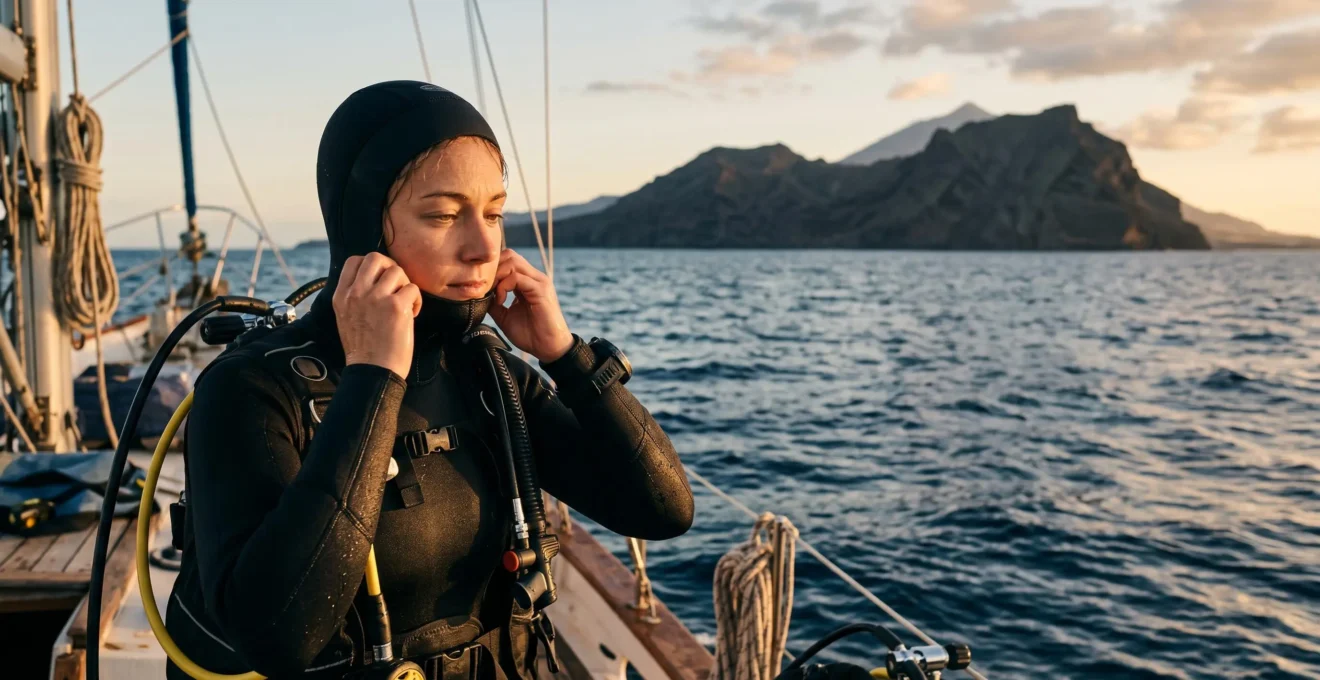
Packing a neoprene hood for summer in Tenerife isn’t about the surface temperature; it’s a strategic decision to manage cumulative ‘thermal debt’ and mitigate unseen risks.
- Even in warm water, you lose significant heat on multi-dive days, a deficit that a hood drastically reduces.
- It offers crucial, non-negotiable protection against the Atlantic’s invisible threats like thermoclines and jellyfish.
Recommendation: Treat the hood not as a winter accessory, but as essential performance gear for a safer, longer, and more enjoyable dive, especially when using rental equipment.
I’ve seen it a hundred times. A diver, excited for the warm summer waters of Tenerife, looks at their luggage and thinks, « It’s 24°C down there. Do I really need to pack a hood? » The temptation to save space is strong. Most people focus on whether a 3mm or 5mm wetsuit is enough, thinking of exposure protection as a single, monolithic choice. They see the hood as an accessory for frigid quarries, not for sun-kissed volcanic reefs. This is a common, and forgive me for saying, rookie mistake.
Experience teaches you to look beyond the number on the dive computer. The Atlantic isn’t a placid, predictable swimming pool. Your comfort, safety, and the overall quality of your dive don’t just depend on the peak water temperature; they depend on managing what I call ‘thermal debt’ over multiple dives and anticipating the invisible challenges the ocean throws at you. The question isn’t whether you’ll *survive* without a hood. The question is how much better, longer, and more enjoyable your dives could be *with* one. That small, seemingly insignificant piece of neoprene is one of the most powerful tools in your dive bag for managing risk and maximizing your underwater experience.
In this article, we’ll go beyond the surface-level discussion. We will explore the science of heat loss, the practical challenges of diving in the Atlantic, and the hidden risks that make a hood a non-negotiable piece of gear for any serious diver in Tenerife, regardless of the season. Consider this a piece of advice passed down from countless dives in these very waters.
Table of Contents: Why a Dive Hood is Your Best Friend in Tenerife
- Why We Lose So Much Body Heat Through the Head Underwater?
- How to Equalize Your Ears with a Tight Hood Compressing Them?
- Bibbed vs Non-Bibbed Hoods: Which Seals Better with Rental Suits?
- The Risk of Jellyfish Stings on the Neck in Open Water
- How to Choose a Vented Hood to Avoid Air Trapping?
- Why the Atlantic Feels Colder Than the Red Sea at the Same Temperature?
- The Risk of Underestimating Wind Chill on the Boat Ride Back
- Is a 7mm Semi-Dry Suit Necessary for Tenerife Winters or Is 5mm Enough?
Why We Lose So Much Body Heat Through the Head Underwater?
The old saying about losing most of your body heat through your head isn’t just a myth your grandmother told you; underwater, it’s a critical physiological reality. Your scalp is filled with blood vessels close to the surface, and without insulation, it becomes a massive radiator. Water conducts heat away from your body 25 times faster than air. While the exact percentage is debated, research demonstrates that between 20 to 40 percent of your body heat can be lost through an unprotected head. This is significant, but it’s not the whole story.
The real enemy on a diving holiday is not the cold of a single dive, but the accumulation of ‘thermal debt’. Even a small, unnoticeable heat loss on your first dive of the day creates a deficit. Your body starts the second dive slightly colder, even if you feel fine on the surface. This cumulative effect is where the hood proves its worth. Studies on repetitive diving show this thermal debt leads to a much faster onset of cold and discomfort on subsequent dives. A diver who was comfortable on the morning dive is suddenly shivering 40 minutes into the afternoon one, all because they failed to manage the small, consistent heat loss from their head.
Thinking of your hood as a tool to prevent this cumulative thermal deficit is the mindset of an experienced diver. It’s not about feeling cold; it’s about preventing yourself from ever getting to that point, ensuring your last dive of the day is just as comfortable as the first.
How to Equalize Your Ears with a Tight Hood Compressing Them?
One of the most common complaints I hear about hoods, and a frequent excuse for not wearing one, is the difficulty it can cause with equalization. A tight hood can indeed feel like it’s compressing your ears and jaw, making the standard Valsalva maneuver feel ineffective. However, this is a problem of technique, not a fundamental flaw in the equipment. A properly managed hood should never be a barrier to a safe and comfortable descent.
The key is pre-dive preparation and adapting your equalization technique. A few simple steps, practiced by seasoned divers, can eliminate this issue entirely. It’s about creating space and using methods that rely less on facial muscle movement, which a tight hood can restrict. Instead of fighting the hood, you learn to work with it. The following checklist outlines the essential steps to ensure your ears can be cleared easily, even with the snuggest of hoods.
Your Action Plan: Equalizing with a Hood
- Pre-Dive Prep: Before entering the water, gently stretch the neoprene around your ear area. You can do this by inserting your fingers between the hood and your head to create micro-channels that prevent a vacuum seal from forming around your ear canal.
- Ensure Proper Fit: The hood should be snug, but not strangling. If you own the hood, a tiny, strategic nick in the chin/throat area can surprisingly improve jaw mobility and reduce pressure buildup without compromising warmth.
- Master the Toynbee: During descent, practice the Toynbee Maneuver. This involves pinching your nose and swallowing. It uses different muscles than the Valsalva and can be far more effective when a tight hood restricts facial movement.
- The ‘Burp’ Technique: If you feel pressure building up that you can’t clear, briefly pull the chin or side of the hood away from your skin. This « burps » any trapped air or water, instantly equalizing the pressure around your ears and allowing you to continue your descent.
Mastering these small adjustments transforms the hood from a perceived hindrance into an unnoticeable part of your kit. It’s a classic case of a small bit of knowledge overcoming a common diving problem.
Bibbed vs Non-Bibbed Hoods: Which Seals Better with Rental Suits?
Not all hoods are created equal, and the difference is never more apparent than when you’re pairing one with a rental wetsuit. The primary choice you’ll face is between a standard (non-bibbed) hood and a bibbed hood. A non-bibbed hood is a simple cap, while a bibbed hood has a large flap of neoprene (the « bib ») that extends down over your chest, back, and shoulders. For a diver using their own perfectly-fitting semi-dry suit, the choice might be a matter of preference. But for someone using a rental suit, the bibbed hood is a game-changer.
Rental wetsuits, by their nature, have seen a lot of use. Their neck seals can be stretched, worn, and are rarely a perfect fit for any individual diver. This is the primary entry point for cold water. A standard hood does nothing to address this. A bibbed hood, however, solves the problem brilliantly. You tuck the bib *inside* the neck of the wetsuit, creating a second, extensive layer of neoprene. This creates an incredibly effective seal, trapping a layer of water that your body warms and preventing the constant, chilling flush of cold water down your back that is so common with ill-fitting suits. As the experts at DIPNDIVE note in their technical guide, the « Bibbed design provides extra warmth around neck, » which is a vast understatement of its true value in real-world conditions.
This visual shows exactly how the bib tucks under the wetsuit collar, creating a superior water-tight barrier that a simple hood can’t match.
Essentially, the bibbed hood upgrades your rental wetsuit. It compensates for the suit’s biggest weakness—the neck seal—and provides a level of warmth and comfort far exceeding what the suit could offer on its own. It is the single most effective piece of gear for turning a mediocre rental suit into a genuinely warm exposure system.
The Risk of Jellyfish Stings on the Neck in Open Water
Warm Atlantic waters are a wonderful thing, but they bring with them certain « invisible risks » that many divers overlook. We’re not just talking about the occasional stray jellyfish; Tenerife’s waters are part of a marine ecosystem that can include more potent encounters, such as the Portuguese Man o’ War. While sightings are not an everyday event, they are frequent enough to be a serious consideration for any diver’s safety plan. The exposed skin on your face, neck, and ears is the most vulnerable target.
A hood provides a simple, yet incredibly effective, barrier against these threats. The pain and danger from a Man o’ War sting are not to be underestimated. As a recent case in the Canary Islands highlighted, these encounters are serious; a 6-year-old girl was stung in 2023, leading to beach closures. The creature’s tentacles can stretch up to 50 meters and are loaded with a potent venom that causes intense pain and, in some cases, severe systemic reactions. The idea of surfacing through a nearly invisible cloud of these tentacles with an exposed neck is a scenario no diver wants to imagine.
Case Study: Portuguese Man o’ War Incidents in Tenerife
Encounters with the Portuguese Man o’ War are a known risk in the Canary Islands. The warm waters provide an ideal habitat, and incidents are reported periodically. The creature’s long, trailing tentacles contain neurotoxic, cytotoxic, and cardiotoxic venom. Contact with the skin, particularly sensitive areas like the neck, can cause excruciating pain, nausea, and even heart problems in severe cases, as reports of Portuguese Man o’ War encounters confirm. A neoprene hood offers a critical physical barrier, turning a potentially dive-ending (or life-threatening) event into a non-issue.
Wearing a hood isn’t a sign of being overly cautious; it’s a sign of being an informed and prepared diver. It’s a simple piece of armor against one of the ocean’s most unpleasant surprises, allowing you to focus on the beauty of the dive rather than worrying about what might be drifting in the water column.
How to Choose a Vented Hood to Avoid Air Trapping?
Once you’re convinced of a hood’s benefits, a new technical question arises: vented or non-vented? As you dive, air from your regulator’s exhaust can get trapped inside a standard hood, creating an annoying, expanding bubble on top of your head. This « conehead » effect is not just uncomfortable; it can affect your buoyancy and even dislodge your mask. The solution is a vented hood, which incorporates a system to allow this trapped air to escape while preventing water from getting in.
Choosing the right vent system depends on your type of diving and your maintenance tolerance. The designs range from simple micro-perforations to complex one-way valve systems. Each has its own set of advantages and disadvantages in terms of effectiveness, durability, and the care required to keep them functioning properly. For most recreational divers, a simple and robust system is often the best choice, but for those undertaking more technical or deeper dives, a more sophisticated valve might be worth the investment. The following table breaks down the most common designs to help you make an informed choice.
| Vent Design Type | Effectiveness | Durability | Maintenance | Best For |
|---|---|---|---|---|
| Simple Micro-Holes | Moderate – allows gradual air release | High – no moving parts | Low – occasional rinse needed | Recreational diving in calm conditions |
| One-Way Valve Systems | High – prevents water ingress while releasing air | Moderate – valves can wear over time | High – requires regular inspection and cleaning | Technical diving and deep dives |
| Labyrinth Vents | High – controlled air escape pathway | High – integrated design | Moderate – needs periodic flushing | Multi-dive days and varying depths |
| Non-Vented (Traditional) | Low – requires manual burping | Highest – simplest construction | Minimal – basic care only | Shallow dives with proper technique |
Ultimately, a vented hood represents a significant quality-of-life improvement for any diver. It eliminates a common annoyance and allows you to maintain better trim and focus, making it a worthwhile upgrade from a basic, non-vented model.
Why the Atlantic Feels Colder Than the Red Sea at the Same Temperature?
A diver who is perfectly happy in 24°C water in the Red Sea might be surprised to feel a distinct chill in 24°C water in Tenerife. This is not just a psychological trick; it’s the « Atlantic Reality. » The characteristics of a massive oceanic body like the Atlantic are fundamentally different from those of a smaller, more sheltered sea. While the surface temperature might be pleasant, with PADI confirming an 18–24°C annual range for Tenerife, the story changes just a few meters below.
The primary factor is the presence of thermoclines—distinct layers of water with a sharp drop in temperature. In the Atlantic, it’s common to descend through warm surface water and hit a thermocline at 10 or 15 meters, where the temperature can suddenly drop by several degrees. This abrupt change is a shock to the system and is where your ‘thermal debt’ begins to accumulate rapidly if you are not properly protected. A hood acts as your first and best defense against this thermal shock, insulating the most sensitive part of your body.
This illustration captures the essence of descending through the Atlantic’s layers, from the warm, sunlit surface to the cooler, deeper water below.
Furthermore, the Atlantic often has more water movement and currents, which accelerates heat loss through convection. Your body is constantly working harder to stay warm. Believing that 24°C is 24°C everywhere is a fallacy. Understanding the specific thermal character of your dive environment is crucial, and in the Atlantic, that means preparing for temperatures colder than what the surface reading suggests.
The Risk of Underestimating Wind Chill on the Boat Ride Back
The dive isn’t over when you surface. In fact, for many divers, the coldest part of the day happens on the boat ride back to shore. This is a critical, often underestimated, phase of heat loss. You emerge from the water, your suit is soaked, and even a light breeze on the deck of a moving boat can trigger rapid and significant cooling. This is the ‘Cooling Fin Effect’ in action.
As Scuba Diving Magazine succinctly puts it, « Your biggest heat loss while out of the water is likely to be during the surface interval. You’re wet, and as the water evaporates it sucks heat out of your body. Any wind accelerates the process. » Your wet head and neck act as a massive surface area for this evaporative and convective cooling. Keeping your hood on during the boat ride, or at least until you’ve dried off and put on a windbreaker, is one of the smartest things you can do to preserve your core temperature, especially if you have another dive planned for the day.
The ‘Cooling Fin Effect’ on Deck
The combination of wet skin and wind on a boat creates a powerful heat-loss mechanism. Water draws heat from your body as it evaporates, and wind drastically accelerates this process. An unprotected, wet head acts as a massive cooling fin, radiating your precious body warmth into the atmosphere. This is particularly dangerous as it continues to drain your ‘thermal budget’ even after the dive is complete, leaving you colder and more susceptible to hypothermia on your next immersion.
Ignoring this post-dive chill is how you start your second dive already behind on warmth. It’s a simple, avoidable mistake. Treating the surface interval with the same thermal respect as the dive itself is a hallmark of an experienced diver who understands that staying warm is a continuous process.
Key Takeaways
- Cumulative ‘thermal debt’ is real, even in warm water; your second dive is always colder without proper heat management.
- A hood is your primary defense against invisible risks like thermoclines, jellyfish stings, and post-dive wind chill.
- For rental wetsuits, a bibbed hood is a non-negotiable upgrade for a proper seal and maximum warmth.
Is a 7mm Semi-Dry Suit Necessary for Tenerife Winters or Is 5mm Enough?
This entire discussion about hoods naturally leads to the bigger picture of exposure protection, especially when considering different seasons. While our focus has been on summer diving, the principles of thermal management become even more critical in winter, when local diving center data showing temperatures of 18-19°C are the norm. The question then becomes, is a bulky 7mm suit the only answer, or can a smarter, more modular approach work?
This is where the hood truly proves its status as a core piece of equipment, not an optional extra. The debate shouldn’t be a simple « 5mm vs. 7mm. » It should be about the entire thermal system. A high-quality 5mm wetsuit, when paired with a 5mm bibbed hood and a 3mm vest, creates a system that can be even warmer than a standalone 7mm suit, particularly around the body’s core where multiple layers overlap. This modular system provides up to 13mm of neoprene on your chest and back, offering immense thermal protection while retaining more flexibility than a thick, cumbersome 7mm suit.
This comparative table shows how a modular approach, centered around a good hood, can outperform traditional thinking.
| Configuration | Total Thermal Protection | Flexibility | Rental Compatibility | Best For |
|---|---|---|---|---|
| 7mm Semi-Dry (standalone) | High – single integrated system | Moderate – bulkier construction | Low – depends on rental quality | Cold-sensitive divers, single long dives |
| 5mm + 5mm Bibbed Hood + 3mm Vest | Very High – modular system (13mm core) | High – layered flexibility | High – hood compensates for poor rental seals | Multi-dive days, versatile conditions |
| 5mm + Hood only | Moderate-High – addresses main heat loss | Very High – minimal bulk | Moderate – still relies on suit quality | Budget-conscious divers, short dives |
| 3mm + Full accessories | Low-Moderate – insufficient for 18°C | Maximum – unrestricted movement | N/A – inadequate thermal protection | Not recommended for Tenerife winter |
The takeaway is clear: the hood is the cornerstone of a versatile exposure protection strategy. It allows you to adapt a standard 5mm suit for a huge range of temperatures, from warm summer days to chilly winter dives. It offers more warmth, more flexibility, and more value than simply buying a thicker, less versatile wetsuit.
So, when you’re packing for Tenerife, don’t ask yourself if the hood is worth the space. Ask if a comfortable, longer, and safer dive is. The answer, as experience will always tell you, is already in your dive bag.