For a chilly diver, a 5mm suit paired with a hooded vest is more versatile and often more comfortable than a 7mm semi-dry for Tenerife’s winter.
- The key isn’t just raw neoprene thickness, but managing cumulative cold stress across multiple dives.
- The Atlantic’s constant swell cools you much faster than still water, making surface interval management critical.
Recommendation: Prioritize building a modular thermal system (5mm suit + layers) and adopt a robust warming routine between your dives for true comfort.
Packing for a winter dive trip to Tenerife brings a familiar dilemma for any diver who feels the cold. You look at the forecast, see water temperatures hovering around 19°C, and the great debate begins in your head: is my trusty 5mm wetsuit enough, or do I need to invest in a heavy-duty 7mm semi-dry suit to avoid shivering through my safety stop? The fear of being cold can ruin the most beautiful dive, turning a vibrant underwater world into a miserable endurance test.
The common advice often revolves around a simple thickness comparison, suggesting that « thicker is always warmer. » While technically true, this view is overly simplistic and misses the crucial factors that determine true thermal comfort, especially in the Atlantic. The question isn’t just about choosing one suit over another. It’s about understanding how your body loses heat in this specific environment and building a complete thermal management system that keeps you warm and comfortable before, during, and most importantly, between your dives.
This guide moves beyond the « 5mm vs. 7mm » debate. We will explore why Atlantic water feels colder, how to manage your energy when gearing up, compare the versatility of different suit systems, and uncover the hidden risks of cumulative cold on your second dive. The goal is to equip you not just with a suit, but with a strategy to stay genuinely warm, comfortable, and safe, allowing you to fully enjoy Tenerife’s stunning underwater landscapes.
To help you make the best choice for your comfort and safety, this article breaks down all the key factors. We’ll cover everything from the science of cold water to the practicalities of suit maintenance, giving you a complete picture to inform your decision.
Summary: Choosing Your Wetsuit for Diving in Tenerife
- Why the Atlantic Feels Colder Than the Red Sea at the Same Temperature?
- How to Put On a Semi-Dry Suit Without Exhausting Yourself?
- Semi-Dry vs Wetsuit with Hooded Vest: Which Is More Versatile?
- The Risk of Hypothermia on the Second Dive of the Day in Winter
- How to Maintain Your T-Zip to Prevent Leaks in Your Semi-Dry?
- Why We Lose So Much Body Heat Through the Head Underwater?
- Why 19°C Feels Colder in the Atlantic Than in the Mediterranean?
- Why You Should Pack a Neoprene Hood Even for Summer Diving in Tenerife?
Why the Atlantic Feels Colder Than the Red Sea at the Same Temperature?
You might look at the thermometer and see 19°C, the same temperature you’ve dived comfortably in elsewhere, yet the Atlantic feels significantly colder. This isn’t your imagination; it’s due to two key oceanographic factors: convective heat loss and thermoclines. Unlike the often calm, enclosed waters of the Red Sea or Mediterranean, the open Atlantic is characterized by persistent swell and surge. This constant water movement relentlessly strips away the thin, warm boundary layer of water your body heats up inside your suit, a process known as convection. As Technical Dive Travels notes, « The persistent swell and surge of the open Atlantic constantly strips away the thin layer of water warmed by your body… This constant convection feels much colder than the stiller waters. »
Furthermore, the Atlantic off Tenerife is known for sharp thermoclines, which are distinct layers where the water temperature drops suddenly. You might start your descent in pleasant winter water temperatures between 18-20°C at the surface, only to pass through a shimmering boundary a few meters down and find yourself in water that is noticeably colder. Research on thermoclines reveals a potential drop of several degrees Celsius within just a few meters. This sudden change can shock your system and rapidly accelerate heat loss if your thermal protection isn’t adequate.
This combination of constant water replacement against your suit and the potential for sudden temperature drops at depth means that a 19°C dive in Tenerife places a much higher thermal demand on your body than a 19°C dive in a calm, thermally stable environment. It’s this dynamic nature of the Atlantic that you need to prepare for.
How to Put On a Semi-Dry Suit Without Exhausting Yourself?
Choosing a thick 7mm semi-dry suit for warmth introduces a new challenge: getting into it. The struggle to pull tight neoprene over your skin can be so exhausting that you start your dive already tired and sweating, which ironically makes you colder underwater. As PADI’s experts describe it, « When you try to slide the neoprene over your skin, it sticks and bunches, destroying any dive excitement you may have felt, little by little. » Preserving your energy is a key part of thermal management, so mastering the art of donning your suit is essential.
Instead of a brute-force struggle, a few simple techniques can make the process smooth and effortless. The goal is to reduce friction between the suit’s interior and your skin. Using a barrier like a dive skin or even just water can transform the experience from a fight into a smooth glide. These methods not only save you precious energy and reduce pre-dive stress but also protect your expensive suit from damage caused by pulling too hard with your fingernails.
Here are some proven techniques to put on your suit without breaking a sweat:
- Wear a barrier: A full-body dive skin (lycra suit) or even just scuba socks and rash guard make the neoprene slide over your limbs with minimal resistance.
- Use water: A quick shower or a hose with fresh water creates a slippery layer, allowing the suit to slide on easily. This is often the simplest and most effective method.
- Try a specific lubricant: For very tight suits, a mixture of 1 part hair conditioner to 2 parts water in a spray bottle can be applied to the interior, but always rinse your suit thoroughly afterward.
- Use your fingertips, not your nails: Always pull the suit material using the pads of your fingertips to avoid creating small tears in the neoprene that can grow over time.
- Get a buddy’s help: Don’t be afraid to ask your dive buddy for a hand. They can help pull the back of the suit up while you manage the arms and front, especially for the final zip-up.
Semi-Dry vs Wetsuit with Hooded Vest: Which Is More Versatile?
The choice for a Tenerife winter isn’t just about 5mm versus 7mm; it’s about two different thermal systems. A 7mm semi-dry suit is a specialist tool, designed for maximum insulation in a specific temperature band. A 5mm wetsuit combined with a 2-3mm hooded vest, however, is a modular system that offers far greater versatility, a crucial factor for a traveling diver. While a semi-dry provides excellent warmth with minimal water flushing, its reliance on a single T-Zip creates a single point of failure. A broken zipper can end your diving for the day.
The modular system, on the other hand, has built-in redundancy. If your main suit zipper fails, you might still be able to dive with the hooded vest in warmer conditions. More importantly, this system is adaptable. For the cold 19°C morning dive, you wear both. If the afternoon is warmer or you’re doing a shallow dive, you can opt for just the 5mm suit. This adaptability extends to other travel destinations, making your gear useful across a wider range of temperatures, from 18°C to 25°C.
The following table, based on a comparative analysis of wetsuit performance, breaks down the key differences between these two approaches to thermal protection:
| Feature | 7mm Semi-Dry Suit | 5mm Wetsuit + Hooded Vest |
|---|---|---|
| Effective Temperature Range | 16-22°C (specialist tool) | 18-25°C (modular system) |
| Water Flushing | Minimal due to tight seals | More initial flushing, multiple layers |
| Buoyancy Stability | Single stable air layer | Multiple thinner layers, easier trim adjustments |
| Torso Squeeze at Depth | Potential squeeze risk | Less squeeze, better comfort |
| Single Point of Failure | Yes – broken T-Zip ends function | Built-in redundancy, can dive with vest if suit fails |
| Travel Versatility | Limited to specific temperature band | High – adaptable to various destinations |
| Recommended Use | Tenerife winter (18-19°C) | Multi-destination travel (18-25°C) |
The Risk of Hypothermia on the Second Dive of the Day in Winter
The greatest thermal risk on a winter dive day isn’t always the first dive, but the second. Even if you felt « okay » after the first immersion, you’ve likely accumulated a significant « heat debt. » Water conducts heat away from your body with terrifying efficiency; expert sources confirm that heat loss is about 25 times faster in water than in air of the same temperature. After an hour in 19°C water, your core temperature has dropped, even if you haven’t started shivering. Starting your second dive without fully « repaying » this heat debt is a recipe for progressive, and potentially dangerous, hypothermia.
This cumulative cold stress doesn’t just make you uncomfortable; it impairs your cognitive function, slows your reaction times, and affects your body’s ability to off-gas nitrogen, potentially increasing your decompression risk. The surface interval is not just for off-gassing; it’s a critical window for thermal recovery. Huddling in a wet suit, exposed to the wind, is the worst thing you can do. Actively warming up is non-negotiable for safety and comfort.
Treating your surface interval with a deliberate recovery protocol can make the difference between an enjoyable second dive and a miserable, risky experience. This means getting out of wet gear, blocking the wind, and providing your body with the fuel and insulation it needs to rebuild its thermal reserves.
Action Plan: Your Surface Interval Thermal Recovery Protocol
- Block the Wind: Immediately remove your wet gear and don a windproof outer layer, like a dry robe or boat coat, to stop convective heat loss.
- Warm from Within: Drink warm, non-diuretic fluids from a thermos. An isotonic drink is better than coffee, which can dehydrate you.
- Refuel the Furnace: Eat a snack rich in complex carbohydrates and protein, like a banana and a handful of nuts, to fuel your body’s metabolic heat production.
- Cover Your Head: Put on a dry, warm hat (like a beanie) immediately. You lose a significant amount of heat from your head.
- Monitor for Silent Signs: Watch yourself and your buddy for early signs of hypothermia, which can be subtle: apathy, slowed responses, or uncharacteristic quietness.
How to Maintain Your T-Zip to Prevent Leaks in Your Semi-Dry?
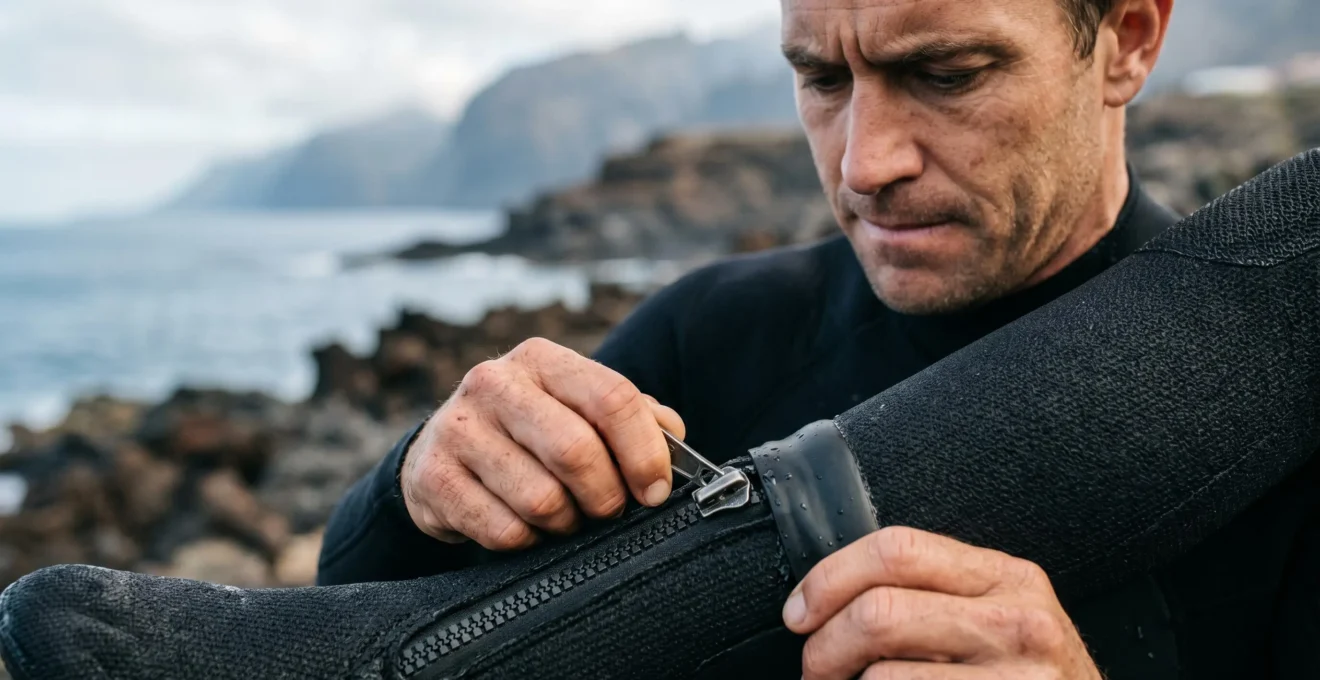
If you opt for a 7mm semi-dry suit, its entire thermal performance hinges on one component: the main T-Zip zipper. Unlike a standard wetsuit zipper, this is a sophisticated sealing mechanism designed to keep water out. If it fails, your expensive semi-dry suit becomes a very leaky, and very cold, 7mm wetsuit. Proper maintenance is not optional; it is essential to ensure the zipper’s longevity and sealing integrity.
The biggest enemies of a sealing zipper are salt crystals, sand, and dirt. After a dive, microscopic salt crystals form in the interlocking teeth. If not cleaned, they act like tiny blades, grinding away at the zipper every time you open and close it. This abrasive damage eventually leads to micro-seepage and, ultimately, a full-blown leak. Similarly, improper lubrication can either fail to protect the mechanism or attract dirt that clogs the teeth.
It’s crucial to understand that there are two parts to zipper care: cleaning and lubrication. Furthermore, lubrication itself has two distinct types: wax for the mechanical pulling action and grease for the sealing surfaces. Using the wrong product can be counterproductive. Following a strict post-dive maintenance routine will protect your investment and ensure your suit performs as expected when you need it most.
- Rinse Immediately: Always rinse the zipper thoroughly with fresh water after every single dive to dissolve salt before crystals can form.
- Scrub Gently: Use an old, soft toothbrush to gently scrub the interlocking teeth after each dive day to remove any embedded sand or salt.
- Wax for Mechanics: Apply a paraffin-based zip wax sparingly to the outer teeth. This lubricates the slider mechanism, making it easier to pull and reducing wear.
- Grease for Sealing: Apply a thin layer of silicone grease specifically to the rubber sealing surfaces on either side of the zipper. This keeps the material supple and ensures a perfect, watertight seal.
- Store Correctly: Store your suit either hanging on a very wide-shouldered hanger or lying flat and unfolded. Folding the suit can put stress on the zipper, causing it to deform over time.
Why We Lose So Much Body Heat Through the Head Underwater?
Leaving your head unprotected in 19°C water is one of the fastest ways to get cold, no matter how thick your suit is. The head acts as a major thermal radiator for the body due to high blood flow close to the skin and a relatively thin layer of insulating fat. But the reason a hood is so critical goes beyond simple heat loss; it’s about tricking your brain.
Case Study: The Neurological Thermoregulation Feedback Loop
Your body’s thermoregulatory center is located in the brain. When it senses the cold on your scalp, it triggers a system-wide defensive response. This includes peripheral vasoconstriction—the narrowing of blood vessels in your arms and legs—to pull warm blood back to your core to protect vital organs. This makes your extremities feel cold faster and can impact your dexterity. Research from Global Underwater Explorers (GUE) demonstrates that keeping the head warm sends a powerful « all is well » signal to the brain. This signal can reduce the severity of the body’s cold-stress response, maintaining better circulation to your hands and feet and reducing overall metabolic stress during the dive.
In essence, a hood doesn’t just insulate your head; it influences your body’s entire physiological response to the cold. As GUE experts state, the connection is critical: « More subtle, and potentially more important to general diving safety, is the way in which a diver’s thermal status can influence decompression risk. » By managing the signals your brain receives, you improve comfort, maintain better function, and potentially enhance safety.
This neurological feedback loop is why a good-fitting neoprene hood is a non-negotiable part of any cold-water thermal system. It’s not an accessory; it’s a primary component. The feeling of cold water flushing into your ears and over your scalp is not only uncomfortable but is also a direct message to your brain’s control center to initiate a cold-defense state. Preventing that signal is a cornerstone of staying truly warm.
Why 19°C Feels Colder in the Atlantic Than in the Mediterranean?
We’ve established that the Atlantic’s swell and surge contribute to a greater feeling of cold through convective heat loss. But there’s a more subtle physical difference at play that distinguishes it from a dive in the calmer, more enclosed Mediterranean Sea, even when the thermometer reads the same temperature. It’s about the consistency and relentlessness of the cooling effect.
In the Mediterranean, a diver often finds pockets of still water. In these moments, the boundary layer of water inside your suit can heat up and remain stable, providing a brief thermal respite. Your body gets a moment to « catch up » on heat production. The experience is one of variable cooling, with periods of more intense cold mixed with periods of relative stability. This allows your perception of cold to be less severe overall.
In the open Atlantic, however, there are no such pockets of stillness. The ocean’s energy is constant. From the moment you descend to the moment you surface, the water is in perpetual motion against your suit. Every wave on the surface translates to surge below, meaning that warm boundary layer is being stripped away continuously and without pause. Your body’s « furnace » is constantly playing catch-up against an unending cooling force. There is no respite. This unwavering thermal drain is what makes the cold feel so much more penetrating and fatiguing, a stark contrast to the more varied thermal experience of an enclosed sea.
This is why a diver who is comfortable in a 5mm suit in the Mediterranean might find themselves chilled in the same suit in Tenerife. It’s not about the peak cold, but the average rate of heat loss over the entire dive. The Atlantic’s constant motion ensures that average rate is consistently high, placing a much greater demand on your thermal protection system.
Key Takeaways
- For chilly divers, a modular 5mm suit with a hooded vest offers more versatility for travel than a single 7mm semi-dry.
- The Atlantic feels colder due to constant swell (convection), which strips heat away faster than in still water.
- The surface interval is critical for thermal recovery; a proper warming routine prevents cumulative cold on the second dive.
Why You Should Pack a Neoprene Hood Even for Summer Diving in Tenerife?
It may seem counterintuitive, but a neoprene hood is one of the most valuable, low-bulk pieces of gear you can pack for Tenerife, even for summer diving. While the surface temperature is a balmy 22-24°C, Tenerife’s Atlantic diving is defined by its potential for surprises. As summer diving conditions data shows, sharp, unexpected thermoclines can still appear on deeper dives, particularly below 25 meters or in areas affected by cold water upwellings.
Encountering a sudden 4-5°C temperature drop without head protection can be a jarring experience, often described as an « ice-cream headache » that can ruin your focus and comfort for the remainder of the dive. A thin 2-3mm hood that can be easily tucked into a BCD pocket weighs almost nothing but acts as invaluable insurance against this possibility. It turns a potentially miserable experience into a non-event.
Beyond thermal insurance, a hood provides crucial protection against other elements. It shields your scalp and neck from sunburn during long surface intervals under the Canary sun and acts as a barrier against the unseen stinging nematocysts from jellyfish or their fragments that can be present in the water column. It also significantly reduces the distracting sensory input of water rushing past your ears, creating a quieter, more serene dive experience. For a minimal investment in weight and space, a hood dramatically increases comfort, safety, and enjoyment in any season.
Ultimately, the choice between a 5mm and 7mm suit is personal, but it should be an informed one. By understanding the principles of thermal management, you can build a system that provides not just warmth, but also comfort, versatility, and safety. Now, you have all the elements to build your personal thermal system and pack your bags with confidence for your Tenerife adventure.
Frequently Asked Questions About Wetsuit Choice for Tenerife
Is a hood necessary for summer diving in Tenerife when surface temperature is 24°C?
Yes for deep dives. Even in summer, dives deeper than 25 meters or sites affected by upwelling can have sharp unexpected thermoclines. A thin 2-3mm hood that fits in a BCD pocket serves as zero-bulk insurance against sudden cold.
What additional protection does a hood provide beyond thermal insulation?
A hood protects against stinging jellyfish nematocysts and their unseen fragments in the water column, prevents painful sunburn on neck and scalp during long surface intervals, and reduces distracting sensory noise from cold water flushing through hair and into ears.
How does a hood improve dive focus and comfort?
By drastically reducing the sensation of cold water rushing through hair and into ears, a hood creates a quieter, more focused dive experience and prevents the sharp ice-cream headache effect that can occur on initial descent, especially through thermoclines.